The Roots of Atheism in Hinduism
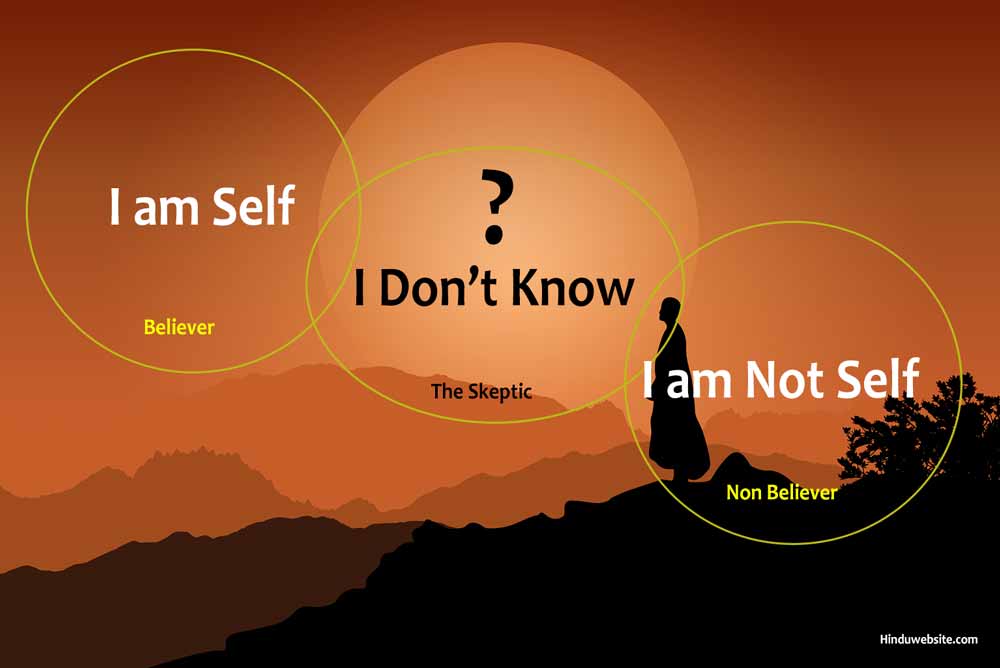
Summary:This essay traces the historical development of atheistic and non-theistic thought within Hinduism, explaining how atheism emerged as a counter-argument to Vedic assertions. It examines how five of the six orthodox philosophical schools are essentially atheistic, not acknowledging a Creator God, and how only the Bhagavadgita and certain Upanishads are distinctly theistic while other paths to liberation require no belief in a Supreme Being.
Hinduism, in its scope and core doctrine, is a tapestry of beliefs, philosophies, and practices that make it an inclusive and tolerant faith. Its inclusive nature, rooted in its historical origins, serves as a welcoming embrace for all who seek spiritual understanding, personal growth, and a balanced attitude toward the spiritual and material aspirations of the human intellect. This broad spectrum of beliefs and philosophies, collectively known as Hinduism, is open to all, regardless of their specific beliefs or practices. Some prefer to call it Sanatana Dharma, the eternal faith, or simply Vaidika Dharma or Hindu Dharma. Whatever may be the truth, today, Hinduism stands in its own light as a major world religion with over a billion followers, offering a sense of acceptance and belonging to all.
Today, Hinduism encompasses all the faiths or Dharmas that originated in India, with the exception of Jainism, Buddhism, and Sikhism. This diverse collection of faiths includes theistic, atheistic, and agnostic beliefs, making it a challenge for scholars to define or categorize Hinduism. It incorporates elements of polytheism, monotheism, atheism, spirituality, and materialism, further complicating its classification.
Hindus worship numerous animate and inanimate objects as deities and make them offerings. As Julius Lipner aptly described, “Hindus can be polytheistic, pantheistic, panentheistic, pandeistic, henotheistic, monotheistic, monistic, agnostic, atheistic or humanist.” This diversity is further reflected in the support for Monism, Dualism, and the mixed doctrines that fall between them, all of which find a place within the vast umbrella of Hinduism.
Atheism as a counter point
One of the most intriguing aspects of Hinduism is its recognition of atheism not just as a belief but as a counter-belief. Historically, atheism in Hinduism emerged as a counter-argument (vivada) to the ideas and beliefs presented in the Vedas and the argument (vada) that it was indisputable and fit enough to validate metaphysical truths. It became the hallmark of those who persistently questioned the major assertions of the Vedas, which the believers accepted as indisputable and inviolable. The atheists and materialists of ancient India, such as the Charvakas and the Lokayatas, were not content with the assertions of the Vedas or the ritual practices they recommended for the fulfillment of human life. They questioned those assertions and demanded proof of the efficacy of the sacrifices or the justification for the Vedic practices such as the Varnashrama Dharma or the pursuit of the four chief aims of human life: Dharma, Artha, Kama, and Moksha. For them, the middle two aims made sense since they could justify them with empirical evidence. Thus, atheism in Hinduism was principally a reaction to the faith the Vedic Practitioners reposed in the inviolability of the Vedas, demanding unconditional allegiance to them.
While many scholars consider the six philosophical schools (Darshnas) of Hinduism to be theistic, only one of them was theistic at its core. The rest were atheistic in the sense that they did not believe in a Creator God or a Controller of all creation. Their doctrines were based on natural and empirical causes derived from their observations of natural phenomena and perceptual evidence. The Nyaya and Vaisheshika schools formulated their doctrines from the physical and rational observation and analysis of the material world and objective reality within the realm of human cognition as if they wanted to make a point against the metaphysical heaviness of the Upanishads and the Vedanta philosophy drawn from it that demanded transcendence and negation of the empirical reality to dwell into the absolute reality it held in great esteem.
However, all the schools of Hinduism acknowledge the existence of eternal souls, their bondage to Samsara, and their transmigration through numerous births and deaths until they attain liberation. Therefore, it is difficult to categorize them as purely atheistic. They are atheistic only in the sense that they do not acknowledge an absolute, universal, supreme reality called Brahman or a Supreme Being called Isvara or Purusha.
Only the Vedanta school (Uttara Mimansa) categorically acknowledges the existence of Brahman and his numerous manifestations. The Purva Mimansa school, which drew its doctrines directly from the Vedas, also did not believe in the existence of a Supreme Being. They believed that human beings could attain liberation or heavenly life through sacrifices only and that there was no need to worship a Supreme Being.
It is also true that in Hinduism, one does not have to believe in God or a Supreme Being to practice spirituality, yoga, or strive for liberation. Of the four principal paths, namely Karma Yoga, Jnana Yoga, Bhakti Yoga, and Sannyasa Yoga, only the third one, Bhakti Yoga, is categorically theistic, while the rest can be practiced by anyone, regardless of whether the practitioner believes in a Supreme God or not. Most Upanishads are theistic, but some verses in them are noncommittal and leave the nature of Brahman’s reality to our imagination or speculation.
However, the Bhagavadgita is distinctively theistic and God-centric., just like the Isa Upanishad. It holds that Isvara, the Supreme Lord of the Universe, is the Lord, Commander, Controller, Upholder, and Source of everything. He is responsible for our births, deaths, and even liberation. Therefore, one must surrender to him, take refuge in him with exclusive devotion, offer all actions to him, perform all their obligatory duties as an offering to him, and earn his grace to escape from this world.
Thus, in the Bhagavadgita, we see a clear departure from the beliefs of the ancient world, in which every belief, practice, path, or yoga has been interpreted from a theistic perspective with God as the center and circumference of all existence and in which humans are obligated to follow him and live a divine centered life to discharge their karmic debt and attain oneness with him.