The Bhagavadgita on Supreme Bliss, Truth, and Stability in Self
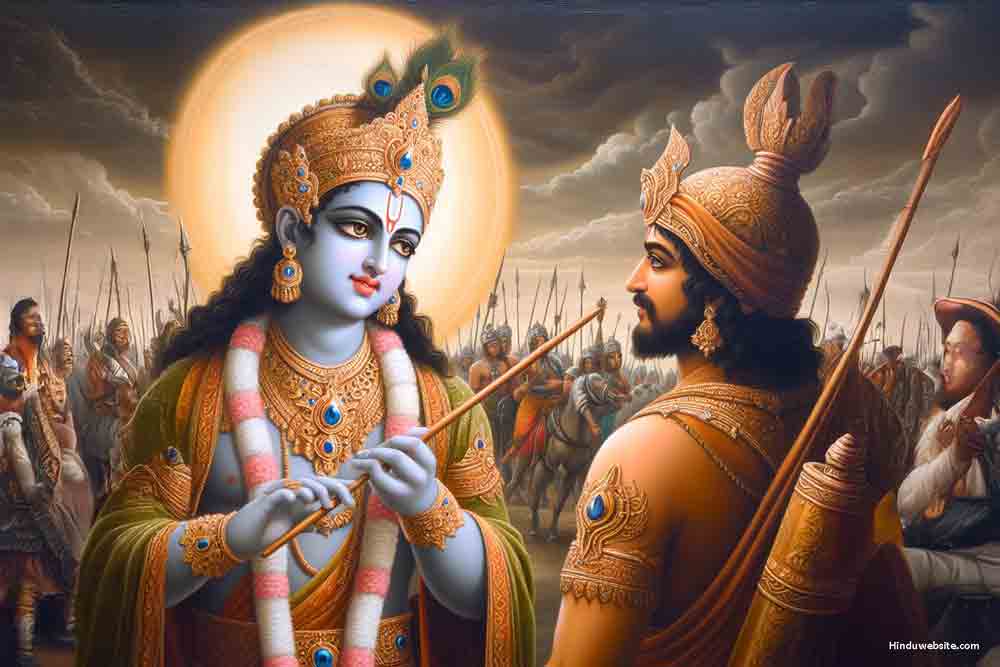
Krishna Arjuna Samvadam - Image: Al
Summary: Commentary on Bhagavadgita Chapter 6, Verse 21 describing infinite bliss (ananda) realized through buddhi (intelligence) when desires, attachments, and gunas are suppressed. Explains how yogis grasp transcendental happiness in turya state through self-control and meditation, experience of rapturous aloneness in Self-oneness, distinction between stateful samadhi (samprajnata) with awareness of bliss versus final seedless samadhi (asamprajnata/nirbija), and permanent establishment in truth, bliss, and perfection.
Chapter 6 Sloka 21
sukham ātyantikam yat tad buddhigrāhyam atīndriyam
vetti yatra na caivāyam sthitaś calati tattvatah.
Translation
sukham = happiness, bliss; atyantikam = endless, infinite, supreme; yat = which; tat = that; buddhi = intelligence; grahyam = realized, grasped; atindriyam = beyond the senses, transcendental; vetti = knows; yatra = wherein; na = not; ca = and; eva = surely; ayam = this; sthitah = situated; calati = moves, deviates; tattvatah = truth, reality.
Meaning
" That infinite and supreme bliss which is grasped by intelligence but beyond the senses, having become established (in that), he no longer deviates from (its) truth.
Commentary
When desires, attachments, and gunas are fully suppressed, and when the mind becomes still through meditation and self-control, the yogi realizes the infinite oneness of the Self and the happiness that flows from it. He grasps it through wakeful discernment in the silence of turya within himself, not through his senses since it does not arise from the contact of the senses with sense objects. It happens internally within himself due to the dissolution of his duality in the oneness of the Self and his subjective experience of rapturous aloneness without a second. It is grasped by intelligence because it is the highest and the nearest tattva in the body to the Self, and when it is pure, it allows the light and bliss of the Self to radiate through it uninterruptedly. A yogi experiences the blissful state of the Self only when there are no impurities in him, and his lower nature is completely subdued. The ignorant ones cannot experience it because, in them, the Self (one’s pure consciousness) remains enveloped by a thick cloud of impurities. United with the Self, without any barriers in between, the pure mind reflects the purity and intelligence of the Self in all four states of consciousness. Hence, the yogi who attains oneness within himself is never separate from it and does not deviate from the truth or the consciousness it reflects. Truth, bliss, and perfection, the supreme qualities of the Supreme Lord, become permanently established in him when his individuality and consciousness are completely dissolved.
Early commentators of the Yogasutras, such as Vacaspati Misra and Vijnanabhkshu, described the blissful (ananda) condition which arises in yoga through samyama as one of the advanced states of stateful (samprajnata) samadhi, short of the final or the most excellent state in which there is no awareness of even that bliss. In this state, a yogi frequently falls into rapturous trances because of the predominance of sattva and intense devotion. While it is a good sign that he has progressed on the path and is nearer the supreme goal, it can also be a source of distraction, especially if he becomes attached to it and wishes to experience it repeatedly. Therefore, he should be on guard and treat these experiences with indifference. Formations, objectivity, duality, and subtle sensations and feelings in the consciousness disappear only in the final state of objectless self-absorption (asamprajnata samadhi) or seedless (nirbija) samadhi. The distinction between these two types of samadhi is subtle and difficult to theorize. Even those who experience it do not know exactly what they have gone through.
The intuitive awareness (samprajnata) of the ecstatic state of self absorption within oneself arises in intense concentration (samyama), in which the mind and the senses do not participate. The yogi experiences a vague objectivity in that state. It is difficult to say how much of that experience he can bring back into his wakeful state or recollect it clearly. Awareness of the blissful nature of the Self arises in intelligence (buddhi) because, among the constituents of Nature, only it can reflect the brilliance and the purity of the Self. In that state, the yogi may have a vague recollection of the blissful state, as if he has gone through a transcendental dream state. According to some commentators, in this state of samadhi, which is incomplete but almost nondual, there is no real or direct experience of oneness with the Self. The experience arises due to nearness rather than oneness, while the mind is not yet ready for complete dissolution. It is as if you are standing on the edge of an infinite ocean, and you can feel its depth and incredible power, but you have not yet decided to enter it. Whatever the perception of that experience, a yogi who reaches that state of purity and transcendence will not show much interest in the objective experience of his wakeful consciousness. Not even the greatest wonders upon earth will distract him from the truth he just realized or is about to realize.