The Bhagavadgita on Achieving Perfection Through Natural Duty and Gunas
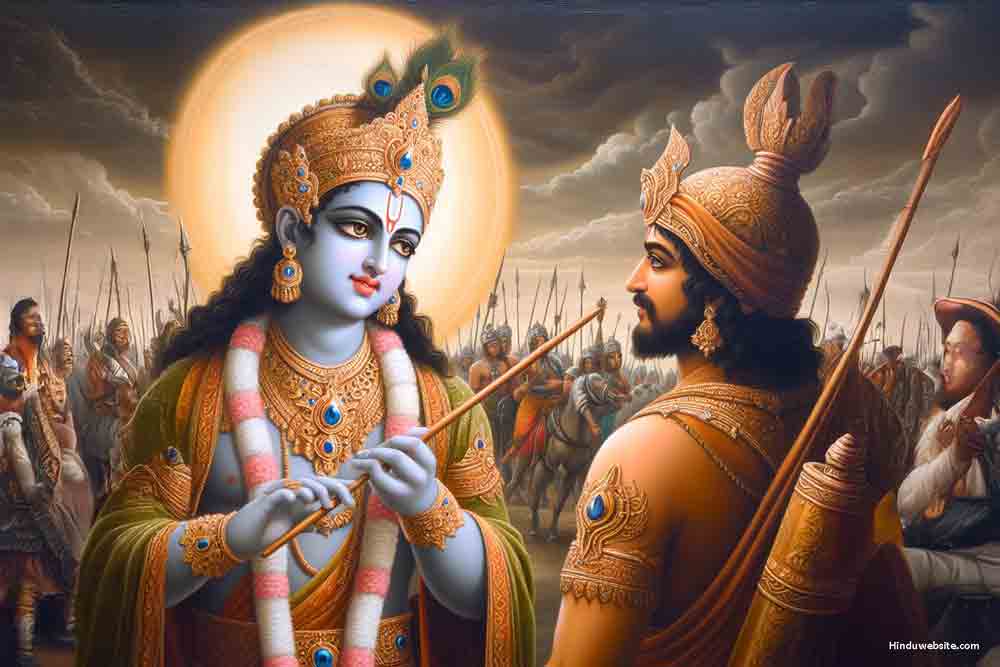
Krishna Arjuna Samvadam - Image: Al
Summary: Commentary on Bhagavadgita Chapter 18, Verse 45 teaching how perfection (siddhi) is attained by performing duties arising from essential nature (svabhava) determined by predominant gunas. Sattvic people practice serenity, self-control, austerity, knowledge. Rajasic individuals (Kshatriyas) exhibit bravery, firmness, skill, generosity. Vaishyas/Shudras perform agriculture, trade, service. Explains karma-sannyasa yoga path, gunatita (beyond modes) state, importance of transcending gunas, and achieving absolute perfection (samsiddhi) through divine grace.
Chapter 18.45
sve sve karmany abhiratah samsiddhim labhate narah
svakarmaniratah siddhim yathā vindati tac chrnu
Translation
sve sve = one's own; karmani = duty; abhiratah = following, taking delight; samsiddhim = absolute perfection, excellence, success; labhate = attains; narah = a person, human being; sva-karma = by his own duty; niratah = following; siddhim = perfection, success; yatha = how, in what manner; vindati = attains; tat = that; srnu = hear, listen.
Meaning
" By following one's own duty, a human being attains absolute perfection. Listen to how that perfection is achieved by following one's own duty.
Commentary
Svakarma means the duty which arises from one’s essential nature. It is the duty ordained by God for humans according to their natural propensities or predominant modes. The idea is that one should follow one’s natural inclinations to attain perfection in life and fulfill one’s obligation to God and others. Siddhi means perfection. It refers to the serene state of purity and sameness, which is completely free from the impurities of ignorance, delusion, desires, duality, attachments, egoism, evil qualities, and mental disturbances. It begins with the practice of jnana karma-sannyasa yoga, in conjunction with other yogas such as adhyatama and buddhi yogas, which lead to the purification of the mind and body and the firmness of the mind, faith, and resolve. In whatever way one may begin the practice, the ultimate aim is to abide in the Self with unwavering devotion and attain liberation.
This verse clearly states that perfection is attained only by following one’s duty (svakarma). The duties are specific to one’s essential nature as determined by the predominance of the modes. Sattvic people attain purification and perfection by selflessly performing the duties listed in verse 42: serenity, self-control, austerity, cleanliness, endurance, uprightness, knowledge, wisdom, and faith. Rajasic people (Kshatriyas) attain it by performing their duties as listed in verse 43: acting with bravery, vigor, firmness, skill, generosity, and lordliness and not fleeing from the battlefield. Lastly, Vaishya and Shudras should attain it by selflessly practicing their duties as stated in the previous verse, namely agriculture, cattle rearing, trade and commerce, business, arts and crafts, and service.
When the three classes of people perform their duties in this manner, without desiring their fruit, the predominant gunas in them strengthen, and the weaker modes are suppressed or weakened. When karma-sannyasa yogis reach a certain level of optimum perfection in their practice, and their minds and bodies are purified through sacrificial duties, mystic powers (siddhis) manifest in them as the outward expression of their growing perfection and spiritual progress. However, such developments on the path of liberation are not as important as the ultimate goal of attaining liberation, sameness, or oneness. Hence, without being distracted by them, yogis should remain focused on reaching the ultimate goal, transcending the gunas. Although they play an important role in practicing obligatory duties, in the advanced stages, the gunas should be transcended since they induce desire-ridden actions and attachments. If they are active, one is always vulnerable to their influence. Therefore, ideally, householders must advance from practicing karma-sannyasa to transcending the gunas and entering the pure state of self-absorption.
The journey of liberation is long and arduous. A householder must begin his pursuit of Moksha by performing duties selflessly according to his essential nature (karma svabhavajam) and sacrificing (tyaga) their fruit. When duties are performed, and obligations are met through jnana karma-sannyasa yoga, he must attain the modeless state of self-awareness, transcending the gunas and becoming a gunatita, one who is beyond the modes. According to the Yogasutras, it is achieved when the gunas retire into their original, latent state and stop inducing desires and attachments or causing mental modifications (chitta vrittis). However, one should not stop there but continue practicing self-control (samyama) and exclusive devotion until the final state of absolute perfection (samsiddhi) is attained. However, it cannot be attained through duty and devotion only. The grace of the Supreme Lord is also essential. This is explained in the next verse.