The Bhagavadgita on Faith (Shraddha) Shaped by Essential Nature and Gunas
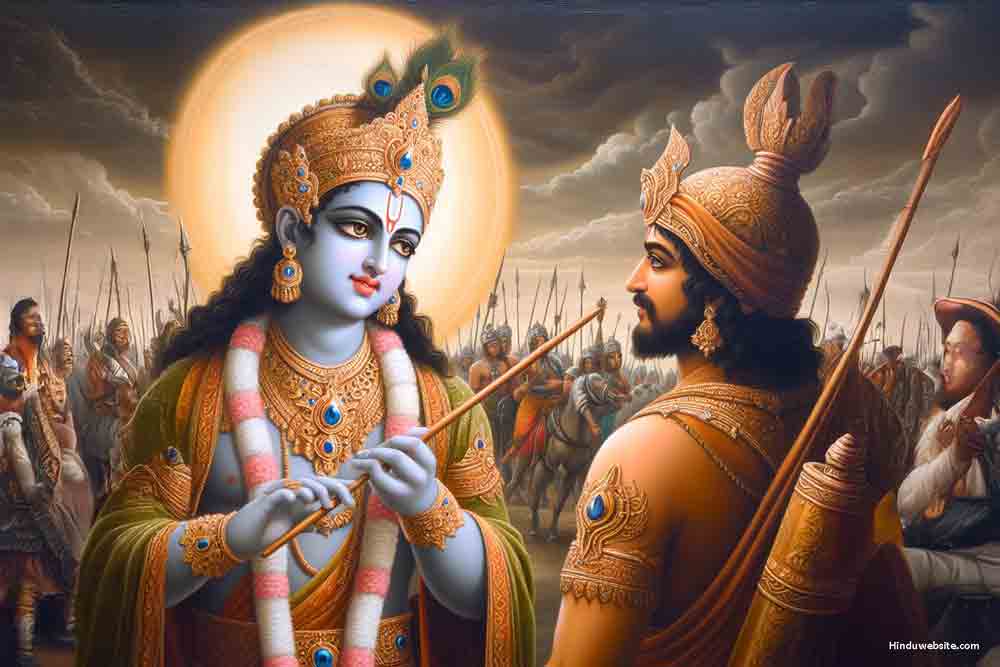
Krishna Arjuna Samvadam - Image: Al
Summary: Commentary on Bhagavadgita Chapter 17, Verse 3 explaining relationship between sattva and faith (shraddha). Pure faith arises only from sattva predominance, enabling exclusive devotion, discernment, stability, detachment, renunciation. Mixed faith from rajas/tamas creates desires, doubt, delusion. Analyzes three key statements: faith manifests according to sattva, person is made of their faith, person is certainly what their faith is. Emphasizes changing beliefs requires improving knowledge, cultivating sattva through self-purification.
Chapter 17 Sloka 03
sattvānurūpā sarvasya śraddhā bhavati bhārata
śraddhāmayoyam puruso yo yacchraddhah sa eva sah
Translation
sattva-anurupa = according to sattva; sarvasya = in everyone; sraddha = faith; bhavati = manifests; bharata = O descendent of Bharata; sraddha = faith; mayah = made up of; ayam = this; purusah = personl; yah = who; yat = that; sraddhah = faith; sah = that; eva = surely; sah = he.
Meaning
" O descendant of Bharata, faith manifests in everyone (or everywhere) according to sattva. A person is made up of his faith only. He is surely what his faith is.
Commentary
According to this verse, shraddha or faith arises from essential nature. It is pure when it is induced by sattva, but when mixed with rajas and tamas, it becomes mixed and impure. In other words, sattva is necessary to cultivate pure devotion and establish the mind in the Self or divine thoughts. When sattva prevails, ananya bhakti (exclusive devotion), discernment, mental stability, vairagya (detachment), and the attitude of sannyasa (renunciation) arise naturally. When the other two modes predominate, devotion becomes mixed with desires, passions, worldliness, ignorance, and delusion. Hence, one must cultivate sattva to achieve liberation. However, in the advanced stages, one must transcend all the gunas to abide in sameness. In the following discussion, we examine the three important statements of Lord Krishna.
Sattvānurūpā sarvasya śraddhā bhavati. It means as is sattva, and so is faith. According to some, it means, as is the essential nature, and so is faith. The latter translation is indeed true since essential nature arises from the three modes, not just sattva. However, since sattva is specifically mentioned, we have to understand that it was done to refer to pure faith. Pure faith is essential to establish the mind in divine thoughts, practice exclusive devotion and absorb the mind in the Self. It arises from the predominance of sattva only. There is no contradiction here since only unwavering faith qualities as true faith. Mixed faith that is prone to doubt and distraction is not true faith at all. From the spiritual or devotional perspective, sattva is absolutely important since it illuminates and purifies one’s faith and devotion, while the other two weaken them and serve as obstacles. When sattva prevails, faith becomes pure and unwavering and strengthens devotion. Devotees with the predominance of sattva are naturally drawn to the Supreme Lord. Faith becomes weak when it is polluted or clouded by the impurities of egoism, lust, selfishness, delusion, ignorance, etc., which arise mainly from rajas and tamas. If sattva is fully suppressed, it leads to erroneous beliefs and demonic tendencies. Those under their influence misuse their faith for evil purposes and perish. In the real world, purely sattvic people are very rare due to karma and other factors. Most people are born with the predominance of rajas and tamas. Their faith, devotion, and commitment to Dharma remain mixed, just as their essential nature. They worship gods and perform obligatory duties but do not achieve perfection because of their vacillating faith. When sattva is predominant, devotion, detachment, self-restraint, and obedience to the teacher or the teaching arise naturally. Hence, sattvic people are more inclined to worship the Supreme Lord and are qualified to attain liberation. Saints, seers, sages, partial incarnations, and enlightened masters fall into his category. They set an example for others through their actions and conduct.
Śraddhāmayoyam puruso. It means a person is made up of his faith. His behavior, thinking, beliefs, likes and dislikes, attitudes, etc., arise from faith, which is, in turn, determined by his nature. As is his faith, so are his actions and pursuits. Therefore, it follows that if one wants to change oneself, one must focus on one’s beliefs and cultivate the right faith or the right beliefs, interests, and pursuits. For that, one has to improve one’s knowledge and discernment and cultivate sattva by purifying one’s mind and body. Scriptural knowledge or the study of scriptures like the Bhagavadgita is useful in this regard. They provide valuable guidance to help devotees overcome their impurities and cultivate pure and unwavering faith. Faith serves as one’s moral and spiritual compass. Judging by how a devotee practices his faith, which gods he worships, or methods he follows, one can ascertain his true nature and where he stands in relation to himself, the world, and the Supreme Being. With that knowledge, he can make informed decisions about improving himself and his spiritual practice. Faith is foundational to achieving progress on all fronts. It is foundational to one’s morality, character, conduct, knowledge, wisdom, devotion, and relationship with God, the world, and oneself. Therefore, to change himself and progress in the right direction materially and spiritually, a devotee must change his beliefs (faith), what they tell about him, and what he can do about them.
Yacchraddhah sa eva sah. It means a person is certainly what his faith is. Faith does not mean only religious faith. It includes the sum of beliefs that influence one thinking, actions, personality, and behavior. Although we are rational beings, we depend more on our beliefs, accepting them as facts without validating them rationally. We rely upon them, consciously or unconsciously, in making decisions or performing actions and in dealing with the ambiguity and uncertainty of our complex lives. From a philosophical perspective, our beliefs are the residue of our past to which we cling because they are deeply interwoven into the fabric of our nature and consciousness. Without discernment, beliefs can fuel our illusions and erroneous or irrational thoughts and lead us in the wrong direction or create confusion and conflicts. Facts can be verified and validated, but you cannot do the same with beliefs or assumptions. A belief or an assumption is what you accept as a fact without valid proof. It becomes problematic if you are attached to it and refuse to see the truth when evidence is presented. Many people cling to their erroneous perceptions and beliefs because of their essential nature. Unless they improve, their faith or beliefs will not improve. Therefore, self-purification is necessary to cultivate knowledge, right faith, right beliefs, right thinking, and right actions. Faith also influences our transmigration from one birth to another through our beliefs, desires, thoughts, and actions. They leave their residues in our consciousness as latent impressions (samskaras), which become the seed for our future births. Therefore, to escape from samsara by overcoming injurious and irrational beliefs and the desires and actions they induce, a devotee must cultivate sattva. When his essential nature shines with sattva, his faith becomes the raft by which he can cross the ocean of Samsara. When he is purified by faith and devotion, the Lord illuminates his intelligence and shows him the safest way to achieve liberation.