The Bhagavadgita on Fruits of Actions: Sattva, Rajas, and Tamas Outcomes
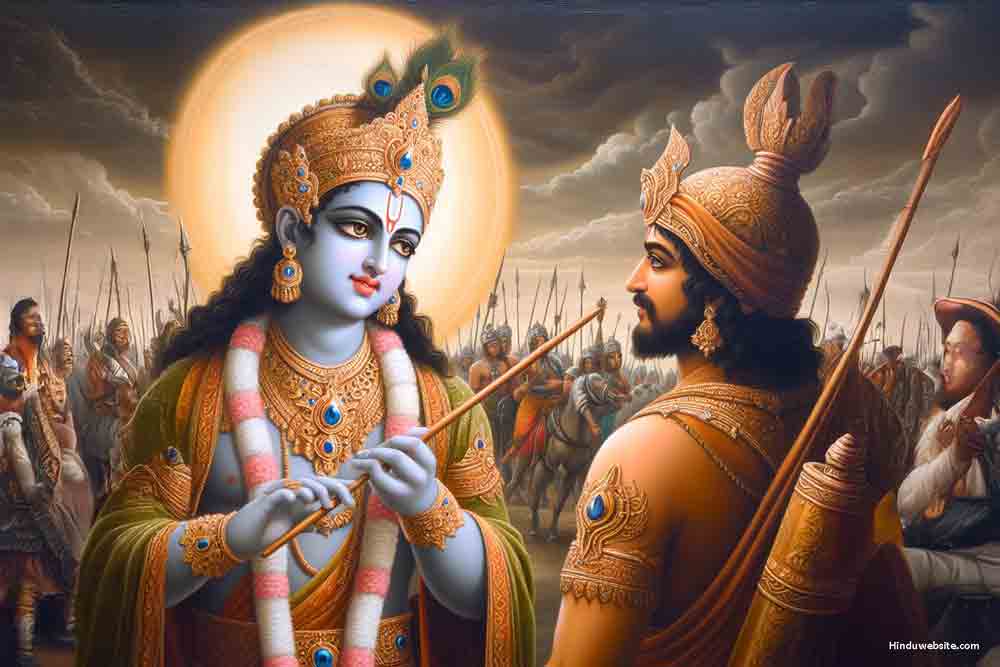
Krishna Arjuna Samvadam - Image: Al
Summary: Commentary on Bhagavadgita Chapter 14, Verse 16 explaining consequences arising from actions influenced by triple gunas. Sattvic (pure) actions produce spotless fruit, peace, happiness, discernment, self-control, and divine qualities leading to liberation. Rajasic actions yield sorrow (dukkha) through desires, attachments, restlessness. Tamasic actions create ignorance, delusion, egoism, inertia, suffering from repeated births. Details how sattva cultivates purity and nirvitarka samapatti state while rajas/tamas strengthen impurities and bondage.
Chapter 14 - Sloka 16
karmanah sukrtasyāhuh sāttvikah nirmalah phalam
rajasas tu phalam duhkham ajñānam tamasah phalam
Translation
karmanah = of actions; su-krtasya = of good; ahuh = they say; sattvikam = pure, virtuous; nirmalam = spotless, sinless, pure; phalam = fruit; rajasah = of rajas; tu = but; phalam = fruit; duhkham = sorrow; ajnanam = ignorance; tamasah = of tamas; phalam = fruit.
Meaning
" They say the fruit of good actions is pure and sinless, but the fruit of rajas is sorrow, (and) the fruit of tamas is ignorance.
Commentary
Sukruta means righteous actions or sattvic actions. They produce peace and happiness and lead to liberation. Pain and suffering (dukkha) are the fruit of desire-ridden actions induced by rajas. Ignorance (of the Self) and delusion are the fruits of actions that arise from tamas. Just as a fruit inherits its qualities from the tree that produces it, consequences partake the nature of actions that produce them, and the nature of actions depends upon the nature of those who perform them. Thus, the gunas extend their sway through the chain of cause and effect and create ripples in the ocean of life. Karma arises from kamya-karmas (desire-ridden actions) only. The fruit of such actions (karma phalam) leads to further causes and effects, keeping the wheel of Dharma moving. The sinful karma, which arises as the cumulative effect of desire-ridden actions, serves as a self-correcting mechanism to help them learn valuable lessons from their suffering and past mistakes and improve themselves.
Karma in Sanskrit means both action and its consequences. Good actions lead to good ends when sattva is predominant. Sattva strengthens sattva. It transforms, purifies, and produces peace, happiness, stability, and other positive states in one’s consciousness. One becomes pure and holy, and virtues such as discernment, nonviolence, truthfulness, etc., arise when the mind is filled with sattva. Divine qualifies manifest. One experiences cheerfulness, one-pointedness, stability, self-control, knowledge, contentment, discernment, etc. They produce the highest happiness (anuttama sukha). In that serene state, the yogi becomes pure and transparent and reflects the intelligence of his divine nature. Subduing his desires and cravings and the modifications of his mind through continued practice (abhyasa), he succeeds in attaining insight into the nature or essence of things without conceptualization, imagination, or any mental notion or formation (nirvitarka samāpatti). In that expansive state, with the mind, the modes, and the body completely resting, he experiences supreme peace and discerning wisdom.
Thus, sattva is conducive to self-transformation, dissolution of impurities, stability, knowledge, wisdom, and selfless devotion. In contrast, rajas and tamas are considered impurities because they induce desires and attachments and keep the mind and senses in their outgoing mode (prvritti) and a restless state. They are also agents of transformation but in a retrogressive sense since they keep the beings distracted and deluded and produce impure qualities such as ignorance, delusion, egoism, selfishness, inertia, etc., resulting in sinful karma, suffering, and bondage. Most of the ills in the world and unwholesome behaviors and attitudes in people arise from them only. They also reinforce evil passions such as lust, anger, pride, vanity, fear, and envy. As this verse states, actions and the consequences they produce lead to ignorance, sorrow, and suffering. By ignorance, we mean the ignorance of the Self, which produces the mistaken notion that the mind and body constitute the real self. In this context, suffering means suffering from repeated births and deaths and the afflictions and modifications such as mental turbulence, aging, sickness, and death to which beings are subject due to their desires and attachments.
The fruit of sattva is nearness to Isvara (the Self) through purification and devotion. The fruit of rajas is attachment to the world and its objects through desires and passions. The fruit of tamas is attachment to egoism, the mind, and the body due to deluded notions and evil actions. According to The Yoga Vasishta, predominantly sattvic people do not act indiscriminately. They study sacred scriptures, consult holy ones, and enquire into the nature of reality and the world's appearance. With the knowledge thus gained, they understand the truths about themselves and the world and avoid the mistakes that delay their liberation or prolong their delusion, bondage, and ignorance. Therefore, the scripture says that one should aim to cultivate sattva to escape from samsara quickly. It does not mean rajasic and tamasic people cannot attain liberation. They must find appropriate methods to offset their impure modes and rescue themselves from the ocean of samsara. As stated before, in the end, one has to transcend the triple modes to attain the Self.