The Bhagavadgita on Brahman's Paradoxical Nature: Neither Sat Nor Asat
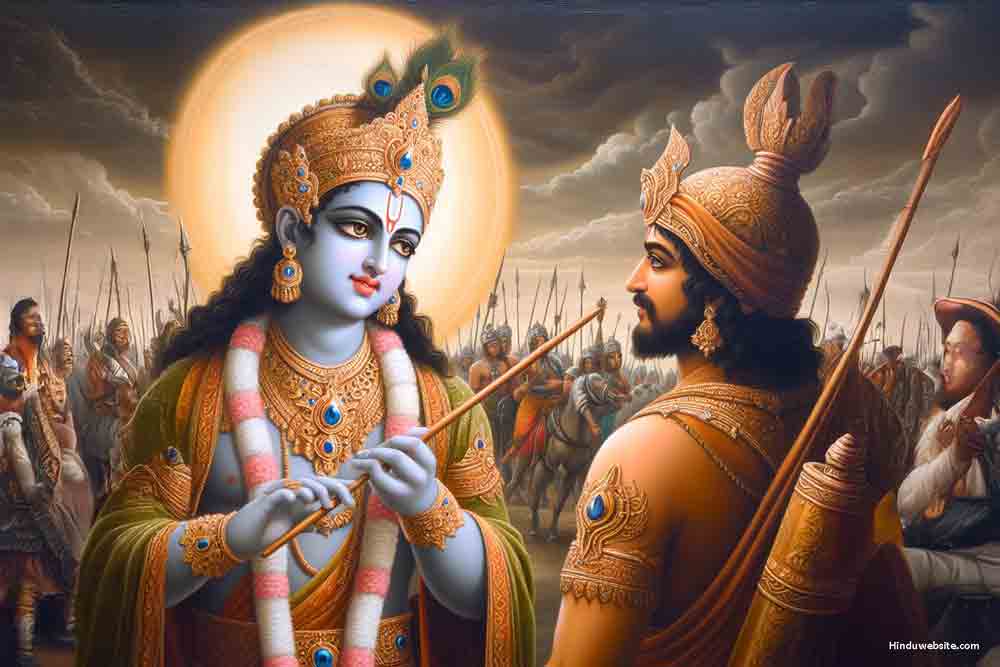
Krishna Arjuna Samvadam - Image: Al
Summary: Commentary on Bhagavadgita Chapter 13, Verse 13 exploring Brahman as unknowable Reality beyond existence (Sat) and non-existence (Asat). Explains how Sat represents manifested Prakriti with God, Asat represents unmanifested Prakriti, while Brahman transcends both states eternally. Discusses neti-neti (not this) approach, Kena Upanishad's teaching that Brahman is other than known/unknown, and why absolute Reality cannot be grasped objectively through conventional knowing methods.
Chapter 13 Sloka 13
jneyam = what is to be known, knowable; yat = that; tat = which; pravaksyami = I shall now speak; yat = which; jnatva = knowing; amrtam = immortality; asnute = tastes, attains; anadi = without beginning; mat= considered, thought of, believed; param = Supreme; brahma = Brahman; na = not; sat = being; tat = that; na = nor; asat = non-being; ucyate = is said.
Translation
" That which is to be known, I shall now speak to you, knowing which immortality is attained. The Supreme Brahman, believed to be without beginning, is said to be neither being nor non-being.
Commentary
What is to be known (jneyam) is Brahman because only by knowing him can one gain liberation from the cycle of births and deaths. Upon liberation, an embodied Self returns to its original state of pure consciousness, which is immortal, blissful, indestructible, and all-knowing. In an embodied state, knowing the Self is the same as knowing Brahman because, in their essential nature, they are either the same or, as the dualists proclaim, represent the same reality. However, even if we accept the latter argument, we have to acknowledge that the Universal Self is more expansive, pervasive, and completely independent, while the individual Self is dependent upon him and in some way connected to him. Now, who is this Brahman, knowing whom, we transcend our limitations and gain immortality? How do we know that the reality we experience in a transcendental and non-dualistic state is Brahman only? Here, Lord Krishna, an incarnation of the Supreme Self, made a somewhat paradoxical statement about the absolute state of Brahman, saying that it is neither Sat nor Asat.
If Brahman is neither of them, then what else is he? Indeed, there is no ambiguity about what he said in this verse. Lord Krishna quoted the Vedas to describe himself, saying that he was infinite and ‘believed’ to be neither Sat nor Asat. "Sat" means existence, truth, reality, beingness, goodness, purity, and virtue. It represents the manifested aspect of Prakriti in association with Brahman. Asat means non-existence, falsehood, unreality, non-beingness, or impurity. It refers to the unmanifested or undifferentiated aspect of Prakriti in association with Brahman. Brahman remains unmanifested, invisible, formless, and hidden in both states because he is eternal, indestructible, immutable, and fixed. What manifests (sambhuta), unmanifests (asambhuta), or transforms is Prakriti. Sat and Asat, known as existence and nonexistence or manifested and unmanifested, are her states. When she becomes active at the beginning of creation, Brahman manifests as Isvara in association with her. His higher and lower natures represent Sat, while he is other than them. When he withdraws from her at the end of creation and reverts to his pure state, she reverts to her primordial and unmanifested state and becomes Asat. Thus, Brahman is the connecting link between the Sat and Asat aspects of Prakriti. He is their support as well as their cause. Some scholars, however, describe the Purusha (the Cosmic Self) or the Supreme Lord (Isvara) as Sat, his creation as Asat, and Brahman's supreme and absolute Reality as different and distinct from both.
The truth is that Brahman has no states, qualities, or modes. He is eternally the same and beyond all known methods of knowing him objectively. Hence, he is considered indeterminate and ungraspable. He cannot be known by the known methods of knowing: study, perception, analysis, comparison, imagination, learning, etc., however pure and stable the internal organ (antahkarana) is. Absolute reality cannot be known by these methods but only absolutely through oneness, in which awareness is not a process or state but reality. In the absolute state of Brahman, (perhaps) knowing is not a movement driven by desires or modes or the knower and the known but spontaneous self-knowing. We cannot know Brahman by negation, affirmation, comparison, analysis, or imagination. The Upanishads suggest the neti-neti (not this, not this) approach to know him. However, that knowing is not true knowing but an approximation or, at best, an intellectual speculation. Brahman is beyond names and forms and everything we define and describe in our consciousness. To the human mind, he is knowable and unknowable, real and unreal. We cannot say conclusively that he is this and that or not this and not that. He is always the same in parts and the sum of parts, whether present or absent in creation or whether Prakriti is active or inactive. He is all this. At the same time, he is not them or in them.
Sat and asat are also translated as being and non-being. Some interpret them as Brahman with form (murtam) and without form (amurtam). Beingness implies individuality, objectivity, materiality, and specificity. Non-beingness, which is devoid of them, transcends all known realities, states of existence, modes, modalities, and consciousness. While with some difficulty, we may draw a few conclusions about his qualities, names, forms, potencies, and manifestations, the Supreme Non-Being is unknowable in a knowable state of duality and perhaps even in the transcendental state. The Reality of Brahman is neither emptiness nor fullness, neither existence nor non-existence, neither consciousness nor unconsciousness. Entering its absolute and perfect state, one becomes nothing and, at the same time, everything. One ceases to exist as a limited being and (perhaps) becomes all. The skepticism is intended because what can we say about that which is the object of knowing but cannot truly or definitively be known in specific terms?
Since it is so difficult to grasp the essential nature of Brahman or intellectualize it with the known interpretations and definitions of our conditioned knowledge, the Kena Upanishad declares that Brahman is other than the known and so also above the unknown. If you think you have understood him, you have known him but little. If you think you do not know him, you probably know him. Brahman is other than all that we know or envision. It is difficult to say what he is and is not. We can only speculate about him but cannot be sure. We must, therefore, surrender our knowledge, intelligence, and discernment to the Supreme Lord and let him decide how far he will make himself known.