The Status Of The Bhagavadgita In Hindu Literature
Bhagavadgita Wisdom Index Page
Summary: The essay explains why Bhagavadgita is considered an important scripture of Hinduism, an Upanishad and a Yoga treatise, but still not included in the sruti literature
Notes: I have translated the Bhagavad Gita three times. The first one was a loose translation. The second one was a word-to-word translation in 2013 with detailed commentary. The third attempt was made in 2025, rewriting the 2013 commentary entirely. The writings in this section are different from the commentary I wrote. Here, I intend to share with you, occasionally, my reflections on the knowledge, philosophy, and wisdom of the Bhagavad Gita from a spiritual perspective as a long series. Jayaram V
The Bhagavadgita is the most popular sacred text of Hinduism in the contemporary world. It has a wider appeal which transcend social and cultural barriers across many nations. A lot of Hindus might have heard of the Bhagavadgita. Some of them might have read it and a few of them may actually follow it.
Many people are not naturally inclined to read religious scriptures, because it would require effort. Instead, they would try to gain knowledge by watching movies and television serials which are made with devotional and religious themes to appeal to religious people. Perhaps more people would read the Bhagavadgita if they find ready-made solutions in it to resolve their immediate problems.
The scripture does offer many solutions to our daily problems such as how we can avoid stress and strain, deal with our relationships, perform actions with greater attention or live with peace and equanimity. However, to know them, and use them in your daily life you have to read the verses and use your discriminating intelligence to know their meaning. Once you grasp its wisdom, you will find in it many solutions to your problems. You may even customize the knowledge and the solutions according to your specific needs and circumstances. However, it requires a lot of effort (abhyas).
The Bhagavadgita is not considered or a divine revelation in the same sense as the Vedas, which only qualify as the Shruti. By shruti we mean the texts which were passed down to us through hearing only rather than through any intellectual or creative effort. Only the four Vedas enjoy that status. Since the Bhagavadgita forms part of the Mahabharata, which is considered a historical text (itihasa), it does not have that status.
The Upanishads constitute the end part of the Vedas. Traditionally, the Bhagavadgita has not been associated with any Veda as an Upanishad. It is a text in its own right. You cannot also equate it with any yoga text such as the Yogasutras of Patanjali because it does not exclusively deal with the subject of Yoga only. Instead, it deals with a number of yogas or methods and philosophical concepts of which classical yoga forms a part.
This leaves us with the question, “What is the true status of the Bhagavadgita in Hinduism?” The answer is found in the scripture itself. Each chapter in the Bhagavadgita ends with a particular verse, which speaks about the nature of the Bhagavadgita and the title of the chapter. Its wording is the same in all the chapters except for the name of the title. For example, the first chapter in the texts reads as shown below:
"iti srīmadbhāgavadgītāsupanisatsu brahmavidyāyām yogasāstre srikrisnārjunasamvāde arjunavisādayogo nāma prathamo 'dhyayah.1"
The statement suggests that the Bhagavadgita is an Upanishad, a branch of knowledge about Brahman (brahma vidya), a scripture of yoga (yoga sastram) and a dialogue (samvadam) between Sri Krishna and Arjuna. Let us examine each of these assertions.
The Bhagavadgita is an Upanishad because it contains the essence of all the Upanishads. It was taught in secrecy to Arjuna by Lord Krishna when he was sitting near him (Upanishad). Secondly, it is Brahma Vidya because it deals with the subject of Brahman, how to discern him and attain in him through various approaches. The Upanishads contain many references to Brahma Vidyas, which are considered to be 30-40 and which are useful to cultivate the knowledge of Brahman (Brahmajnanam). The Bhagavadgita is a compendium of Brahma Vidyas and contains knowledge of his duties, manifestations, attributes, functions and universal form.
Thirdly, the Bhagavadgita is a scripture on yoga (yoga sastram) because it profusely deals with the subject. You learn from it about various yogas, yoga states, methods and approaches. Indeed, every chapter in the Bhagavadgita bears the title of yoga and points to some yoga.
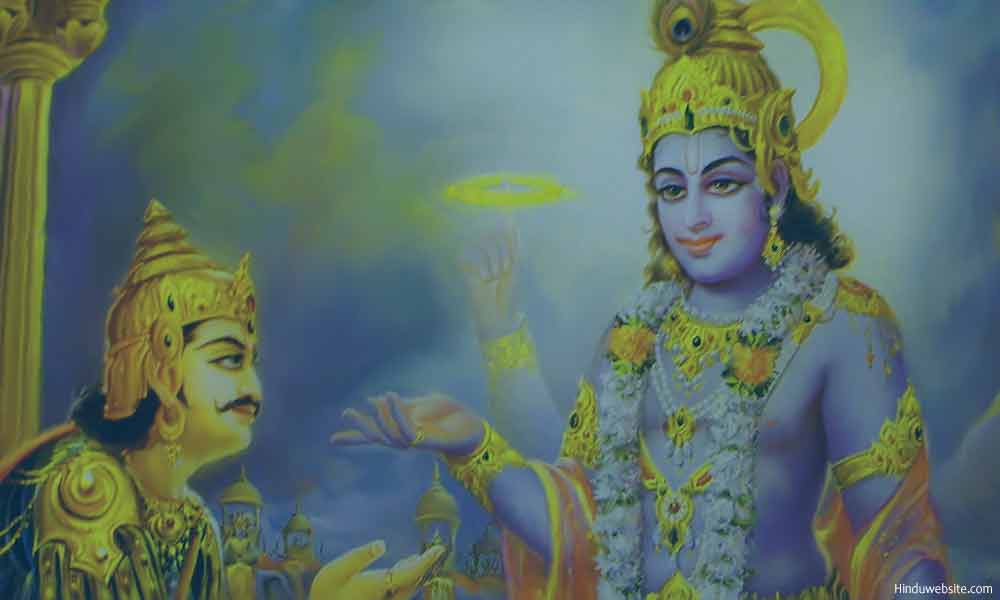
Further, the book is not the monologue of a spiritual teacher. It is not a one-sided teaching, but a conversation (samvadam) between a devotee (Arjuna) and a divine teacher (Krishna) in which Arjuna as the seeker of knowledge and advice had an opportunity to raise doubts, ask questions and seek clarifications.
Finally, the knowledge of the Bhagavadgita flowed from a divine source or a heavenly source namely Lord Krishna. Hence, just as the Asvattha tree which is mentioned in the Upanishads, the Bhagavadgita has its roots high in the heaven and its branches spread everywhere in the mortal world.