Hinduwebsite Editorial - Conditioned Ignorance, The New Social Trend
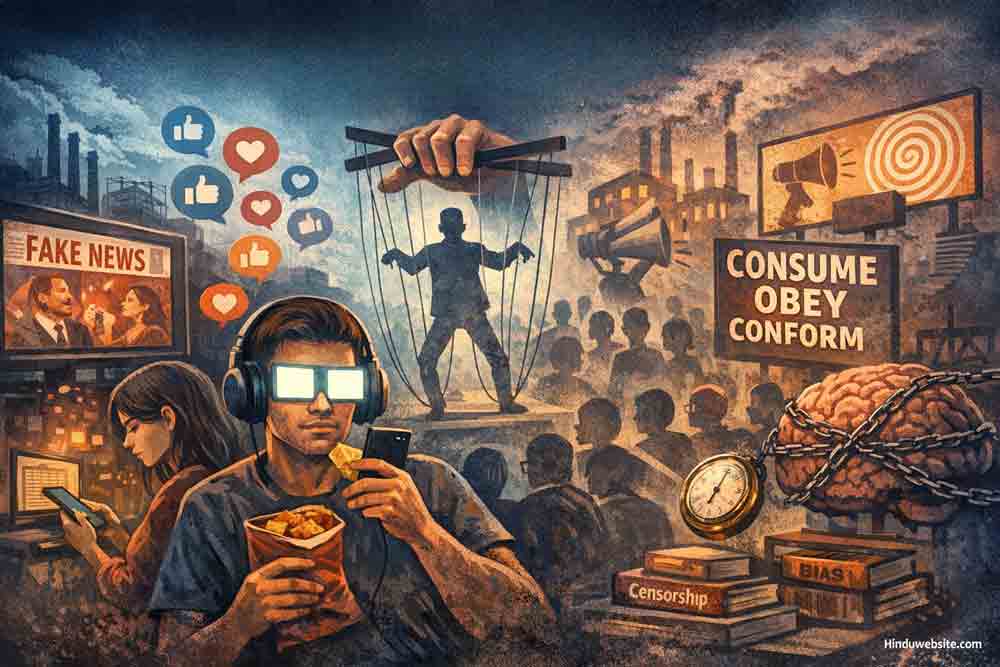
Summary: Conditioned ignorance is a distinctly modern phenomenon, visible across many countries and cultures. It can make life feel simpler by reducing complexity to slogans and habits. Yet it may also keep people uninformed about values, problems, and practical knowledge that matter for survival and success. Without that grounding, individuals can slip into passive roles, becoming easier to steer by commercial, political, and ideological forces.
A few centuries ago, it was difficult for most people to understand the wider world in which they lived. They either needed unusual determination or had to be born into educated, wealthy families to gain much schooling or obtain reliable information. Even then, learning was constrained by limited facilities, slow communication, and scarce resources. Child mortality was high because of disease and recurring famines; many children died before they could fully understand the circumstances around them.
In today’s world, many societies have reduced some of these hardships. People generally have more opportunities to pursue education, including later in life. In many countries, public schooling is free or subsidized, and governments encourage (and sometimes require) children to attend. Loans, subsidies, and scholarships can help students pursue college, and international study is possible for those who can access it. People who want to broaden their understanding can draw on vast information online and in public libraries to learn about events, ideas, and professions. Evening schools and distance-learning options also enable working adults to continue studying while employed.
The Industrial Revolution and later technological advances changed how people learn and build literacy. In many places, literacy rates rose, giving more individuals the ability to read, write, and make decisions for themselves and their families. Policies such as compulsory education (including in countries like India) have contributed to significant improvements in literacy. Modern schooling, first systematized in the West, has often helped people question inherited assumptions and improve living standards and financial security.
The symptoms
Yet, has all this translated into increased knowledge and intellectual ability? Knowledge-wise, are people in today's world any better than their ancestors? Has the education system created more ethically aware, enlightened, principled, and intellectually active people? Let us examine the following.
1. Compared to previous generations, many people spend more time on passive entertainment that can displace sustained reading and reflection. Instead of regularly seeking knowledge that develops attention and critical thinking, some people devote hours to television, sports, movies, and other highly stimulating online content that can keep them distracted and selectively uninformed.
2. Substance abuse remains widespread. In many regions, binge drinking affects young people and adults alike, and public debate continues about whether some drugs should be legalized or decriminalized for recreational use.
3. Many people can name entertainers, influencers, and controversial public figures more readily than scholars, philosophers, writers, poets, and scientists who contribute to long-term social progress. Popular attention often rewards novelty and spectacle, while serious culture can be treated as inaccessible or dull.
4. Many readers gravitate toward formulaic popular fiction and crime novels rather than literature, history, philosophy, or serious journalism that deepens understanding and challenges critical thinking.
5. Some people increasingly distrust the value of virtue and good conduct. In certain circles, moral language is treated with suspicion, and success can be celebrated even when the methods used to achieve it are questionable.
6. Crime, corruption, violence, and deception in personal dealings remain serious concerns, and in many places they are perceived to be rising or becoming more visible.
7. Some people place a high value on personal autonomy even when it includes choices that are clearly self-defeating, and they resist disciplines that require long-term commitment.
8. Many citizens cannot name their leaders, explain how elections work, describe the basics of their constitution, or recount the history of the country in which they live.
9. Many people are influenced by ideological messaging, simplified slogans presented as serious analysis, and manufactured social or political causes rather than by inherited traditions or religious beliefs.
10. Some people define freedom primarily as freedom from restraint: freedom from parents and social expectations, freedom to drink to excess or use harmful drugs, freedom to disregard laws, freedom to take what is not theirs, and freedom to waste time without purpose.
11. Some people undervalue hard work, reject practical advice, and become dependent on government support, while resenting those who are self-reliant and productive.
These and other developments suggest that progress does not automatically produce better character, and that mass education, expensive schools, and even excellent teachers and books do not necessarily translate into wiser or more self-aware communities. Learning still requires individual effort. Society can expand access and provide facilities, but each person decides how to use them. Individual responsibility still matters. Those who take ownership of their lives will pursue education anyway, while those who believe society owes them everything may remain disengaged and dissatisfied. You can send someone to elite schools, but they may still carry unresolved inner conflicts with them.
Many people today are encouraged to stay selectively uninformed about important aspects of their lives and society. This does not happen entirely by accident: ignorance can be profitable. It feeds parts of the entertainment economy and can be exploited by political systems. Both often promise to create social awareness and liberate people from “mental slavery,” yet they frequently produce the opposite effect. Widespread confusion can also help certain ideologies and belief systems prevail and shape people’s decisions and choices.
Conditioned and managed ignorance can be a major weakness of modern society. Because it serves powerful interests and supports multiple industries by producing customers, fans, buyers, and patrons, the problem is unlikely to disappear quickly. In every age, a small number of influential actors have shaped public opinion through various forms of conditioning—offering people the feeling of freedom while quietly narrowing what they notice, value, and question.
Attribution: Image for this article created with AI