The Buddha on the Origin of Suffering
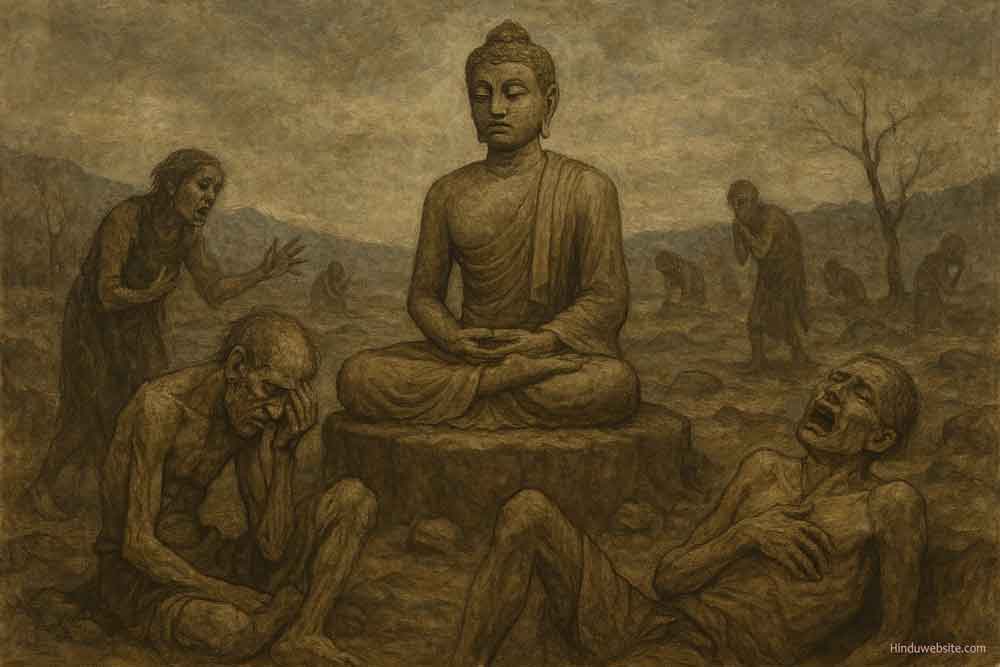
Summary: The Second Noble Truth addresses the fundamental question: why do we suffer? This essay presents selected teachings of the Buddha on the origin of suffering (Samudaya), examining the chain of causation that begins with ignorance and craving and perpetuates the cycle of rebirth and dukkha. Understanding the origin of suffering is essential for finding the path to its cessation.
"And this, monks is the noble truth of the origination of dukkha: the craving that makes for further becoming — accompanied by passion and delight, relishing now here and now there — i.e., craving for sensual pleasure, craving for becoming, craving for non-becoming." — Samyutta Nikaya LVI.11
Craving inevitably leads to more dukkha
If this sticky, uncouth craving
overcomes you in the world,
your sorrows grow like wild grass
after rain.
If, in the world, you overcome
this uncouth craving, hard to escape,
sorrows roll off you,
like water beads off
a lotus.
— Dhammapada 335-336
If its root remains
undamaged and strong,
a tree, even if cut,
will grow back.
So too if latent craving
is not rooted out,
this suffering returns
again
and
again.
— Dhammapada 338
Abandoning craving opens up the possibility of Awakening
"Monks, any desire and passion with regard to craving for forms is a defilement of the mind. Any desire and passion with regard to craving for sounds... craving for aromas... craving for flavors... craving for tactile sensations... craving for ideas is a defilement of the mind. When, with regard to these six bases, the defilements of awareness are abandoned, then the mind is inclined to renunciation. The mind fostered by renunciation feels malleable for the direct knowing of those qualities worth realizing."
— Samyutta Nikaya XXVII.8
Source: Reproduced and reformatted from Access to Insight edition © 2005 For free distribution. This work may be republished, reformatted, reprinted, and redistributed in any medium. It is the author's wish, however, that any such republication and redistribution be made available to the public on a free and unrestricted basis and that translations and other derivative works be clearly marked as such.