Thoughts and Quotations – Book by Jayaram V
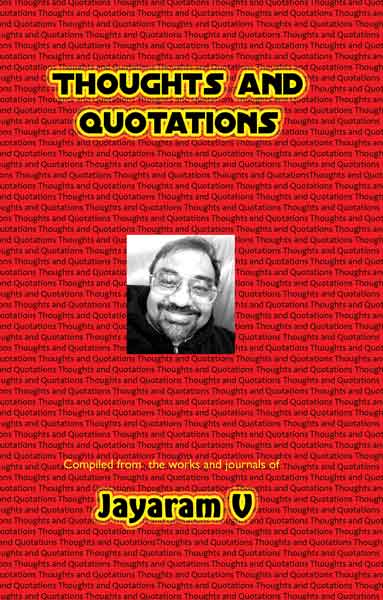
Thoughts and Quotations
Summary: Thoughts and Quotations is Jayaram V’s expansive collection of short reflections, aphorisms, and philosophical notes drawn from his books, journals, and personal writings. The anthology explores how inner life shapes outer experience, emphasizing themes such as attention, self‑awareness, disciplined thinking, karma, suffering, and spiritual growth. Blending practical insight with the depth of Hindu and yogic philosophy, the book encourages readers to question assumptions, cultivate clarity, and approach life with steadiness and compassion. Designed as a treasury of contemplative prompts, it serves as a guide for reflection, self‑improvement, and inner transformation.
Detailed Book Summary
Thoughts and Quotations by Jayaram V is a wide-ranging anthology of short reflections, aphorisms, and brief essays drawn from the author’s books, journals, notes, and online writings. In the preface, Jayaram frames the collection as both personal and universal: the entries “speak about the world as much as they speak about me,” reflecting his convictions, limitations, and interpretations rather than any claim to absolute originality. He positions the work as material for study and contemplation, hoping it will either guide readers toward their goals or at least provoke deeper thinking, while also acknowledging that writing for a broad audience may unintentionally offend.
The book’s organizing principle is thematic breadth rather than linear argument. Across hundreds of entries—ranging from a single line to a paragraph—the author explores how inner life shapes outer life. A recurring idea is that attention is destiny: where one’s attention repeatedly goes reveals where one’s life is heading. Many passages emphasize self-awareness, disciplined thinking, and the need to examine assumptions, motives, and beliefs. Beliefs, he suggests, are powerful engines that shape happiness, courage, success, and failure, but they also create distortions; clear thinking requires suspending prejudice and resisting the mind’s habit of substituting assumptions for truth.
Another central thread is the relationship between suffering and growth. Jayaram treats adversity as soil for future joy and character, arguing that pain can be embraced as a teacher rather than resisted as an enemy. He contrasts reactive living—driven by emotion, blame, fear, and habit—with responsive living, which uses intelligence, restraint, and perspective to choose the next right action. He frequently returns to the idea that real change is inward: the world is difficult to transform directly, but transformation of the self creates ripple effects that contribute to broader change.
The collection is deeply informed by Indian spiritual philosophy, especially Hindu and yogic concepts. Ideas such as karma, dharma, renunciation, the Self, meditation, and equanimity appear throughout, often presented in practical language. Karma is described as radical responsibility: what happens to us is tied to our actions, and liberation begins as an idea that must be embodied through daily conduct. Yoga and meditation are presented not as mystical escape but as training in steadiness, awareness, and non-reactivity—learning to find silence beneath life’s noise. The “higher self” is portrayed as a refuge and compass, and freedom is defined less as comfort and more as release from fear, craving, and the compulsions of identity.
Overall, the book functions like a portable treasury of moral and spiritual prompts, inviting the reader to slow down, question automatic thinking, cultivate compassion, and pursue an inner stability that can withstand the shifting conditions of life.