Sacred Numbers of Hinduism – Book by Jayaram V
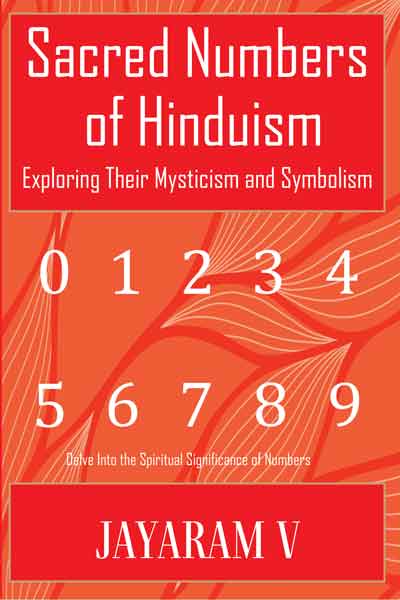
Sacred Numbers of Hinduism: Their Mysticism & Symbolism
Summary: Sacred Numbers of Hinduism is Jayaram V’s comprehensive guide to the symbolic and spiritual meaning of numbers in Hindu thought. Drawing on the Upanishads, the Bhagavad Gita, cultural history, and traditional classifications, the book explains how numbers, from zero and one to recurring sets like three, four, seven, and 108, encode metaphysical ideas and map cosmic processes. Blending clarity with depth, it shows how enumeration shapes cosmology, ritual, language, and inner discipline. This accessible work is ideal for readers seeking a structured introduction to Hindu symbolism and the hidden architecture of sacred meaning
Detailed Book Summary
Numbers are everywhere in Hindu tradition, shaping cosmology, ritual, language, and inner life. Sacred Numbers of Hinduism explores what familiar numbers like zero (shunya), one (eka), and three can reveal when read through the lens of Hindu spirituality and symbolism. Drawing on Sanskrit concepts, key scriptural touchpoints (including the Upanishads and the Bhagavad Gita), and the lived texture of practice, Jayaram V traces how numbers map ideas such as Brahman, Purusha and Prakriti, dharma, and the path toward self-realization. Clear and engaging, this book invites both curious newcomers and experienced readers to see the “hidden architecture” of meaning behind Hindu sacred thought, one number at a time.
What does zero mean in a spiritual tradition that speaks of the unmanifest, the absolute, and the return of all things to their source? Why do Hindu texts and practices return again and again to certain counts, three, four, five, seven, nine, ten, and beyond? Sacred Numbers of Hinduism: Exploring Their Mysticism and Symbolism offers a guided tour of the symbolic life of numbers within Hinduism, showing how enumeration becomes a practical way to organize knowledge, describe creation, and contemplate the deepest questions of existence.
The book opens with a clear orientation: in the Indian world, numbers were not only tools for counting but also frameworks for meaning, used to map deities, cosmic functions, time cycles, ritual structures, and inner disciplines. Jayaram V sets the stage by reflecting on how human beings learn numbers, how they shape everyday life, and how many cultures have also sensed a “mystic” dimension to number. From there, the focus turns decisively to Hindu sources and interpretive traditions.
A major early emphasis is zero (shunya). The book discusses the historical rise of zero in India and then moves into its metaphysical reach: emptiness as a concept, the unmanifested reality, and the way Hindu thought can treat “absence” not as mere nothingness but as an indeterminate ground from which manifestation proceeds. The discussion connects zero with themes such as Nirguna Brahman, the movement between manifest and unmanifest, and symbolic forms like the bindu in tantric imagery.
From one (eka) onward, each chapter examines a number’s linguistic, philosophical, and religious associations. The treatment is not limited to abstract ideas: it also includes concrete cultural expressions (for example, how Sanskrit grammatical forms treat number, gender, and case) and the way numeric patterns show up in cosmology, devotional life, and traditional classifications. As the numbers unfold, readers encounter key Hindu frameworks, such as the interplay of Purusha and Prakriti, the recurring importance of triads and tetrads in describing cosmic processes, and the way dharmic order is expressed through structured sets.
After covering the base numbers, the book expands into “other numbers” that recur in Hindu practice and sacred culture, such as 18, 108, and large-scale number systems used to speak about cosmic time. Along the way, it highlights how numbers can function as mnemonic devices, ritual guides, and contemplative prompts, without requiring readers to adopt numerology as belief.
A concluding section on numbers in Hindu philosophy ties these themes together by pointing to explicitly number-centered systems and classifications, including Samkhya and other philosophical categories. The result is a readable, wide-ranging presentation that blends cultural history, Hindu spiritual concepts, and practical interpretive insight, ideal for readers who want a structured introduction to Hindu symbolism that is both thoughtful and accessible.
This book is for general readers, students, scholars, and spiritual practitioners who want a clear, modern guide to sacred number symbolism in Hindu tradition, from the Upanishadic vision of Brahman to everyday patterns of meaning.