Brihadaranyaka Upanishad Translation and Notes by Jayaram V
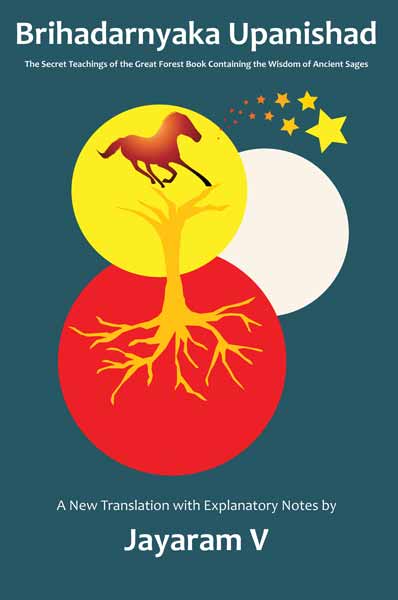
Brihadaranyaka Upanishad With Devanagari Script, Translation and Notes
Summary: The Brihadaranyaka Upanishad is one of the oldest and most expansive sources of Vedic and Upanishadic philosophy. This edition presents the text with Devanagari script, an accurate English translation, and explanatory notes by Jayaram V . It guides readers through its symbolism, metaphysics, and contemplative practices, including teachings on self‑knowledge, breath, identity, renunciation, and liberation. The work highlights the Upanishad’s dialogues, especially Yajnavalkya’s inquiries, offering a clear path for study, reflection, and disciplined inner practice.
Detailed Book Summary
Enter the “great forest” of the Brihadaranyaka Upanishad, one of the oldest and most expansive sources of India’s spiritual philosophy, presented here with Devanagari script, English translation, and practical notes by Jayaram V. This revised edition is ideal for readers who want more than inspiration: it offers a clear path through dense symbolism, foundational metaphysics, and lived inquiry. From the Upanishad’s famous insight “Aham Brahmasmi” (I am Brahman) to the searching dialogues of Yajnavalkya, including the transformative exchange with Maitreyi, this book supports study, reflection, and disciplined practice on selfhood, desire, death, renunciation, and liberation.
A classic text, meant to be practiced, not only studied
The Brihadaranyaka Upanishad is widely regarded as one of the largest, oldest, and most comprehensive Upanishads. It belongs to the Shukla (White) Yajurveda and, by arrangement, forms part of the Satapatha Brahmana, which is why it carries an unusual richness: it preserves early Vedic ritual material while simultaneously pushing beyond ritual into the Upanishadic quest for direct self-knowledge.
This revised edition by Jayaram V (First Edition 2013; Revised 2024) presents the text with Devanagari script, translation, and explanatory notes. The aim is fidelity to the original Sanskrit while helping readers, students, scholars, and serious practitioners, work with the Upanishad as both a historical-philosophical document and a living contemplative guide.
What you’ll encounter: ritual symbolism and inner discipline
The Upanishad contains references to early Vedic practices (including the horse sacrifice and procreation ceremonies) that can feel distant to modern readers. Rather than leaving these passages opaque, the notes and explanations help uncover their symbolic and spiritual intent, how external rite can be read as an inner offering: ego subdued, desire examined, and action purified through discipline.
At the same time, the text offers a remarkably direct map of inner life: creation and duality, the constitution of human personality, the roles of food and breath, the meaning of sleep and dreaming, the afterlife, and the spiritual logic behind renunciation and liberation.
A clear structure for sustained reading
The Brihadaranyaka is divided into three khandas, each with two chapters:
- Madhu Khanda (honey/essence): symbolism, creation, the body as a sacred field, and the “sweetness” of Brahman within life.
- Muni (Yajnavalkya) Khanda: dialogues and penetrating inquiry led by the great teacher Yajnavalkya.
- Khila Khanda (supplemental): further teachings on Brahman’s infinity and procedural material tied to aims such as wealth and progeny, useful for understanding the Vedic worldview and the Upanishad’s bridge between worldly life and transcendence.
Core teachings, translated into practice
While the Upanishad is philosophically foundational, it is also intensely practice-oriented if approached correctly. Key themes become repeatable disciplines:
- Breath as refuge and purifier: multiple sections present breath (prana) as invincible among the bodily powers, subtle, sustaining, and less vulnerable to corruption than the senses. Practically, this points toward training attention through breath, restraint, and steadiness (a natural bridge for readers familiar with pranayama and meditation).
- Name–form–action (identity construction): the Upanishad analyzes how ordinary identity forms and hardens. As a practice, this becomes self-observation: noticing how labels, appearances, and habitual actions create a “self” that can be loosened through insight.
- Waking, dream, deep sleep: these states are used to question what is constant beneath changing experience. For contemplatives, this supports a direct inquiry into the witness behind perception.
- Neti, neti (“not this, not this”): the text repeatedly refuses to reduce Brahman to an object. Practically, this is a method of release, dropping identifications one by one (body, senses, thoughts, roles) until attention rests in what cannot be objectified.
The Upanishad’s unforgettable dialogues
The Brihadaranyaka is also famous for its teachers and debates, Yajnavalkya, Ajatasatru, Janaka, Pavahana Jaivali, and others, showing spiritual knowledge being tested, refined, and earned.
Among its most transformative passages is the conversation between Yajnavalkya and Maitreyi (presented twice with minor variations). It challenges modern assumptions about love, value, and security by insisting that what is truly “dear” is the Self, not possessions, roles, or relationships. Read as practice, it becomes a daily discipline of re-centering: identifying what you cling to for wholeness and turning the search inward.
Karma, death, and liberation, without sentimental shortcuts
The text confronts the major existential drivers of practice: karma and consequence, desire and bondage, the journey of souls after death, and why mere ritual merit is not the final answer. It argues for an inner maturity, restraint, truthfulness, disciplined living, and ultimately renunciation (not necessarily withdrawal from life, but release of craving and ego-centered action). Liberation is framed as a shift beyond duality and fear into what the Upanishad points to with its celebrated declaration: “Aham Brahmasmi”, a realization that is not merely intellectual, but transformative.
Why this edition helps
Jayaram V’s notes are designed to clarify critical words and phrases, historical references, and hidden symbolism, while keeping the reader oriented toward what matters most: using the text for study, contemplation, and inner refinement. The result is a volume that can support close reading in classrooms and scholarship, while remaining usable for advanced practitioners who want the Upanishad as a companion to meditation and self-inquiry.