The Essential Bhagavadgita: A Study in Its Philosophy and Doctrine
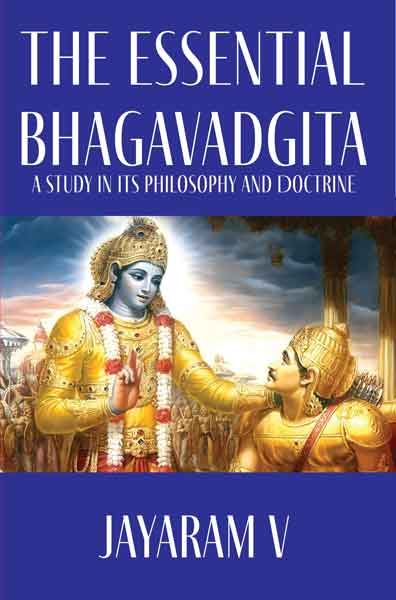
The Essential Bhagavadgita: A Study in Its Philosophy and Doctrine
Summary: The Essential Bhagavadgita: A Study in Its Philosophy and Doctrine offers a comprehensive, practice‑oriented exploration of the Gita’s central teachings. Jayaram V presents the scripture as a guide for living with clarity amid duty, conflict, and emotional turbulence, emphasizing karma yoga, discernment, meditation, and devotion as integrated paths to inner steadiness. The book explains the distinction between body and Self, the psychology of desire and suffering, the role of the gunas, and the meaning of selfless action. Written in a modern, accessible style, it serves seekers, students, and practitioners looking for a grounded companion to the Gita.
Detailed Book Summary
The Essential Bhagavadgita: A Study in Its Philosophy and Doctrine invites you into the Gita’s living heart, not as an abstract scripture, but as a practical guide for the conflicts, duties, and doubts that shape real life. Jayaram V presents the Bhagavad Gita as a path of inner transformation that can be practiced amid work, relationships, and responsibility, not apart from them. Blending clarity with devotional depth, this book explores how selfless action (karma yoga), discernment, meditation, and bhakti can steady the mind, loosen the grip of desire, and point you toward self-realization. Whether you read as a seeker or a student, it offers a grounded way to approach Hindu spirituality with purpose, balance, and inner peace.
The Essential Bhagavadgita: A Study in Its Philosophy and Doctrine (Second Edition, 2025) by Jayaram V is a wide-ranging, practice-oriented exploration of the Bhagavad Gita’s central teachings. Written for online readers who want both meaning and method, it treats the Gita not only as a revered Hindu scripture within the Mahabharata, but also as a “yoga shastram”, a guide to living with clarity in the middle of life’s pressures, choices, and moral complexity. Rather than presenting the text as distant theology, the book repeatedly returns to a practical question: how can a person fulfill duty without being consumed by ego, anxiety, and the push-pull of desire?
The work opens by placing the Gita within Hinduism’s broader scriptural and philosophical landscape. It discusses its stature alongside the Upanishads and the Brahmasutras (prasthanatraya), and explains how the Gita’s teachings have supported multiple Vedanta perspectives over time. At the same time, the author emphasizes its universal accessibility: the dialogue between Krishna and Arjuna is framed as a mirror of the inner dialogue within every person, between higher aspiration and the turbulence of the mind.
From there, the book develops the Gita’s core doctrines through a clear thematic arc. A recurring emphasis is the distinction between the perishable body and the imperishable Self (atman), and how ignorance of that distinction fuels grief, fear, and confusion. The discussion of sorrow, beginning with Arjuna’s collapse on the battlefield, becomes a doorway into the Gita’s psychology of suffering: the senses contact objects, attachment forms, and from attachment arise anger, delusion, and loss of discernment. Against this chain, the text proposes steady awareness, restraint, and an inward turn that supports equanimity.
A major focus is karma and freedom. The book stresses the Gita’s insistence that action itself is not the true problem; bondage comes from craving the fruits of action. This is where karma yoga becomes foundational: doing one’s svadharma (one’s own duty) with detachment, surrendering ownership and doership, and treating work as an offering to Ishvara. The author returns often to the practical consequences of this shift, less inner conflict, greater stability, and a way to live responsibly without being dominated by the outcomes.
Alongside karma yoga, the book explores jnana yoga (the path of knowledge) as disciplined inquiry into Self, Nature (prakriti), and the play of the gunas, sattva, rajas, and tamas. Discernment (buddhi) is presented as essential for seeing through mistaken identity and the distortions created by desire. The text also addresses maya as the world’s instability and our mind’s tendency to turn perception into a false sense of permanence, urging readers toward detachment and clearer seeing rather than escapism.
Devotion (bhakti) is treated not as mere ritual or emotion, but as a purified, single-minded orientation toward the Supreme, supported by inner discipline, self-control, and renunciation of selfish motive. The book draws from the Gita’s own progression of practices: when steady contemplation is difficult, begin with sincere effort, selfless work, and relinquishing results; as the mind becomes calmer, devotion deepens naturally. Meditation and yogic methods, concentration, dhyana, and samadhi-like absorption, appear as part of this integrated path to self-realization.
Overall, this is a comprehensive, modernly stated guide to the Bhagavad Gita’s philosophy and spiritual practice, suited for readers who want a serious yet readable approach, lay seekers, committed practitioners, students, and scholars looking for a structured companion to Hindu spirituality and the Gita’s teachings.