The Awakened Life: Spiritual Knowledge from India’s Sacred Traditions
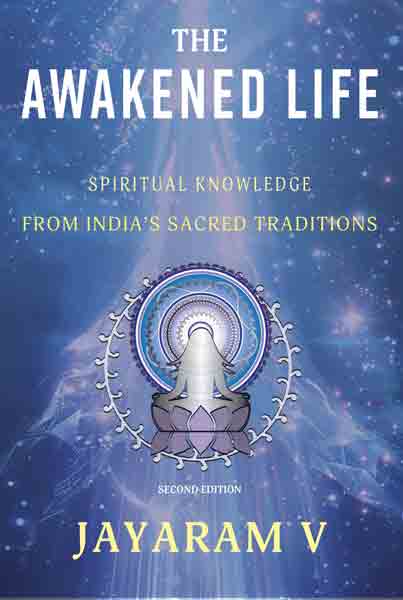
The Awakened Life: Spiritual Knowledge from India’s Sacred Traditions
Summary:The Awakened Life presents a clear, practical approach to spiritual growth rooted in Hindu philosophy and India’s sacred texts. Jayaram V explores meditation, devotion, karma, detachment, and inner steadiness while emphasizing that awakening unfolds within everyday life, not apart from it. The book examines ego, fear, desire, and suffering, offering frameworks for mindful action, ethical living, and emotional balance. With accessible language and guidance for householders, it encourages readers to recognize the divine in the ordinary and cultivate awareness, compassion, and self‑mastery without withdrawing from modern responsibilities.
Detailed Book Summary
Discover The Awakened Life: Spiritual Knowledge from India’s Sacred Traditions (Second Edition, 2024) by Jayaram V, an inspiring, practical guide to spiritual awakening, self-realization, and mindful living rooted in Hindu philosophy and Indian sacred texts such as the Upanishads and the Bhagavadgita. Written for modern householders and seekers, this accessible book explores meditation, devotion (bhakti), karma and right action, detachment, faith, and inner peace, showing how to recognize the divine presence in daily life, overcome ego, fear, desire, and attachment, and build steady spiritual practice without stepping away from work, relationships, or responsibilities.
In The Awakened Life: Spiritual Knowledge from India’s Sacred Traditions (Second Edition, 2024), Jayaram V presents a wide-ranging yet practical approach to spirituality for readers who want inner transformation while remaining fully engaged in modern life. Drawing primarily from Hindu scripture and philosophy, especially the Upanishads and the Bhagavadgita, while also acknowledging insights that resonate with Buddhism and other traditions, the book reframes spiritual growth as a shift in perception: from a narrow, ego-centered outlook to a God-centered and Self-aware way of living. Instead of treating spirituality as escape, it treats everyday experience, work, relationships, uncertainty, and change, as the very setting in which awareness, compassion, self-mastery, and peace can be cultivated.
The opening chapters ground the discussion in the author’s reflections on spiritual experience and the difficulty of understanding God, the Self, and reality beyond habitual thinking. Jayaram argues that much human suffering is intensified by identification with the ego-self, an identity built from roles, labels, memories, anxieties, and social conditioning. As the reader learns to observe the mind and question what they cling to, a wider identity becomes possible: one rooted in the enduring Self, supported by faith, and expressed through conscious choices. A consistent thread throughout the book is that awakening is not merely an idea to believe, but a way of seeing and responding, learning to notice the sacred in the ordinary, and allowing spiritual values to shape daily actions.
Across short, essay-style chapters, the book explores key inner obstacles, ego, fear, desire, attachment, and a divided sense of identity, and offers frameworks to meet them with clarity and steadiness. One recurring framework is the need to balance emotion, reason, and belief as complementary ways of understanding life, so that spirituality does not become either dry intellectualism or impulsive sentiment. Another is the “middle path” principle: avoiding extremes and cultivating moderation, discernment, and ethical restraint. By connecting these ideas to practical self-observation, the text encourages readers to become less reactive, more tolerant, and more capable of holding complexity without losing inner balance.
Jayaram devotes special attention to fear and suffering, treating them as both psychological patterns and spiritual challenges. He outlines ways to work skillfully with fear through awareness, detachment, surrender, and practical contemplations that loosen the grip of anxious thinking. The book also clarifies how intention shapes karma, how motives influence not only outcomes, but character, habits, and the quality of one’s inner life. In discussing “manifesting,” the emphasis remains grounded: meaningful change requires ethical purpose, disciplined effort, and alignment with the well-being of others rather than wishful thinking or self-serving desire.
Practical guidance for householders is woven throughout. Readers are encouraged to bring mindfulness to ordinary events, contemplate impermanence, and practice meditation and self-discipline as steady supports for inner freedom. The book highlights devotion and a personal relationship with God as a source of strength and orientation, while also stressing virtue, compassion, and tolerance in social life. Rather than fixating on results, the reader is guided toward right action, doing one’s duty with care and sincerity, while letting go of grasping and agitation. Along the way, Jayaram introduces essential Sanskrit vocabulary to help readers engage more deeply with Indian spiritual concepts and practices.
Overall, The Awakened Life functions as both a spiritual handbook and an online-friendly reference for anyone searching for Hindu spirituality, Bhagavad Gita teachings, Upanishadic wisdom, meditation guidance, mindfulness practice, and practical self-help for inner peace. With a clear focus on overcoming ego and attachment, aligning intention with ethical living, and cultivating steadiness amid uncertainty, the book invites readers to live with greater awareness, compassion, and a widening sense of the divine in all things, without withdrawing from the responsibilities of modern life.