
About the Vedas and Vedic Literature
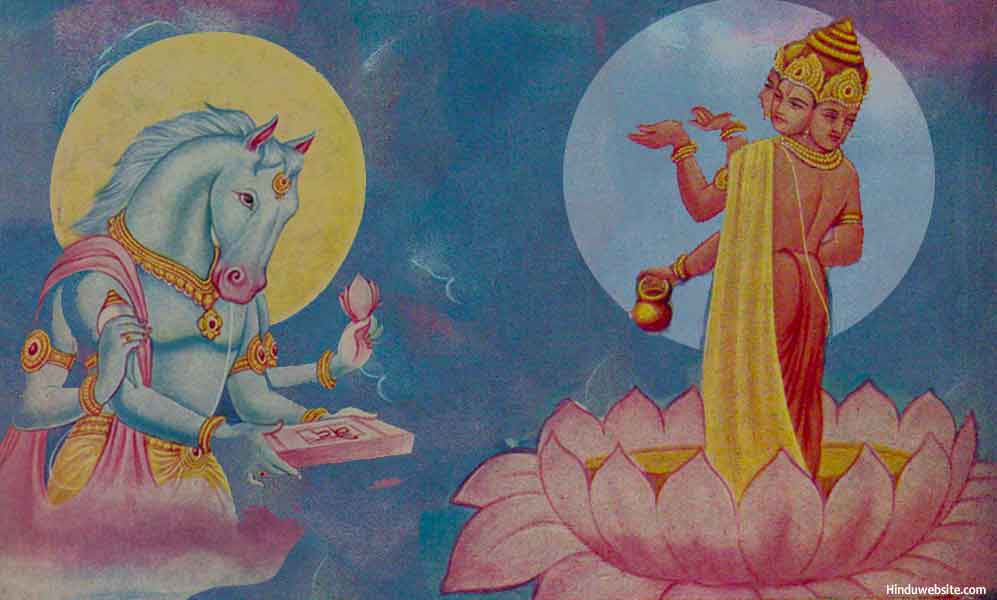
Hayagriva returning the Vedas to Brahma
The Vedas are elaborate texts containing thousands of hymns. They are believed to be divine revelations and not manmade (apaurusheya). They said to exist eternally in the highest heaven, revealed to the human beings for their welfare and to facilitate the nurturing of gods who cannot make food of their own. Vedic sacrifices are the means by which the order and regularity of creation can be maintained and social order can be continued. Hence the Vedas are imperative for the welfare of the world. The Vedas are divided into four parts:
- The Samhitas
- The Brahmanas
- The Aranyakas
- The Upanishads
Their significance in the religious and spiritual practices of Hinduism and Hindu philosophy is briefly explained below.
The Samhitas
These are the main textual portions of the Vedas containing the hymns or the suktas. The Rigveda Samhita contains 1017 or 1028 suktas or hymns, divided into ten divisions or mandalas. Each Mandala correspond with the name of a Rishi who was probably instrumental in its creation. These divisions however do not correspond with the order in which they were created. For example the first and the tenth Mandalas are considered to be latter day compositions compared to the rest. 1
The Samaveda Samhita is known as the Book of Chants. It contains 1549 (or according to some 1810) hymns which are meant to be sung by a special class of priests known as Udgatris at the time of soma sacrifice. Most of the hymns in this Samhita are copied verbatim from the Rigveda and the remaining few from other existing sources. The hymns contained in this Samhita are more lyrical in nature and suggest to the early musical traditions of the Vedic people.
The Yajurveda Samhita is known as the Book of the Yajus (sacrificial prayers). The mantras are meant to be chanted by a special class of priests called Adhavaryus during sacrificial ceremonies. The Samhita is divided into Black Yajurveda, which is a disorderly mixture of prose and chants, and the White (Vajasaneyi) Yajurveda, which consists of only chants and contributed extensively by sage Yajnavalkya. The Black Yajurveda is considered to be older of the two and composed around 1200 BC.
For a long time the Atharvaveda was not considered a Veda at all. Kautilya's Arthashastra, for example, mentions only the first three. Atharvaveda Samhita contains mostly magical chants which alludes to the growing influence of the native kings over the Aryan traditions. The Samhita is divided into 20 books and about 75 hymns which are essentially spells, marriage and burial songs and curses. The Atharvaveda Samhita is the oldest document of the Indian medicine and magical formulas to deal with disease and sickness. The priests who chanted these hymns were prized by the royalty for their special ability to cure diseases and drive away the evils spirits or curse their enemies.
The Brahmanas
These are explanatory books or guide books providing information about the Samhitas and the procedures to observe in the performance of rituals. They serve as reference books for the Brahman priests to understand the purport of the Samhitas. For the practicing Brahmanas, they are important because they explain the meaning of the hymns and the procedures to be followed to perform various types of sacrifices. For ordinary people many procedures followed in the Vedic rituals do not make sense. The Brahmanas provide justification or rationale for the actions performed during each sacrifice. Each Veda (Samhita) has one or more Brahmanas.
The Rigveda has two Brahmanas, Kaushitaki Brahmana and Aitareya Brahmana. The Samaveda has three Brahmanas, Tandya-maha Brahmana, Sadavinsa Brahmana and Jaiminiya Brahmana. These Brahmanas contain information about the then existing native people of India and the methods by which they should be admitted into the Aryan fold. The Satapatha Brahmana belongs to the Vajsaneya or White Yajurveda and believed to be composed by Yajnavalkya. The Satapatha Brahmana is the most important of all the Brahmanas. It's title literally means the Brahmana of 100 paths. The Brahmana contains information about the important sacrificial ceremonies of the Vedic kings such as the Asvamedha and Rajasuya yajnas. It also deals with the relationship between the priests and the rulers. The Brihadaranyaka Upanishad is attached to this Brahmana.
The Aranyakas
These are forest books, which according to some were originally part of the Brahmanas and later were recognized as a separate section. Some of the Aranyakas also form part of the Upanishads, as in case of the Brihadaranyaka Upanishad. They are provide explanatory notes about the external and internal aspects of certain esoteric Vedic rituals, meant especially for those who have an advanced knowledge of the sacrificial rituals. In the Aranyakas one may discern the gradual shift in emphasis from the ritual aspects of the religion emphasized in the Samhitas to the spiritual and philosophical aspects presented in the Upanishads. The knowledge contained in the Aranyakas was also meant originally for those who retired from active householder's duty and entered into ascetic mode of living (vanaprastha). Some of the information in them pertain to advanced aspects of sacrificial rituals that are not usually performed in public. As the name suggests, the Aranyakas were meant for people who lived in forests and performed Vedic sacrifices for the welfare of the world or the benefit of the kings.
The Upanishads
The Upanishads constitutes the end part of the Vedas (Vedanta). They deal with philosophical and mystical aspects of Vedas and deal with subjects like Brahman, atman, nature of reality, the meaning of true knowledge, the state of oneness, the four states of consciousness, the constitution of the worlds, the nature of highest reality, the nature of true sacrifice and so on. They contain disjointed and loosely organized pieces of metaphysical and speculative truths about Brahman and Atman. Some of them are mere expositions, some are composed in narrative form and some in the form of conversations. Each Vedas has its own set of Upanishads. Some of the Upanishads are very ancient, while some are more recent. The Upanishads lack coherent approach to spiritual subjects, but contain profound philosophy regarding existence, bondage and liberation. Their number is uncertain. However, about 12-15 are considered very important. The Chandogya and Brihadaranyaka Upanishads constitute the largest of the Upanishads and account for more than 60% of the Upanishadic knowledge. They are also two of the oldest Upanishads. While the Upanishads are predominantly Brahmanical, extolling the supremacy of Brahman and Atman, some of them represent the sectarian philosophies of Vaishnavism and Saivism. There are also subject specific Upanishads such as the Yoga Upanishads.
Significance of the Vedas
Most of the hymns in the Vedas do not make sense today because of the changes that took place in the Vedic religion in the last 3000 years. Many gods of the old Vedic religion have vanished or yielded place to new gods of the subcontinent. It was the price the priests of the later Vedic period had to pay to withstand the popularity of the non Vedic traditions and continue their own by securing the support of the kings and the nobility with some compromises here and there. We have no idea how much of the Vedas were compromised and how much of it was kept intact. We know for sure that many of the ancient gods were sacrificed to keep the tradition alive and the priests in power.
Whatever might be the truth, the Vedas constitute the base as well as the hub of the Hindu tradition. For centuries they served as the source book of standards (pramana) to test the validity of a philosophical statements. If a truth was not supported by the Vedas it was not accepted as a philosophical truth. Those who disregarded this principle were considered as heretics and outside the fold of Hinduism. Even today many scholars tend to define a person as a Hindu only if he or she accepts the authority of the Vedas.
The Vedangas
Vedangas means limbs of the Vedas. They are useful in the study of the Vedas as ancillary subjects. They are six in number, namely Siksha (pronunciation), Kalpa (explanations regarding rituals), Vyakarna (grammar), Nirukta (etymology), Chhanda (metrics) and Jyotisha (astrology). No knowledge of the Vedas is complete without their proper study. In the ancient times a student had to learn these six subjects invariably to complete his education. For a more detailed information on the Vedangas please read this article available in another section.
Sutra literature
The Hindu Sutra literature was composed much later than the Vedas and belong to a later period. They are manuals of instructions for people to follow in their social, religious, economic and political affairs. They are a diverse body of literature, containing many scriptures which are loosely grouped together as sutra literature. It consists of Strauta Sutras which deal with ceremonies and the Grihya Sutras, which deal with domestic rules, duties, rites and sacrifices. They contain information about the samskaras (sacraments), types of marriages, the five kinds of sacrifices and the seven types of pakayajnas, the four types of ashramas, the duties of various castes and so on.
Smriti - Dharmasastras
The Dharmashastras, books of dharma, constitute the smriti literature. They are religious law books named after their composers, such as Gautama, Baudhayana, Apastamba and Vashishta. The deal with code of conduct and how to practice dharma by various classes of people and in various social and religious situations. The Dharmashastras are more like books of guidelines rather than law books, because their enforcement depended upon the patronage of the king and their reach. Not all people in ancient India practiced Hindu traditions and therefore the law books were not applicable to all. Even among the Hindus, not all had equal access to the religious scriptures or religious knowledge. Therefore, they were observed strictly by the Brahmanas who practiced Vedic rituals and to some extent by the Kshatriyas and Vaisyas who had access to such knowledge.
Darsanas
The schools of Hindu philosophy are known as Darsanas. Darsana means, sight, vision, a point of view or a perspective. Each school of Hindu philosophy approaches the knowledge, reality, existence and creation from a different perspective. Hence a study of each school is necessary to develop a complete picture of the Hindu philosophical thought. Hindu tradition recognizes six schools of Hindu philosophy, grouped into three pairs. They are: Nyaya and Vaisheshika, Samkhya and Yoga, and Mimansa and Vedanta. Each of these schools has a history, teacher tradition, sub-sects and original literature in the form of sutras and their commentaries (bhasyas).
Suggestions for Further Reading
- What is Vedanta?
- Who Is Brahman And What Is Self-realization?
- The Symbolism of Time or Kala and Death in Hinduism
- Developments in the Early Vedic Tradition
- The Role of Archakas, Temple Priests, in Hinduism
- Essays on the Vedas
- Mantras in Hinduism
- The Mantra Tradition of Hinduism
- Hymns from the Rig Veda
- Ritual and Spiritual Aspects of the Vedic Tradition
- Significance of the Vedas in Life and Liberation
- The Vedas as the Source of Valid Knowledge
- Internal Links to Vedas and Vedic Resources
- Yajna - The Vedic Sacrifice
- Essays On Dharma
- Esoteric Mystic Hinduism
- Introduction to Hinduism
- Hindu Way of Life
- Essays On Karma
- Hindu Rites and Rituals
- The Origin of The Sanskrit Language
- Symbolism in Hinduism
- Essays on The Upanishads
- Concepts of Hinduism
- Essays on Atman
- Hindu Festivals
- Spiritual Practice
- Right Living
- Yoga of Sorrow
- Happiness
- Mental Health
- Concepts of Buddhism
- General Essays