
Early Western Images Of Hinduism
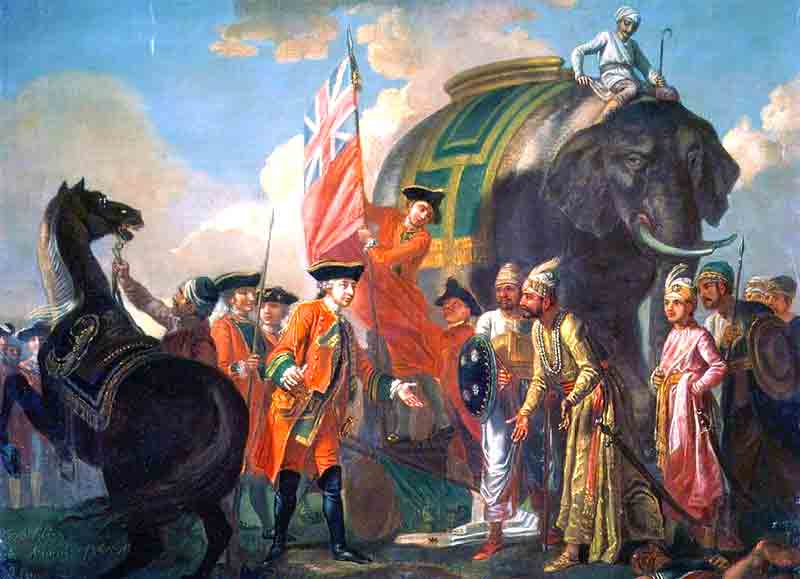
Robert Clive and Mir Jafar after the Battle of Plassey
The discovery of the glory of extinct or little known civilizations of the world owes a great deal to European research and scholarship. The spade of the European excavator lent a helping hand to the geologist who divided up time dealing with the physical history of the earth into three main epochs - Tertiary, Quaternary and Recent - in which to fix the period of a particular culture; the paleontologist who examined the fossils of anthropoids (viz. those of Pithecanthropoids, Australopithecines, Heidelberg Man, Piltdown Man, Neanderthal Man, etc.) to determine the mode of man's descent on the earth; and the archaeologist who deciphered artifacts, inscriptions, and monuments to establish the antiquity of civilizations.
The interpretation of hieroglyphs on the Rosetta Stone by Young and Champollion opened the sealed book of Egypt’s glorious past. The excavations of M. Botta and Layard in South West Asia yielded sufficient findings on which could be built up the edifice of Assyrian civilization. Likewise, the researches of British indologists such as John Jephaniah Holwell, Nathaniel Brassey Halhed, Alexander Dow, Charles Wilkins, Sir William Jones, Alexander Cunningham and many others culminated in the birth of indology, aimed at a scientific and systematic study of India's past – its history, social and political institutions, literature, language and religion.
There were three marked stages in the development of indological studies: the period of curiosity and speculation, the period of appreciation and vilification, and the period of archaeologists. Among the first Europeans who tried to understand India's cultural past were the two eighteenth century Jesuit priests at Malabar -Father Johann Hanxledon who compiled the first Sanskrit grammar in Latin which remained unpublished, and Father Coeurdoux who established a linguistic and ethnic kinship between the Brahmins and the descendants of Noah.1 Much earlier, a Dutch missionary, Abraham Roger, had published a translation of the poems of Bhartrihari,2 and introduced his countrymen to the customs and beliefs of the Hindus with his Open Door to the Hidden Heathendom. But his works failed to generate sufficient interest among the Europeans.
Those who had read or heard the accounts of early European travelers to India, came to believe that the Hindus were like a ‘fiendish race’ who burnt their widows, threw their children to crocodiles in the rivers, tortured themselves in many ways (viz. by throwing themselves beneath the wheels of Juggernaut) and committed other horrible deeds, and that their religion consisted of innumerable deities, of sordid and sometime preposterous mythological accounts, of vague philosophical doctrines, of mechanical and endless rites and of abominable caste system strangulating an opaque social structure.3 Pierre Martin, member of the Society of Jesus in the early 18th century observed that the Hindus worshipped vulgar objects; ‘..no idolatry among the ancients was ever more gross or more horrid than that of these Indians,’ he wrote.4 Another English traveler, William Bruton spoke of the Bengalis as uncivilized people who professed a religion marked by animistic and necromantic traits.5
The Megasthenesean image of India as a land of marvel and mystery, however, persisted in the European mind. Even those who dubbed Hinduism as voodooistic appreciated its ethical doctrines and saw a somewhat hazy monotheism at its basis. Henry Lord, an English clergyman at Surat (a seaport in Gujarat) in the 17th century, for example, remarked that even though the Hindus were superstitious they had an ardent faith in God, and worshipped Him in diverse ways.6 Many others like Alexander Hamilton tried to draw similarities between Hinduism and Christianity viz. their stress on moral values and their concept of the immortality of the human soul, though often giving an upper hand to the latter both in terms of philosophical profundity and historical antiquity.7
It was a common belief that civilization was primarily a European phenomenon; that the Jews whose descent could be traced from the Biblical Hebrews, had the oldest civilization in the world, and that they had imparted the quintessence of wisdom to the rest of mankind. Distinguished Christians like Sir Isaac Newton and Jacques B. Bossuet deftly argued in their respective works, Chronology of Ancient Kingdoms and An Universal History that the ancient Greeks had acquired their knowledge from the Jews. The ‘Know Thyself’ of Socrates was but a partial echo of the ‘Seek Wisdom’ of Solomon.8
Thomas La Gru, however, struck a discordant note by contending that the Greeks owed their learning neither to the Jews nor to the Egyptians as suggested by Andre Dacier in The Life of Pythagoras with His Symbols and Golden Verses but to the Brahmins. He maintained, nevertheless, that even the Brahmins had been taught by the Jews as it was evident from the mission of the Apostle St. Thomas to India.9
By the middle of the 18th century some Jesuit missionaries had learnt the rudiments of Sanskrit. They compiled a work L'Ezour Vedam, ‘a highly inaccurate version of Yajurveda which was to influence Voltaire’.10 Most of them believed that the Hindus had borrowed their religious ideas from the Books of Moses and other apostles such as St. Pantaenus. Jean Boutchet, for example, drew a similitude between Abraham, the first of the great postdiluvian patriarchs, and Brahma, the first God of the Hindu triad; between Moses, the Hebrew patriarch, and Kṛṣṇa the incarnation of Lord Viṣṇu as also between the Christian and Hindu doctrines of Trinity.11 But these arguments were soon to boomerang on the Jesuits - for the issue of hypothetical analogies raised the question of chronology - and if it were historically established that Hinduism existed long before the Mosaic code or that the Vedas preceded the Torah, the myth of Jewish civilization being the preceptor of Indians could be dispelled.12
The most ribald attack on the Christian presumptions was made by Voltaire who pointed out inconsistencies in the narrative and chronology of the Old Testament. In The Questions of Zapata one of his characters who aspired for priesthood asked: ‘How shall we proceed to show that the Jews whom we burned by the hundred were, for thousands of years, the chosen people of God?’13 In another article on religion, Voltaire quipped: ‘After our own holy religion which, doubtless, is the only good one, what religion would be the most objectionable. . . . Christianity must be divine since it has lasted 1700 years despite the fact that it is full of villainy and nonsense.’14 Voltaire turned the tables on the western theologians by arguing that the Christian, even the Jewish dogmas and rites, could be traced to Greece, Egypt and India - the last being the oldest nation in the world, ‘the ancient among ancients.’15
The ball was thus set into motion. It was left to the British indologists to strike it violently towards those who believed that the Western religion could in no way be equated to the Eastern faiths as they had all resulted from ‘a primitive revelation’. John Jephaniah Holwell was particularly harsh on such writers (specially Abbe de Guyon, the author of Historie des Indes) who regarded the Hindus as a race of stupid idolaters. ‘I venture to pronounce them all very defective, fallacious and unsatisfactory to an inquisitive searcher after truth and only tending to convey a very imperfect and injurious resemblance of a people, who from the earliest times have been an ornament to the creation - if so much can with propriety be said of any known people upon earth’, he wrote. Holwell contended that the mythology as well as the cosmogony of the Egyptians, Greeks and Romans had been derived from the doctrines of the Hindus, and that the religious beliefs of ancient Europeans were based on ‘the later perversions of Hinduism.’ Though Holwell did not adhere to the orthodox view that the oldest Hindu treatise had been written about five thousand years ago which is more than six centuries before the Flood and about two thousand years before the Mosaic writings, he believed that Hinduism was, ‘the most ancient religion’ from which all other religions had originated. It is, however, not certain whether he regarded Judaism as derivative from Hinduism or vice versa.16
Holwell was fascinated by the monotheistic character of Hinduism, its ethics, its doctrine of the immortality of the human soul, its belief in transmigration, its notion of kala (time) its concept of the age of the universe and it dissolution, etc. Both Pythagoras and Zoroaster built up their religious and philosophic systems on these beliefs - though with some variation. In his view, these sages visited India about the time of Romulus, ‘not to instruct but to be instructed.’17 He argued that the doctrine of metempsychosis as well as the three underlying principles behind the Eleusinian mysteries - unity of Godhead, guardianship of God over His creatures, and future state of rewards and punishments - were fundamental to Hinduism and had been preached by brahmins from time immemorial, ‘not as mysteries but as religious tenets.’18 Holwell was, however, not unaware that philosophical Hinduism was incongruous with the prevalent religion of the gentoos (hindus), with its characteristic aberrations like caste, redundant ceremonials, intricate modes of worship and sacerdotal slavery.
An Irish by birth, Holwell joined the service of the British East India Company in 1732 and worked in various capacities as a surgeon, member of the Calcutta Council, and as Governor of Bengal, though only for a short period. He was as much known for his versatility as for his eccentricities. His famous works include Narrative of the Black Hole which has since been seriously questioned by historians, and his account of Hinduism in three parts, published successively in 1765, 1767 and 1771, under a rambunctious title: Historical Events, Relative to the Province of Bengal and the Empire of Indostan. as also the Mythology and Cosmogony, Fasts and Festivals of the Gentoos, Followers of the Shastah, and a Dissertation on the Metempsychosis, Commonly Though Erroneously Called the Pythagorean Doctrine.
Holwell's works elicited much interest in Europe. The Annual Register described his expatiations as ‘a very curious and important acquisition to the general stock of literature in Europe.’ Voltaire spoke in eulogizing terms about him and accepted his chronology of the Hindus. Guillaume-Thomas-Francois Raynal, a French clergyman, described Holwell as an apologist for even the worst features of Hinduism. Joseph Priestley an English Chemist, author and clergyman, upheld the Mosaic History against Holwell's account. So did Rev. Richard Watson who described the Hindu chronology as ‘fictitious and absurd’, ‘monstrous and asinine' and ‘a mere fable’.
Holwell was not alone among the East India Company's servants who endeavoured to lift the veil from the hoary past of India. He was joined by Alexander Dow, Nathaniel Brassey Halhed, Charles Wilkins and Sir William Jones - all of whom tried in their own way to discover and interpret the available data. They received due patronage from Warren Hastings, the Governor General of Fort William in Bengal, who was known for his oriental tastes. Hastings was convinced that if he were to rule efficiently he must keep himself abreast of the history and language, the laws and customs, and even the religious beliefs of the natives. Although he was aware of the political gains that would accrue from a deep probe into the Indian antiquity, he was convinced that such a study would create better understanding between the rulers and the ruled and enrich the existing knowledge of Europe about India. ‘He sought to understand Indian culture as a basis for sound administration.’20 During his period (1772-1785) Hindu and Muslim Personal Law received protection, and Muslim criminal law was upheld. ‘The people of this country,’ he wrote, ‘do not require our aid to furnish them with a rule for their conduct.’21
Coming back to the British indologists, Alexander Dow, a Scot by birth, joined the service of the British East India Company as an infantry officer in 1760. Later, he was promoted to the rank of a Colonel. Like Holwell, he was immensely interested in oriental history, literature and religion, and published many works which won him recognition; famous among them are: Tales Translated from the Persian of Inatulla, Firishta's History of Hindostan in three volumes, and A Dissertation Sur Les Moeurs, Les Usages, Le Language, Et La Philosophie Des Hindous.
Dow made a conscientious effort to study Hinduism in the conviction that posterity would not forgive the British for ignoring ‘the learning and religious opinions’ of the governed, just as the present generation of Europeans was finding fault with the Greek and Roman writers for not studying the religion and philosophy of the Druids. He regretted that the European travelers had prejudiced the mind of the West against India and disgraced ‘a system of religion and philosophy, which they did by no means investigate.’ He refused to join the chorus of theologians who laid exclusive claims to the religious and moral doctrines that had been delivered to mankind by God. ‘To attentive inquirers into the human mind, it will appear that commonsense upon the affairs of religion is pretty equally divided among all nations’, he wrote.
Dow created a dichotomy between philosophical and practical Hinduism and argued that the tree of religion must not be judged only from its rotten fruit. Beneath superstitions and absurd rituals he discovered a faith imbued with the vitality that characterized Judaism and Christianity. He rejected the common belief that the Hindus were polytheists. Rather, he argued, that every religion was followed by two types of people (Hinduism being no exception) : those who looked up to the Divinity through the medium or reason and philosophy; and those who simply believed every holy legend and allegory that came down from antiquity. Dow was all praise for the Sanskrit language which he described as ‘the grand repository of the religion, philosophy and history of the Hindoos.’ Dilating upon the Hindu concept of the Soul and transmigration he showed that the doctrines were not exclusively Christian.23
Dow's contemporaries regarded him as more learned than Holwell. His knowledge of Hinduism was considered nearly perfect. Voltaire was among his ardent admirers, and is said to have quoted from his writings. Although the Evangelicals disapproved of some of his notions, he was generally held in high regard.
Nathaniel Brassey Halhed rejected the common belief that the Hindus had no laws whatever, ‘but such as relate to the ceremonious peculiarities of their superstition.’4 Under the patronage of Warren Hastings, he published A Code of Gentoo Laws, which as his mentor described ‘was executed with great ability, diligence and fidelity... from a Persian version of the original Sanskrit, which was undertaken under the immediate inspection of the Punḍits. . .’ 25 Halhed agreed with Holwell and Dow that the Indian way of life had been misrepresented in the West. With regard to the Hindu chronology, he argued that since there was no mention of the Flood in the accounts of the natives, one could surmise that the period of Noah must have followed that of the Gentoo scriptures. ‘How any of the descendants of Noah could so totally lose every trace of the language, the manners and religions of their general parent?’ he asked. ‘The world does not now contain annals of more indisputable antiquity than those delivered down by the ancient brahmins.’26 Like Dow he contended that the Hindus, in all ages had believed in the transmigration of souls which they described as kāyāpraveśa.21 He was amazed to discover that the Indians knew the use of gunpowder in ancient times, ‘far beyond all periods of investigation.’28
Born in 1751 and educated at Harrow and Christ Church, Halhed joined the East India Company as a writer in 1771. His monumental work, A Grammar of the Bengali Language published in 1778 initiated the era of printing in Bengal and made him a celebrity. After returning to England in 1785, Halhed devoted himself wholeheartedly to oriental studies and translated many works including the Mahābhārata and the Upaniṣads (from a Persian version by Dara Shikoh). These, however, remained unpublished and divested him of much credit. He died in 1830. Halhed's claims for being the first Briton to discern a link between Sanskrit and Bengali as also the first to handle the Company's correspondence in Bengali, were not without foundation.
While in India Halhed inspired one of his brilliant colleagues who had been instrumental in the printing of his Grammar of the Bengali Language, to take up Sanskrit. His name was Charles Wilkins. He arrived in Bengal a year before Halhed and cultivated cordial relations with Warren Hastings who granted him study leave to go to Banaras. Hastings suggested him to publish a translation of the Bhagvadgītā, and when it was ready in 1785, appended a masterly preface to it. Other prominent works translated by Wilkins were: the Hitopadeśa (1787), Kālidāsa's Shakuntalā (1789), Jayadeva's Gītagovinda (1792) and Institutes of Hindoo Law (published posthumously in 1794).
Wilkins had many firsts to his credit: he was the first European to have rendered the Bhagavadgītā (directly from Sanskrit) into English; the first to publish a Grammar of the Sanskrit language; the first to design and cast the printing types in Bengali (Should one call him India's Caxton?); the first Superintendent of the first English press in India and; the first to have succeeded in deciphering inscriptions in Sanskrit. The arrival of Sir William Jones in Calcutta as a Judge of the Supreme Court in 1783 marked a significant development in indological studies. His phenomenal contribution to linguistics with its various ramifications such as phonetics, phonology, morphology and syntax, earned for him a niche in history books both of the East and the West. An oxonian by education, he was a man of distinguished scholarship and chiselled his ideas after carefully weighing each and every fact, least bothering about the impact of his conclusions. While dilating upon the chronology of the Hindus he made it clear that he was prepared to reject the Mosaic History if it could be proved to be erroneous or conjectural. ‘I, who cannot help believing the divinity or the messiah, from the undisputed antiquity and manifest completion of many prophesies, especially those of Isaih...am obliged, of course, to believe the sanctity of the venerable books, to which that sacred person refers as genuine; but it is not the truth of our national religion, as such that I have at heart; it is truth itself; and if any cool unbiased reasoner will clearly convince me that Moses drew his narrative through Egyptian conduits from the primeval fountains of Indian literature, I shall esteem him as a friend...and promise to stand among the foremost in assisting to circulate the truth he has ascertained.’29
Jones was at first indifferent towards Sanskrit but soon after his arrival in India the classical language fascinated him to such an extent that he sought the help of learned panḍitas to acquire mastery over it. Being a polyglot who is said to have known almost every major language except Welsh, his mother tongue, Jones developed a quick grasp over Sanskrit, rummaged through its literature, translated some of its perennial texts into English, formulated his historical observation on the Sanskritic sources and continued his studies till his death in Calcutta in 1794. He found it ‘more perfect than the Greek, more copious than the Latin, and more exquisitely refined than either.’ Although he did not regard either Greek or Latin as derivative from Sanskrit he discovered an affinity between them ‘both in the roots of verbs and in the forms of grammar than could possibly have been produced by accident.’30
Jones was convinced that Sanskrit and other Indo-European languages owed their origin to a common ancestor who was definitely not Hebraic. From a similitude of languages he deduced a somewhat monogenetic view of the origin of the races who spoke them. He drew parallels between the Gods of Greece, Italy and India, between the manners and customs of these peoples as also their philosophical systems. He found the Hindu concept of the four yugas to be quite in conformity with the Grecian and Roman ages. Hence, the history of the world could be commonly divided in four periods: first, the Diluvian or purest age i.e. the times preceding the deluge till the beginning of idolatrous practices at Bable; second, the Patriarchic or pure age, beginning from the rise of Patriarchs in the family of Sem to the establishment of great empires by the descendants of his brother Ham; thirdly, the Mosaic or less pure age, and lastly, the impure age beginning with the warnings of prophets to ‘apostate kings and degenerate nations’ and which would continue till all the genuine prophesies were fulfilled. Jones contended that the Hindus had ‘an immemorial affinity’ with the Ethiopians, Persians. Egyptians, Phoenicians, Greeks, Tuscans, Scythians, the Chinese, Japanese and Peruvians, and that their common place of origin was Iran. He thus initiated the study of modern ethnology and philology.31
Although Jones did not lose his faith in the Books of the Bible yet he developed a taste for the sacred Hindu texts, some of which he described as ‘magnificent and sublime in the highest degree.’ The wild music at the Kali temple on the occasion of a festival which he attended, reminded him of ‘the scythian measures of Diana's adorers in the splendid opera of Iphegenia in Tauris.’ He held ancient Indian arts and sciences in high esteem and spoke in eulogising terms about the Hindu treatises on grammar, logic, rhetoric, music and astronomy. He was amazed to find in the Manusmṛti a passage dealing with the legal interest of money and its limited rate in different cases ‘with an exception in regard to adventures at sea’ - a fact which the European Jurisprudence could not recognize till the reign of Charles I.32
Without disparaging the achievements of the west, Jones lauded the Hindus for introducing the world to the method of instruction by apologues, the decimal system and the game of chess. He provided a rational basis to the monistic philosophy of the Upaniṣads had been dubbed as ‘confusing’, ‘crude and false’, and ‘visionary’ by the Europeans. He was convinced that the ethical doctrines which the Europeans boasted to have introduced to Indians were, in fact, taught to them either by Ethiopians or by Indians themselves.33
The work of scholarly civil servants, specially Jones, paved the way for ‘the philological recognition of the common Aryan origin of the main languages of Europe and Northern India, and the critical respect paid in the west to Sanskrit and its ancient literature encouraged the Hindu reforming spirit as well as a sense of inherited stature.’ 34 Along with Charles Wilkins, Jones founded the Asiatic Society of Bengal in 1784 and became its first President. The columns of the Society's Journal were used to lay before Europe the gems of oriental literature. Jones' renderings from Sanskrit into English include such immortal works as The Institutes of Hindu Law (Manusamhitā), Jayadeva's Gītagovinda, the Hitopadeśa (ascribed to Nārāyaṇa, a tantric writer of Bengal) and Kālidāsa's Sakuntlā. The last translation re-rendered into German in 1971 greatly influenced Goethe and Herder, ‘and -through the Schlegel brothers - the entire romantic movement, which hoped to find in the East all the mysticism and mystery that seemed to have died on the approach of science and enlightenment in the west.’35 Other works of Jones which won him acclaim were A Grammar of Persian Language and The Mohammedan Law of Succession.
The conclusions of Jones, Wilkins and others proved beyond doubt that Hinduism was neither derivative nor a bundle of fables and superstitions but a historic faith, having a comprehensive system of ethics, transcendental metaphysics, cosmical mythology and a monotheistic base. Hinduism that had once appeared as devilish now came to be regarded as human and sometime divine. The 18th century British writers laid the foundation on which was raised the superstructure of Indology by their successors namely, Henry Thomas Colebrooke, Horace Hayman Wilson, James Princep, William Boxburg, Thomas Oldham, Alexander Cunningham, James Fergusson, F.E. Pargiter, Max Muller and many others. Their work received a fillip at the hands of many other European orientalists who made a phenomenal contribution to indological studies. Prominent among them were Anquetil Duperron, Friedrich Schlegel, Leonard de Chezy, Franz Bopp, Eugene Burnouf, Otto Von Boehtlingk, Buhler, Theodore Goldstrucker, Eugene Hultzsch, Hermann Jacobi, F. Rosen, Sylvain Levi, Rudolph Von Roth, Emile Senart and Albrechet Weber. The stage was thus set for a better European understanding of India despite the vigorous attacks of Evangelicals and the rational questioning of the tenets of Hinduism by the Utilitarians in the last decades of the 18th century.
Suggestions for Further Reading
- Hinduism - The Faith Eternal
- The Aryan invasion
- Battle over history
- The Myth, Romance and Historicity of Alexander and His Influence on India
- The History of Bharata or India According to Indian Astronomers
- Historians and Indian history
- Secularism in ancient India
- The Pros and Cons of the Theory of Aryan Invasion into India
- The biggest holocaust in world history
- Hinduism, modern history
- Essays On Dharma
- Esoteric Mystic Hinduism
- Introduction to Hinduism
- Hindu Way of Life
- Essays On Karma
- Hindu Rites and Rituals
- The Origin of The Sanskrit Language
- Symbolism in Hinduism
- Essays on The Upanishads
- Concepts of Hinduism
- Essays on Atman
- Hindu Festivals
- Spiritual Practice
- Right Living
- Yoga of Sorrow
- Happiness
- Mental Health
- Concepts of Buddhism
- General Essays
REFERENCES
1. See A.L. Basham, The Wonder That was India (New York, 1954), pp. 5-6.
2. The translations which appeared in C.E.,1651 were paraphrased in Dutch prose on the basis of a Portuguese version of the lyrics of the Indian poet, Bhartṛhari
3. See Rev A. Hume, ‘The Contact of Christian and Hindu Thought: Points of Contrast and of Likeness’ in J.H. Barrows (ed. ) , The World's Parliament of Religions, Vol.II (Chicago, 1893), pp. 1269-76.
4. J. Lockman, Travels of the Jesuits into Various Parts of the World, Vol. II (London, 1782), p. 416.
5. ‘News from the East Indies or a Voyage to Bengalla’ in A Complete Collection of Voyages and Travels, Vol.11 (London, 1745), pp. 278-79.
6. ‘A Display of Two Forraign Sects in the East-Indies, Ibid, Vol. IV, pp. 331-32.
7. A New Account of the East Indies, Vol.1 (Edinburgh, 1727), p. XXII.
8. Rabbi H. Peirira Mendes, ‘Orthodox or Historical Judaism’ in Walter R. Houghton (ed.) Neeley's History of the Parliament of Religions (Chicago and New York, 1894), p. 213.
9. D.F. Lach, Asia in the Making of Europe (Chicago, 1965), Vol. I, pp. 401-02.
10. See Michael Edwards, British India 1772-1947: A Survey of the Nature and Effects of Alien Rule (London, 1967), p. 302.
11. J. Lockman. Vol. II, pp. 241-72, passim.
12. For a fuller explanation of the idea see P.J. Marshall (ed.), The British Discovery of Hinduism in the 18th Century (Cambridge, 1970), pp. 24-26.
13. Will Durant, The Story of Philosophy (New York, 1966), P. 238.
14. Ibid., p. 239.
15. Ibid., p. 239.
16. J.Z. Holwell, ‘The Religious Tenets of the Gentoos’ in P.J. Marshall (ed.) p. 46.
17. Ibid., p. 62.
18. Ibid., p. 63.
19. For a detailed discussion of such views see P.J. Marshall (ed.) pp. 32, 34, 35.
20. Percival Spear, The Oxford History of Modern India (Delhi, 1978), p. 69.
21. Minute by Munro ‘On the State of the Country’, December 31, 1824.
22. Alexander. Dow, ‘A Dissertation Concerning the Customs Manners, Language, Religion and Philosophy of the Hindoos’ in P.J. Marshal (ed), pp. 107-08, 138.
23. Ibid., pp. 108, 139.
24. Ibid., p. 142.
25. Letter from Warren Hastings to Nathaniel Brassey Halbed, March 27, 1775.
26. See P.J. Marshall (ed.), p. 162.
27. Ibid., p. 162.
28. Ibid., pp. 167-68.
29. Sir William Jones, ‘On the Gods of Greece, Italy and India', Ibid., p. 200.
30. Sir William Jones, ‘On the Hindus’, Ibid., p. 252
31. Sir William Jones, ‘On the Gods of Greece, Italy and India’, Ibid., p. 209.
32. Ibid., pp. 237, 257-59.
33. Ibid., pp. 258-59.
34. Francis Watson, A Concise History of India (London, 1981), p. 18.
35. Will Durant, The Story of Civilization: Our Oriental Heritage (New York, 1942), p. 372.
About the Author: : Dr.Satish
Kapoor is a Punjab University gold medalist and record holder in
history from Punjab University, Chandigarh, a former British Council
Scholar at School of Oriental and African Studies, University of
London, an Associate editor of the 18-volume Encyclopedia of Hinduism(a
project of India Heritage Research Foundation) to be released in
2010, and a contributor to Encyclopedia of Sikhism(Punjabi University,
Patiala) and Encyclopedia of Indian Art and Culture(Harman Publications).
His publications entitled, CULTURAL CONTACT AND FUSION; SWAMI VIVEKANANDA
IN THE WEST and THE KHALSA; SUBSTRATUM,SUBSTANCE AND SIGNIFICANCE
have been applauded for in-depth research and new insights. Besides
, he has contributed twelve chapters to published books, some of
them by GND University, Amritsar and Punjabi University, Patiala.
He has also published about 400 articles, book reviews etc. to newspapers,
periodicals and research journals and broadcast /telecast more than
200 talks/features/documentaries. For nearly three years he did
a daily column SPIRITUAL NUGGETS for THE TRIBUNE,CHANDIGARH.
Dr. Satish Kapoor was a PG Lecturer in History and Director, Centre
for Historical Studies at Lyallpur Khalsa College, Jalandhar before
being elevated to the post of Principal in 2005. After serving the
institution till 2008, he joined as Secretary, Dayananda Institutions,
Solapur(Maharashtra) which comes under the umbrella of DAV College
Management Trust ,New Delhi.
On 5th April 2009,he was bestowed with Shahid Rajpal DAV Literary
Award by sh T.N.Chaturvedi,former Governor of Karnataka. The award
is given for original research in arts, science, literature, indology
,Vedic studies etc. He was honored for his research on the subject;
HINDUISM ;1000 YEARS ;IMAGES,IMPACT AND PERSPECTIVES.