
Descriptions Of Ancient India During Mauryan Period
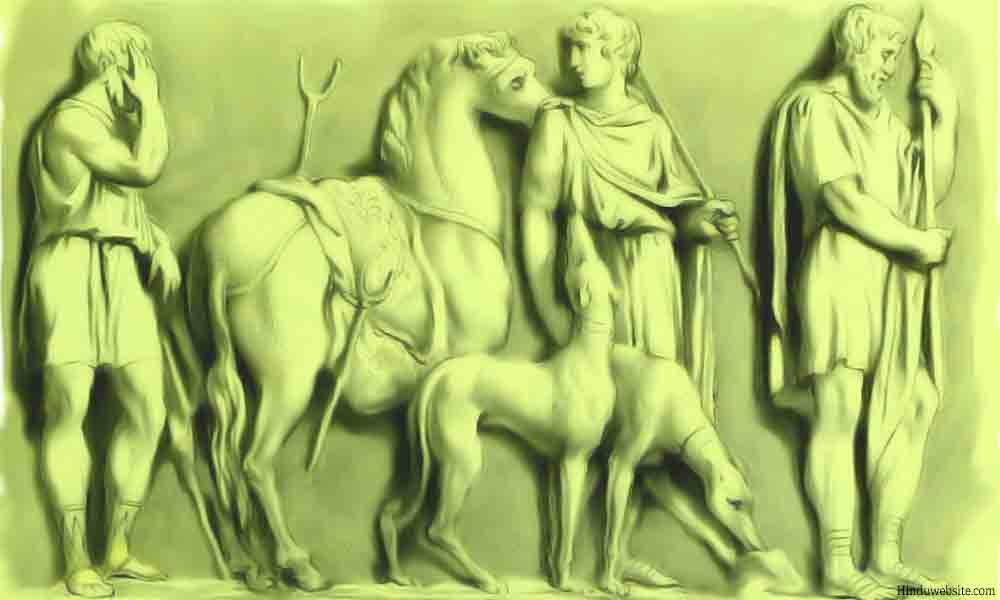
Arrian's works is significant because he quotes extensively from the Indica or Indika, the work of Megasthanese, who was a Greek ambassador in the court of Chandragupta Maurya, who according to some Greek historians, had a brief encounter with Alexander before he defeated the Nandas and became the ruler of Magadha. Megasthanese stayed in India for several years and recorded his personal observations and experiences in the form of a book. Unfortunately the original work of Megasthanese was lost and is currently available only in the form of extracts and quotes from the works of other historians such as Arrian.
Due credit must be given to Arrian, who unlike Herodotus, writes about the Indian subcontinent in greater detail and from more authentic sources like the Indica. Most of it is about Alexander's conquests, interspersed with graphic, (and imaginary) descriptions of ancient India and some very detailed descriptions of how people lived..
Megasthanese describes that there were seven castes in ancient India, wisemen performed sacrifices and practiced prophecy to predict natural calamities and bigger events, farmers were left to themselves even during wars and that elephants were often given as gifts to women to seek sexual favor. The country was crisscrossed with great rivers and dotted with great cities. Soldiers lived lavishly when they were not fighting and people lived frugal but decent lives. Indian archers were dreaded because their arrows coudl pierce through toughest armor.
However, as you will notice, much of what is written here is based on indirect references and Arrian's comments that Dionysius and Heracles ruled India and introduced civilization to the country is fiction at the best. However, the description of the animals, how they are caught and tamed, how the wise men conduct themselves, and information regarding the social classes and how people lived are greatly interesting and informative. Probably, from this perspective, this works is more valuable than many Puranas and other ancient literary sources we know. - Jayaram V
ANABASIS ALEXANDRI: BOOK VIII (INDICA)
I. ALL the territory that lies west of the river Indus up to the river Cophen is inhabited by Astacenians and Assacenians, Indian tribes. But they are not, like the Indians dwelling within the river Indus, tall of stature, nor similarly brave in spirit, nor as black as the greater part of the Indians. These long ago were subject to the Assyrians; then to the Medes, and so they became subject to the Persians; and they paid tribute to Cyrus son of Cambyses from their territory, as Cyrus commanded. The Nysaeans are not an Indian race; but part of those who came with Dionysus to India; possibly even of those Greeks who became past service in the wars which Dionysus waged with Indians; possibly also volunteers of the neighbouring tribes whom Dionysus settled there together with the Greeks, calling the country Nysaea from the mountain Nysa, and the city itself Nysa. And the mountain near the city, on whose foothills Nysa is built, is called Merus because of the incident at Dionysus' birth. All this the poets sang about Dionysus; and I leave it to the narrators of Greek or Eastern history to recount them. Among the Assacenians is Massaca, a great city, where resides the chief authority of the Assacian land; and another city Peucela, this also a great city, not far from the Indus. These places then are inhabited on this side of the Indus towards the west, as far as the river Cophen.
II. But the parts from the Indus eastward, these I shall call India, and its inhabitants Indians. The boundary of the land of India towards the north is Mount Taurus. It is not still called Taurus in this land; but Taurus begins from the sea over against Pamphylia and Lycia and Cilicia; and reaches as far as the Eastern Ocean, running right across Asia. But the mountain has different names in different places; in one, Parapamisus, in another Hemodus; elsewhere it is called Imaon, and perhaps has all sorts of other names; but the Macedonians who fought with Alexander called it Caucasus; another Caucasus, that is, not the Scythian; so that the story ran that Alexander came even to the far side of the Caucasus. The western part of India is bounded by the river Indus right down to the ocean, where the river runs out by two mouths, not joined together as are the five mouths of the Ister; but like those of the Nile, by which the Egyptian delta is formed; thus also the Indian delta is formed by the river Indus, not less than the Egyptian; and this in the Indian tongue is called Pattala. Towards the south this ocean bounds the land of India, and eastward the sea itself is the boundary. The southern part near Pattala and the mouths of the Indus were surveyed by Alexander and Macedonians, and many Greeks; as for the eastern part, Alexander did not traverse this beyond the river Hyphasis. A few historians have described the parts which are this side of the Ganges and where are the mouths of the Ganges and the city of Palimbothra, the greatest Indian city on the Ganges.
III. I hope I may be allowed to regard Eratosthenes of Cyrene as worthy of special credit, since he was a student of Geography. He states that beginning with Mount Taurus, where are the springs of the river Indus, along the Indus to the Ocean, and to the mouths of the Indus, the side of India is thirteen thousand stades in length. The opposite side to this one, that from the same mountain to the Eastern Ocean, he does not reckon as merely equal to the former side, since it has a promontory running well into the sea; the promontory stretching to about three thousand stades. So then he would make this side of India, to the eastward, a total length of sixteen thousand stades. This he gives, then, as the breadth of India. Its length, however, from west to east, up to the city of Palimbothra, he states that he gives as measured by reed-measurements; for there is a royal road; and this extends to ten thousand stades; beyond that, the information is not so certain. Those, however, who have followed common talk say that including the promontory, which runs into the sea, India extends over about ten thousand stades; but farther north its length is about twenty thousand stades. But Ctesias of Cnidus affirms that the land of India is equal in size to the rest of Asia, which is absurd; and Onesicritus is absurd, who says that India is a third of the entire world; Nearchus, for his part, states that the journey through the actual plain of India is a four months' journey. Megasthenes would have the breadth of India that from east to west which others call its length; and he says that it is of sixteen thousand stades, at its shortest stretch. From north to south, then, becomes for him its length, and it extends twenty-two thousand three hundred stades, to its narrowest point. The Indian rivers are greater than any others in Asia; greatest are the Ganges and the Indus, whence the land gets its name; each of these is greater than the Nile of Egypt and the Scythian Ister, even were these put together; my own idea is that even the Acesines is greater than the Ister and the Nile, where the Acesines having taken in the Hydaspes, Hydraotes, and Hyphasis, runs into the Indus, so that its breadth there becomes thirty stades. Possibly also other greater rivers run through the land of India.
IV. As for the yonder side of the Hyphasis, I cannot speak with confidence, since Alexander did not proceed beyond the Hyphasis. But of these two greatest rivers, the Ganges and the Indus, Megasthenes wrote that the Ganges is much greater than the Indus, and so do all others who mention the Ganges; for (they say) the Ganges is already large as it comes from its springs, and receives as tributaries the river Cainas and the Erannoboas and the Cossoanus, all navigable; also the river Sonus and the Sittocatis and the Solomatis, these likewise navigable. Then besides there are the Condochates and the Sambus and Magon and Agoranis and Omalis; and also there run into it the Commenases, a great river, and the Cacuthis and Andomatis, flowing from the Indian tribe of the Mandiadinae; after them the Amystis by the city Catadupas, and the Oxymagis at the place called Pazalae, and the Errenysis among the Mathae, an Indian tribe, also meet the Ganges. Megasthenes says that of these none is inferior to the Maeander, where the Maeander is navigable. The breath therefore of the Ganges, where it is at its narrowest, runs to a hundred stades; often it spreads into lakes, so that the opposite side cannot be seen, where it is low and has no projections of hills. It is the same with the Indus; the Hydraotes, in the territory of the Cambistholians, receives the Hyphasis in that of the Astrybae, and the Saranges from the Cecians, and the Neydrus from the Attacenians, and flows, with these, into the Acesines. The Hydaspes also among the Oxydracae receives the Sinarus among the Arispae and it too flows out into the Acesines. The Acesines among the Mallians joins the Indus; and the Tutapus, a large river, flows into the Acesines. All these rivers swell the Acesines, and proudly retaining its own name it flows into the Indus. The Cophen, in the Peucelaetis, taking with it the Malantus, the Soastus, and the Garroeas, joins the Indus. Above these the Parenus and Saparnus, not far from one another, flow into the Indus. The Soanus, from the mountains of the Abissareans, without any tributary, flows into it. Most of these Megasthenes reports to be navigable. It should not then be incredible that neither Nile nor Ister can be even compared with Indus or Ganges in volume of water. For we know of no tributary to the Nile; rather from it canals have been cut through the land of Egypt. As for the Ister, it emerges from its springs a meagre stream, but receives many tributaries; yet not equal in number to the Indian tributaries which flow into Indus or Ganges; and very few of these are navigable; I myself have only noticed the Enus and the Saus. The Enus on the line between Norica and Rhaetia joins the Ister, the Saus in Paeonia. The country where the rivers join is called Taurunus. If anybody is aware of other navigable rivers which form tributaries to the Ister, he certainly does not know many.
V. I hope that anyone who desires to explain the cause of the number and size of the Indian rivers will do so; and that my remarks may be regarded as set down on hearsay only. For Megasthenes has recorded names of many other rivers, which beyond the Ganges and the Indus run into the eastern and southern outer ocean; so that he states the number of Indian rivers in all to be fifty-eight, and these all navigable. But not even Megasthenes, so far as I can see, travelled over any large part of India; yet a good deal more than the followers of Alexander son of Philip did. For he states that he met Sandracottus, the greatest of the Indian kings, and Porus, even greater than he was. This Megasthenes says, moreover, that the Indians waged war on no men, nor other men on the Indians, but on the other hand that Sesostris the Egyptian, after subduing the most part of Asia, and after invading Europe with an army, yet returned back; and Indathyrsis the Scythian who started from Scythia subdued many tribes of Asia, and invaded Egypt victoriously; but Semiramis the Assyrian queen tried to invade India, but died before she could carry out her purposes; it was in fact Alexander only who actually invaded India. Before Alexander, too, there is a considerable tradition about Dionysus as having also invaded India, and having subdued the Indians; about Heracles there is not much tradition. As for Dionysus, the city of Nysa is no mean memorial of his expedition, and also Mount Merus, and the growth of ivy on this mountain then the habit of the Indians themselves setting out to battle with the sound of drums and cymbals; and their dappled costume, like that worn by the bacchanals, of Dionysus. But of Heracles the memorials are slight. Yet the story of the rock Aornos, which Alexander forced, namely, that Heracles could not capture it, I am inclined to think a Macedonian boast; just as the Macedonians called Parapamisus by the name of Caucasus, though it has nothing to do with Caucasus. And besides, learning that there was a cave among the Parapamisadae, they said that this was the cave of Prometheus the Titan, in which he was crucified for his theft of the fire. Among the Sibae, too, an Indian tribe, having noticed them clad with skins they used to assert that they were relics of Heracles' expedition. What is more, as the Sibae carried a club, and they brand their cattle with a club, they referred this too to some memory of Heracles' club. If anyone believes this, at least it must be some other Heracles, not he of Thebes, but either of Tyre or of Egypt, or some great king of the higher inhabited country near India.
VI. This then must be regarded as a digression, so that too much credence may not be given to the stories which certain persons have related about the Indians beyond the Hyphasis; for those who served under Alexander are reasonably trustworthy up to the Hyphasis. For Megasthenes tells us this also about an Indian river; its name is Silas, it flows from a spring of the same name as the river through the territory of the Sileans, the people also named both from river and spring; its water has the following peculiarity; nothing is supported by it, nothing can swim in it or float upon it, but everything goes straight to the bottom; so far is this water thinner and more aery than any other. In the summer there is rain through India; especially on the mountains, Parapamisus and Hemodus and the Imaus, and from them the rivers run great and turbulent. The plains of India also receive rain in summer, and much part of them becomes swamp; in fact Alexander's army retired from the river Acesines in midsummer, when the river had overflowed on to the plains; from these, therefore, one can gauge the flooding of the Nile, since probably the mountains of Ethiopia receive rain in summer, and from them the Nile is swollen and overflows its banks on to the land of Egypt the Nile therefore also runs turbid this time of the year, as it probably would not be from melting snow; nor yet if its stream was dammed up by the seasonal winds which blow during the summer; and besides, the mountains of Ethiopia are probably not snowcovered, on account of the heat. But that they receive rain as India does is not outside the bounds of probability; since in other respects India is not unlike Ethiopia, and the Indian rivers have crocodiles like the Ethiopian and Egyptian Nile; and some of the Indian rivers have fish and other large water animals like those of the Nile, save the river-horse: though Onesicritus states that they do have the river-horse also. The appearance of the inhabitants, too, is not so far different in India and Ethiopia; the southern Indians resemble the Ethiopians a good deal, and, are black of countenance, and their hair black also, only they are not as snub-nosed or so woolly-haired as the Ethiopians; but the northern Indians are most like the Egyptians in appearance.
VII. Megasthenes states that there are one hundred and eighteen Indian tribes. That there are many, I agree with Megasthenes; but I cannot conjecture how he learnt and recorded the exact number, when he never visited any great part of India, and since these different races have not much intercourse one with another. The Indians, he says, were originally nomads, as are the non-agricultural Scythians, who wandering in their waggons inhabit now one and now another part of Scythia; not dwelling in cities and not reverencing any temples of the gods; just so the Indians also had no cities and built no temples; but were clothed with the skins of animals slain in the chase, and for food ate the bark of trees; these trees were called in the Indian tongue Tala, and there grew upon them, just as on the tops of palm trees, what look like clews of wool. They also used as food what game they had captured, eating it raw, before, at least, Dionysus came into India. But when Dionysus had come, and become master of India, he founded cities, and gave laws for these cities, and became to the Indians the bestower of wine, as to the Greeks, and taught them to sow their land, giving them seed. It may be that Triptolemus, when he was sent out by Demeter to sow the entire earth, did not come this way; or perhaps before Triptolemus this Dionysus whoever he was came to India and gave the Indians seeds of domesticated plants; then Dionysus first yoked oxen to the plough and made most of the Indians agriculturists instead of wanderers, and armed them also with the arms of warfare. Further, Dionysus taught them to reverence other gods, but especially, of course, himself, with clashings of cymbals and beating of drums and dancing in the Satyric fashion, the dance called among Greeks the 'cordax'; and taught them to wear long hair in honour of the god, and instructed them in the wearing of the conical cap and the anointings with perfumes; so that the Indians came out even against Alexander to battle with the sound of cymbals and drums.
VIII. When departing from India, after making all these arrangements, he made Spatembas king of the land, one of his Companions, being most expert in Bacchic rites; when Spatembas died, Budyas his son reigned in his stead; the father was King of India fifty-two years, and the son twenty years; and his son, again, came to the throne, one Cradeuas; and his descendants for the most part received the kingdom in succession, son succeeding father; if the succession failed, then the kings were appointed for some pre-eminence. But Heracles, whom tradition states to have arrived as far as India, was called by the Indians themselves 'Indigenous.' This Heracles was chiefly honoured by the Surasenians, an Indian tribe, among whom are two great cities, Methora and Cleisobora, and the navigable river Iobares flows through their territory. Megasthenes also says that the garb which this Heracles wore was like that of the Theban Heracles, as also the Indians themselves record; he also had many sons in his country, for this Heracles too wedded many wives; he had only one daughter, called Pandaea; as also the country in which she was born, and to rule which Heracles educated her, was called Pandaea after the girl; here she possessed five hundred elephants given by her father, four thousand horsemen, and as many as a hundred and thirty thousand foot-soldiers. This also some writers relate about Heracles; he traversed all the earth and sea, and when he had rid the earth of evil monsters he found in the sea a jewel much affected by women. And thus, even to our day, those who bring exports from India to our country purchase these jewels at great price and export them, and all Greeks in old time, and Romans now who are rich and prosperous, are more eager to buy the sea pearl, as it is called in the Indian tongue for that Heracles, the jewel appearing to him charming, collected from all the sea to India this kind of pearl, to adorn his daughter. And Megasthenes says that this oyster is taken with nets; that it is a native of the sea, many oysters being together, like bees; and that the pearl oysters have a king or queen, as bees do. Should anyone by chance capture the king, he can easily surround the rest of the oysters; but should the king slip through, then the others cannot be taken; and of those that are taken, the Indians let their flesh rot, but use the skeleton as an ornament. For among the Indians this pearl sometimes is worth three times its weight in solid gold, which is itself dug up in India.
IX. In this country where Heracles' daughter was queen, the girls are marriageable at seven years, and the men do not live longer than forty years. About this there is a story among the Indians, that Heracles, to whom when in mature years this daughter was born, realizing that his own end was near, and knowing of no worthy husband to whom he might bestow his daughter, himself became her husband when she was seven, so that Indian kings, their children, were left behind. Heracles made her then marriageable, and hence all the royal race of Pandaea arose, with the same privilege from Heracles. But I think, even if Heracles was able to accomplish anything so absurd, he could have lengthened his own life, so as to mate with the girl when of maturer years. But really if this about the age of the girls in this district is true, it seems to me to tend the same way as the men's age, since the oldest of them die at forty years. For when old age comes on so much sooner and death with age, maturity will reasonably be earlier, in proportion to the end; so that at thirty the men might be on the threshold of old age, and at twenty, men in their prime, and manhood at about fifteen, so that the women might reasonably be marriageable at seven. For that the fruits ripen earlier in this country than elsewhere, and perish earlier, this Megasthenes himself tells us. From Dionysus to Sandracottus the Indians counted a hundred and fifty-three kings, over six thousand and forty-two years, and during this time thrice [Movements were made] for liberty . . . this for three hundred years; the other for a hundred and twenty years; the Indians say that Dionysus was fifteen generations earlier than Heracles; but no one else ever invaded India, not even Cyrus son of Cambyses, though he made an expedition against the Scythians, and in all other ways was the most energetic of the kings in Asia; but Alexander came and conquered by force of arms all the countries he entered; and would have conquered the whole world had his army been willing. But no Indian ever went outside his own country on a warlike expedition, so righteous were they.
X. This also is related; that Indians do not put up memorials to the dead; but they regard their virtues as sufficient memorials for the departed, and the songs which they sing at their funerals. As for the cities of India, one could not record their number accurately by reason of their multitude; but those of them which are near rivers or near the sea, they build of wood; for if they were built of brick, they could not last long because of the rain, and also because their rivers overflow their banks and fill the plains with water. But such cities as are built on high and lofty places, they make of brick and clay. The greatest of the Indian cities is called Palimbothra, in the district of the Prasians, at the confluence of the Erannoboas and the Ganges; the Ganges, greatest of all rivers; the Erannoboas may be the third of the Indian rivers, itself greater than the rivers of other countries; but it yields precedence to the Ganges, when it pours into it its tributary stream. And Megasthenes says that the length of the city along either side, where it is longest, reaches to eighty stades its breadth to fifteen; and a ditch has been dug round the city, six plethra in breadth, thirty cubits high; and on the wall are five hundred and seventy towers, and sixty-four gates. This also is remarkable in India, that all Indians are free, and no Indian at all is a slave. In this the Indians agree with the Lacedaemonians. Yet the Lacedaemonians have Helots for slaves, who perform the duties of slaves; but the Indians have no slaves at all, much less is any Indian a slave.
XI. The Indians generally are divided into seven castes. Those called the wise men are less in number than the rest, but chiefest in honour and regard. For they are under no necessity to do any bodily labour; nor to contribute from the results of their work to the common store; in fact, no sort of constraint whatever rests upon these wise men, save to offer the sacrifices to the gods on behalf of the people of India. Then whenever anyone sacrifices privately, one of these wise men acts as instructor of the sacrifice, since otherwise the sacrifice would not have proved acceptable to the gods. These Indians also are alone expert in prophecy, and none, save one of the wise men, is allowed to prophesy. And they prophesy about the seasons of the year, or of any impending public calamity: but they do not trouble to prophesy on private matters to individuals, either because their prophecy does not condescend to smaller things, or because it is undignified for them to trouble about such things. And when one has thrice made an error in his prophecy, he does not suffer any harm, except that he must for ever hold his peace; and no one will ever persuade such a one to prophesy on whom this silence has been enjoined. These wise men spend their time naked, during the winter in the open air and sunshine, but in summer, when the sun is strong, in the meadows and the marsh lands under great trees; their shade Nearchus computes to reach five plethra all round, and ten thousand men could take shade under one tree; so great are these trees. They eat fruits in their season, and the bark of the trees; this is sweet and nutritious as much as are the dates of the palm. Then next to these come the farmers, these being the most numerous class of Indians; they have no use for warlike arms or warlike deeds, but they till the land; and they pay the taxes to the kings and to the cities, such as are self-governing; and if there is internal war among the Indians, they may not touch these workers, and not even devastate the land itself; but some are making war and slaying all comers, and others close by are peacefully ploughing or gathering the fruits or shaking down apples or harvesting. The third class of Indians are the herdsmen, pasturers of sheep and cattle, and these dwell neither by cities nor in the villages. They are nomads and get their living on the hillsides, and they pay taxes from their animals; they hunt also birds and wild game in the country.
XII The fourth class is of artisans and shopkeepers; these are workers, and pay tribute from their works, save such as make weapons of war; these are paid by the community. In this class are the shipwrights and sailors, who navigate the rivers. The fifth class of Indians is the soldiers' class, next after the farmers in number; these have the greatest freedom and the most spirit. They practise military pursuits only. Their weapons others forge for them, and again others provide horses; others too serve in the camps, those who groom their horses and polish their weapons, guide the elephants, and keep in order and drive the chariots. They themselves, when there is need of war, go to war, but in time of peace they make merry; and they receive so much pay from the community that they can easily from their pay support others. The sixth class of Indians are those called overlookers. They oversee everything that goes on in the country or in the cities; and this they report to the King, where the Indians are governed by kings, or to the authorities, where they are independent. To these it is illegal to make any false report; nor was any Indian ever accused of such falsification. The seventh class is those who deliberate abbut the community together with the King, or, in such cities as are self-governing, with the authorities. In number this class is small, but in wisdom and uprightness it bears the palm from all others; from this class are selected their governors, district governors, and deputies, custodians of the treasures, officers of army and navy, financial officers, and overseers of agricultural works. To marry out of any class is unlawful -- as, for instance, into the farmer class from the artisans, or the other way; nor must the same man practise two pursuits; nor change from one class into another, as to turn farmer from shepherd, or shepherd from artisan. It is only permitted to join the wise men out of any class; for their business is not an easy one, but of all most laborious.
XIII. Most wild animals which the Greeks hunt the Indians hunt also, but these have a way of hunting elephants unlike all other kinds of hunting, just as these animals are unlike other animals. It is this they choose a place that is level and open to the sun's heat, and dig a ditch in a circle, wide enough for a great army to camp within it. They dig the ditch five fathoms broad, and four deep. The earth which they throw out of the ditch they heap on either side of the ditch, and so use it as a wall; then they make shelters for themselves, dug out of the wall on the outside of the ditch, and leave small windows in them; through these the light comes in, and also they watch the animals coming in and charging into the enclosure. Then within the enclosure they leave some three or four of the females, those that are tamest, and leave only one entrance by the ditch, making a bridge over it; and here they heap much earth and grass so that the animals cannot distinguish the bridge, and so suspect any guile. The hunters then keep themselves out of the way, hiding under the shelters dug in the ditch. Now the wild elephants do not approach inhabited places by daylight, but at night they wander all about and feed in herds, following the largest and finest of their number, as cows do the bulls. And when they approach the ditch and hear the trumpeting of the females and perceive them by their scent, they rush to the walled enclosure; and when, working round the outside edge of the ditch, they find the bridge, they push across it into the enclosure. Then the hunters, perceiving the entry of the wild elephants, some smartly remove the bridge, others hurrying to the neighboring villages report that the elephants are caught in the enclosure; and the inhabitants on hearing the news mount the most spirited, and at the same time most disciplined elephants, and then drive them towards the enclosure, and when they have driven them thither they do not at once join battle, but allow the wild elephants to grow distressed by hunger and to be tamed by thirst. But when they think they are sufficiently distressed, then they erect the bridge again, and enter the enclosure; and at first there is a fierce battle between the tamed elephants and the captives, and then, as one would expect, the wild elephants are tamed, distressed as they are by a sinking of their spirits and by hunger. Then the riders dismounting from the tamed elephants tie together the feet of the now languid wild ones; then they order the tamed elephants to punish the rest by repeated blows, till in their distress they fall to earth; then they come near them and throw nooses round their necks; and climb on them as they lie there. And that they may not toss their drivers nor do them any injury, they make an incision in their necks with a sharp knife, all round, and bind their noose round the wound, so that by reason of the sore they keep their heads and necks still. For were they to turn round to do mischief, the wound beneath the rope chafes them. And so they keep quiet, and perceiving that they are conquered, they are led of by the tamed elephants by the rope.
XIV. Such elephants as are not yet full grown or from some defect are not worth the acquiring, they allow to depart to their own laim, Then they lead of their captives to the villages and first of all give them green shoots and grass to eat; but they, from want of heart, are not willing to eat anything; so the Indians range themselves about them and with songs and drums and cymbals, beating and singing, lull them to sleep. For if there is an intelligent animal, it is the elephant. Some of them have been known, when their drivers have perished in battle, to have caught them up and carried them to burial; others have stood over them and protected them. Others, when they have fallen, have actively fought for them; one, indeed, who in a passion slew his driver, died from remorse and grief. I myself have seen an elephant clanging the cymbals, and others dancing; two cymbals were fastened to the player's forelegs, and one on his trunk, and he rhythmically beat with his trunk the cymbal on either leg in turn; the dancers danced in circle, and raising and bending their forelegs in turn moved also rhythmically, as the player with the cymbals marked the time for them. The elephants mate in spring, as do oxen and horses, when certain pores about the temples of the females open and exhale; the female bears its offispring sixteen months at the least, eighteen at most; it has one foal, as does a mare; and this it suckles till its eighth year. The longest-lived elephants survive to two hundred years; but many die before that by disease; but as far as mere age goes, they reach this age. If their eyes are affected, cow's milk injected cures them; for their other sicknesses a draught of dark wine, and for their wounds swine's flesh roast, and laid on the spot, are good. These are the Indian remedies for them.
XV. The Indians regard the tiger as much stronger than the elephant. Nearchus writes that he had seen a tiger's skin, but no tiger; the Indians record that the tiger is in size as great as the largest horse, and its swiftness and strength without parallel, for a tiger, when it meets an elephant, leaps on to the head and easily throttles it. Those, however, which we see and call tigers are dappled jackals, but larger than ordinary jackals. Nay, about ants also Nearchus says that he himself saw no ant, of the sort which some writers have described as native of India; he saw, however, several of their skins brought into the Macedonian camp. Megasthenes, however confirms the accounts given about these ants; that ants do dig up gold, not indeed for the gold, but as they naturally burrow, that they may make holes, just as our small ants excavate a small amount of earth; but these, which are bigger than foxes, dig up earth also proportionate to their size; the earth is auriferous, and thus the Indians get their gold. Megasthenes, however, merely quotes hearsay, and as I have no certainty to write on the subject, I readily dismiss this subject of ants. But Nearchus describes, as something miraculous, parrots, as being found in India, and describes the parrot, and how it utters a human voice. But I having seen several, and knowing others acquainted with this bird, shall not dilate on them as anything remarkable; nor yet upon the size of the apes, nor the beauty of some Indian apes, and the method of capture. For I should only say what everyone knows, except perhaps that apes are anywhere beautiful. And further Nearchus says that snakes are hunted there, dappled and swift; and that which he states Peithon son of Antigenes to have caught, was upwards of sixteen cubits; but the Indians (he proceeds) state that the largest snakes are much larger than this. No Greek physicians have discovered a remedy against Indian snake-bite; but the Indians themselves used to cure those who were struck. And Nearchus adds that Alexander had gathered about him Indians very skilled in physic, and orders were sent round the camp that anyone bitten by a snake was to report at the royal pavilion. But there are not many illnesses in India, since the seasons are more temperate than with us. If anyone is seriously ill, they would inform their wise men, and they were thought to use the divine help to cure what could be cured.
XVI. The Indians wear linen garments, as Nearchus says, the linen coming from the trees of which I have already made mention. This linen is either brighter than the whiteness of other linen, or the people's own blackness makes it appear unusually bright. They have a linen tunic to the middle of the calf, and for outer garments, one thrown round about their shoulders, and one wound round their heads. They wear ivory ear-rings, that is, the rich Indians; the common people do not use them. Nearchus writes that they dye their beards various colours; some therefore have these as white-looking as possible, others dark, others crimson, others purple, others grass-green. The more dignified Indians use sunshades against the summer heat. They have slippers of white skin, and these too made neatly; and the soles of their sandals are of different colours, and also high, so that the wearers seem taller. Indian war equipment differs; the infantry have a bow, of the height of the owner; this they poise on the ground, and set their left foot against it, and shoot thus; drawing the bowstring a very long way back; for their arrows are little short of three cubits, and nothing can stand against an arrow shot by an Indian archer, neither shield nor breastplate nor any strong armour. In their left hands they carry small shields of untanned hide, narrower than their bearers, but not much shorter. Some have javelins in place of bows. All carry a broad scimitar, its length not under three cubits; and this, when they have a hand-to-hand fight -- and Indians do not readily fight so among themselves -- they bring down with both hands in smiting, so that the stroke may be an effective one. Their horsemen have two javelins, like lances, and a small shield smaller than the infantry's. The horses have no saddles, nor do they use Greek bits nor any like the Celtic bits, but round the end of the horses' mouths they have an untanned stitched rein fitted; in this they have fitted, on the inner side, bronze or iron spikes, but rather blunted; the rich people have ivory spikes; within the mouth of the horses is a bit, like a spit, to either end of which the reins are attached. Then when they tighten the reins this bit masters the horse, and the spikes, being attached thereto, prick the horse and compel it to obey the rein.
XVII. The Indians in shape are thin and tall and much lighter in movement than the rest of mankind. They usually ride on camels, horses, and asses; the richer men on elephants. For the elephant in India is a royal mount; then next in dignity is a four-horse chariot, and camels come third; to ride on a single horse is low. Their women, such as are of great modesty, can be seduced by no other gift, but yield themselves to anyone who gives an elephant; and the Indians think it no disgrace to yield thus on the gift of an elephant, but rather it seems honourable for a woman that her beauty should be valued at an elephant. They marry neither giving anything nor receiving anything; such girls as are marriageable their fathers bring out and allow anyone who proves victorious in wrestling or boxing or running or shows pre-eminence in any other manly pursuit to choose among them. The Indians eat meal and till the ground, except the mountaineers; but these eat the flesh of game. This must be enough for a description of the Indians, being the most notable things which Nearchus and Megasthenes, men of credit, have recorded about them. But as the main subject of this my history was not to write an account of the Indian customs but the way in which Alexander's navy reached Persia from India, this must all be accounted a digression.
XVIII. For Alexander, when his fleet was made ready on the banks of the Hydaspes, collected together all the Phoenicians and all the Cyprians and Egyptians who had followed the northern expedition. From these he manned his ships, picking out as crews and rowers for them any who were skilled in seafaring. There were also a good many islanders in the army, who understood these things, and Ionians and Hellespontines. As commanders of triremes were appointed, from the Macedonians, Hephaestion son of Amyntor, and Leonnatus son of Eunous, Lysimachus son of Agathocles, and Asclepiodorus son of Timander, and Archon son of Cleinias, and Demonicus son of Athenaeus, Archias son of Anaxidotus, Ophellas son of Seilenus, Timanthes son of Pantiades; all these were of Pella. From Amphipolis these were appointed officers: Nearchus son of Androtimus, who wrote the account of the voyage; and Laomedon son of Larichus, and Androsthenes son of Callistratus; and from Orestis. Craterus son of Alexander, and Perdiccas son of Orontes. Of Eordaea, Ptolemaeus son of Lagos and Aristonous son of Peisaeus; from Pydna, Metron son of Epicharmus and Nicarchides son of Simus. Then besides, Attalus son of Andromenes, of Stympha Peucestas son of Alexander, from Mieza; Peithon son of Crateuas, of Alcomenae; Leonnatus son of Antipater, of Aegae; Pantauchus son of Nicolaus, of Aloris; Mylleas son of Zoilus, of Beroea; all these being Macedonians. Of Greeks, Medius son of Oxynthemis, of Larisa; Eumenes son of Hieronymus, from Cardia; Critobulus, son of Plato, of Cos; Thoas son of Menodorus, and Maeander, son of Mandrogenes, of Magnesia; Andron son of Cabeleus, of Teos; of Cyprians, Nicocles son of Pasicrates, of Soh; and Nithaphon son of Pnytagoras, of Salamis. Alexander appointed also a Persian trierarch, Bagoas son of Pharnuces; but of Alexander's own ship the helmsman was Onesicritus of Astypalaea; and the accountant of the whole fleet was Euagoras son of Eucleon, of Corinth. As admiral was appointed Nearchus, son of Androtimus, Cretan by race, and he lived. in Amphipolis on the Strymon. And when Alexander had made all these dispositions, he sacrificed to the gods, both the gods of his race and all of whom the prophets had warned him, and to Poseidon and Amphitrite and the Nereids and to Ocean himself and to the river Hydaspes, whence he started, and to the Acesines, into which the Hydaspes runs, and to the Indus, into which both run; and he instituted contests of art and of athletics, and victims for sacrifice were given to all the army, according to their detachments.
XIX. Then when he had made all ready for starting the voyage, Alexander ordered Craterus to march by the one side of the Hydaspes with his army, cavalry and infantry alike; Hephaestion had already started along the other, with another army even bigger than that under Craterus. Hephaestion took with him the elephants, up to the number of two hundred. Alexander himself took with him all the peltasts, as they are called, and all the archers, and of the cavalry, those called 'Companions'; in all, eight thousand. But Craterus and Hephaestion, with their forces, were ordered to march ahead and await the fleet. But he sent Philip, whom he had made satrap of this country, to the banks of the river Acesines, Philip also with a considerable force; for by this time a hundred and twenty thousand men of fighting age were following him, together with those whom he himself had brought from the sea-coast; and with those also whom his officers, sent to recruit forces, had brought back; so that he now led all sorts of Oriental tribes, and armed in every sort of fashion. Then he himself loosing his ships sailed down the Hydaspes to the meeting-place of Acesines and Hydaspes. His whole fleet of ships was eighteen hundred, both ships of war and merchantmen, and horse transports besides and others bringing provisions together with the troops. And how his fleet descended the rivers, and the tribes he conquered on the descent, and how he endangered himself among the Mallians, and the wound he there received, then the way in which Peucestas and Leonnatus defended him as he lay there -- all this I have related already in my other history, written in the Attic dialect. This my present work, however, is a story of the voyage, which Nearchus successfully undertook with his fleet starting from the mouths of the Indus by the Ocean to the Persian Gulf, which some call the Red Sea.
XX. On this Nearchus writes thus: Alexander had a vehement desire to sail the sea which stretches from India to Persia; but he disliked the length of the voyage and feared lest, meeting with some country desert or without roadsteads, or not properly provided with the fruits of the earth, his whole fleet might be destroyed; and this, being no small blot on his great achievements, might wreck all his happiness; but yet his desire to do something unusual and strange won the day; still, he was in doubt whom he should choose, as equal to his designs; and also as the right man to encourage the personnel of the fleet, -- sent as they were on an expedition of this kind, so that they should not feel that they were being sent blindly to manifest dangers. And Nearchus says that Alexander discussed with him whom he should select to be admiral of this fleet; but as mention was made of one and another, and as Alexander rejected some, as not willing to risk themselves for his sake, others as chicken-hearted, others as consumed by desire for home, and finding some objection to each; then Nearchus himself spoke and pledged himself thus : '0 King, I undertake to lead your fleet! And may God help the emprise! I will bring your ships and men safe to Persia, if this sea is so much as navigable and the undertaking not above human powers.' Alexander, however, replied that he would not allow one of his friends to run such risks and endure such distress; yet Nearchus, did not slacken in his request, but besought Alexander earnestly; till at length Alexander accepted Nearchus' willing spirit, and appointed him admiral of the entire fieet, on which the part of the army which was detailed to sail on this voyage and the crews felt easier in mind, being sure that Alexander would never have exposed Nearchus to obvious danger unless they also were to come through safe. Then the splendour of the whole preparations and the smart equipment of the ships, and the outstanding enthusiasm of the commanders of the triremes about the different services and the crews had uplifted even those who a short while ago were hesitating, both to bravery and to higher hopes about the whole affair; and besides it contributed not a little to the general good spirits of the force that Alexander himself had started down the Indus and had explored both outlets, even into the Ocean, and had offered victims to Poseidon, and all the other sea gods, and gave splendid gifts to the sea. Then trusting as they did in Alexander's generally remarkable good fortune, they felt that there was nothing that he might not dare, and nothing that he could not carry through.
XXI. Now when the trade winds had sunk to rest, which continue blowing from the Ocean to the land all the summer season, and hence render the voyage impossible, they put to sea, in the archonship at Athens of Cephisodorus, on the twentieth day of the month Boedromion, as the Athenians reckon it; but as the Macedonians and Asians counted it, it was ... the eleventh year of Alexander's reign. Nearchus also sacrificed, before weighing anchor, to Zeus the Saviour, and he too held an athletic contest. Then moving out from their roadstead, they anchored on the first day in the Indus river near a great canal, and remained there two days; the district was called Stura; it was about a hundred stades from the roadstead. Then on the third day they started forthand sailed to another canal, thirty stades' distance, and this canal was already-salt; for the sea came up into it, especially at full tides, and then at the ebb the water remained there, mingled with the river water. This place was called Caumara. Thence they sailed twenty stades and anchored at Coreestis, still on the river. Thence they started again and sailed not so very far, for they saw a reef at this outlet of the river Indus, and the waves were breaking violently on the shore, and the shore itself was very rough. But where there was a softer part of the reef, they dug a channel, five stades long, and brought the ships down it, when the flood tide came up from the sea. Then sailing round, to a distance of a hundred and fifty stades, they anchored at a sandy island called Crocala, and stayed there through the next day; and there lives here an Indian race called Arabeans, of whom I made mention in my larger history; and that they have their name from the river Arabis, which runs through their country and finds its outlet in the sea, forming the boundary between this country and that of the Oreitans. From Crocala, keeping on the right hand the hill they call Irus, they sailed on, with a low-lying island on their left; and the island running parallel with the shore makes a narrow bay. Then when they had sailed through this, they anchored in a harbour with good anchorage; and as Ne'archus considered the harbour a large and fine one, he called it Alexander's Haven. At the heads of the harbour there lies an island, about two stades away, called Bibacta; the neighbouring region, however, is called Sangada. This island, forming a barrier to the sea, of itself makes a harbour. There constant strong winds were blowing off the ocean. Nearchus therefore, fearing lest some of the natives might collect to plunder the camp, surrounded the place with a stone wall. He stayed there thirty-three days; and through that time, he says, the soldiers hunted for mussels, oysters, and razor-fish, as they are called; they were all of unusual size. much larger than those of our seas. They also drank briny water.
XXII. On the wind falling, they weighed anchor; and after sailing sixty stades they moored off a sandy shore; there was a desert island near the shore. They used this, therefore, as a breakwater and moored there: the island was called Domai. On the shore there was no water, but after advancing some twenty stades inland they found good water. Next day they sailed up to nightfall to Saranga, some three hundred stades, and moored off the beach, and water was found about eight stades from the beach. Thence they sailed and moored at Sacala, a desert spot. Then making their way through two rocks, so close together that the oar-blades of the ships touched the rocks to port and starboard, they moored at Morontobara, after sailing some three hundred stades. The harbour is spacious, circular, deep, and calm, but its entrance is narrow. They called it, in the natives' language, 'The Ladies' Pool,' since a lady was the first sovereign of this district. When they had got safe through the rocks, they met great waves, and the sea running strong; and moreover it seemed very hazardous to sail seaward of the cliffs. For the next day, however, they sailed with an island on their port beam, so as to break the sea, so close indeed to the beach that one would have conjectured that it was a channel cut between the island and the coast. The entire passage was of some seventy stades. On the beach were many thick trees, and the island was wholly covered with shady forest. About dawn, they sailed outside the island, by a narrow and turbulent passage; for the tide was still falling. And when they had sailed some hundred and twenty stades they anchored in the mouth of the river Arabis. There was a fine large harbour by its mouth; but there was no drinking water; for the mouths of the Arabis were mixed with sea-water. However, after penetrating forty stades inland they found a water-hole, and after drawing water thence they returned back again. By the harbour was a high island, desert, and round it one could get oysters and all kinds of fish. Up to this the country of the Arabeans extends; they are the last Indians settled in this direction; from here on the territory, of the Oreitans begins.
XXIII. Leaving the outlets of the Arabis they coasted along the territory of the Oreitans, and anchored at Pagala, after a voyage of two hundred stades, near a breaking sea; but they were able all the same to cast anchor. The crews rode out the seas in their vessels, though a few went in seach of water, and procured it. Next day they sailed at dawn, and after making four hundred and thirty stades they put in towards evening at Cabana, and moored on a desert shore. There too was a heavy surf, and so they anchored their vessels well out to sea. It was on this part of the voyage that a heavy squall from seaward caught the fleet, and two warships were lost on the passage, and one galley; the men swam off and got to safety, as they were sailing quite near the land. But about midnight they weighed anchor and sailed as far as Cocala, which was about two hundred stades from the beach off which they had anchored. The ships kept the open sea and anchored, but Nearchus disembarked the crews and bivouacked on shore; after all these toils and dangers in the sea, they desired to rest awhile. The camp was entrenched, to keep off the natives. Here Leonnatus, who had been in charge of operations against the Oreitans, beat in a great battle the Oreitans, along with others who had joined their enterprise. He slew some six thousand of them, including all the higher officers; of the cavalry with Leonnatus, fifteen fell, and of his infantry, among a few others, Apollophanes satrap of Gadrosia. This I have related in my other history, and also how Leonnatus was crowned by Alexander for this exploit with a golden coronet before the Macedonians. There provision of corn had been gathered ready, by Alexander's orders, to victual the host; and they took on board ten days' rations. The ships which had suffered in the passage so far they repaired; and whatever troops Nearchus thought were inclined to malinger he handed over to Leonnatus, but he himself recruited his fleet from Leonnatus' soldiery.
XXIV. Thence they set sail and progressed with a favouring wind; and after a passage of five hundred stades the anchored by a torrent, which ,was called Tomerus. There was a lagoon at the mouths of the river, and the depressions near the bank were inhabited by natives in stifling cabins. These seeing the convoy sailing up were astounded, and lining along the shore stood ready to repel any who should attempt a landing. They carried thick spears, about six cubits long; these had no iron tip, but the same result was obtained by hardening the point with fire. They were in number about six hundred. Nearchus observed these evidently standing firm and drawn up in order, and ordered the ships to hold back within range, so that their missiles might reach the shore; for the natives' spears, which looked stalwart, were good for close fighting, but had no terrors against a volley. Then Nearchus took the lightest and lightest-armed troops, such as were also the best swimmers, and bade them swim off as soon as the word was given. Their orders were that, as soon as any swimmer found bottom, he should await his mate, and not attack the natives till they had their formation three deep; but then they were to raise their battle cry and charge at the double. On the word, those detailed for this service dived from the ships into the sea, and swam smartly, and took up their formation in orderly manner, and having made a phalanx, charged, raising, for their part, their battle cry to the God of War, and those on shipboard raised the cry along with them; and arrows and missiles from the engines were hurled against the natives. They, astounded at the flash of the armour, and the swiftness of the charge, and attacked by showers of arrows and missiles, half naked as they were, never stopped to resist but gave way. Some were killed in flight; others were captured; but some escaped into the hills. Those captured were hairy, not only their heads but the rest of their bodies; their nails were rather like beasts' claws; they used their nails (according to report) as if they were iron tools; with these they tore asunder their fishes, and even the less solid kinds of wood; everything else they cleft with sharp stones; for iron they did not possess. For clothing they wore skins of animals, some even the thick skins of the larger fishes.
XXV. Here the crews beached their ships and repaired such as had suffered. On the sixth day from this they set sail, and after voyaging about three hundred stades they came to a country which was the last point in the territory of the Oreitans: the district was called Malana. Such Oreitans as live inland, away from the sea, dress as the Indians do, and equip themselves similarly for warfare; but their dialect and customs differ. The length of the coasting voyage along the territory of the Arabeis was about a thousand, stades from the point of departure; the length of the Oreitan coast sixteen hundred. As they sailed along the land of India for thence onward the natives are no longer Indians --Nearchus states that their shadows were not cast in the same way; but where they were making for the high seas and steering a southerly course, their shadows appeared to fall southerly too; but whenever the sun was at midday, then everything seemed shadowless. Then such of the stars as they had seen hitherto in the sky, some were completely hidden, others showed themselves low down towards the earth; those they had seen continually before were now observed both setting, and then at once rising again. I think this tale of Nearchus' is likely; since in Syene of Egypt, when the sun is at the summer solstice, people show a well where at midday one sees no shade; and in Meroe, at the same season, no shadows are cast. So it seems reasonable that in India too, since they are far southward, the same natural phenomena may occur, and especially in the Indian Ocean, just because it particularly runs southward. But here I must leave this subject.
XXVI. Next to the Oreitans, more inland, dwelt the Gadrosians, whose country Alexander and his army had much pains in traversing; indeed they suffered more than during all the rest of his expedition: all this I have related in my larger history. Below the Gadrosians, as you follow the actual coast, dwell the people called the Fish-eaters. The fleet sailed past their country. On the first day they unmoored about the second watch, and put in at Bagisara; a distance along the coast of about six hundred stades. There is a safe harbour there, and a village called Pasira, some sixty stades from the sea; the natives about it are called Pasireans. The next day they weighed anchor earlier than usual and sailed round a promontory which ran far seaward, and was high, and precipitous. Then they dug wells; and obtained only a little water, and that poor and for that day they rode at anchor, because there was heavy surf on the beach. Next day they put in at Colta after a voyage of two hundred stades. Thence they departed at dawn, and after voyaging six hundred stades anchored at Calyba. A village is on the shore, a few date-palms grew near it, and there were dates, still green, upon them. About a hundred stades from the beach is an island called Carnine. There the villagers brought gifts to Nearchus, sheep and fishes; the mutton, he says, had a fishy taste, like the flesh of the sea-birds, since even the sheep feed on fish; for there is no grass in the place. However, on the next day they sailed two hundred stades and moored off a beach, and a village about thirty stades from the sea; it was called Cissa, an Carbis was the name of the strip of coast. There they found a few boats, the sort which poor fishermen might use; but the fishermen themselves they did not find, for they had run away as soon as they saw the ships anchoring. There was no corn there, and the army had spent most of its store; but they caught and embarked there some goats, and so sailed away. Rounding a tall cape running some hundred and fifty stades into the sea, they put in at a calm harbour; there was water there, and fishermen dwelt near; the harbour was called Mosarna.
XXVII. Nearchus tells us that from this point a pilot sailed with them, a Gadrosian called Hydraces. He had promised to take them as far as Carmania; from thence on the navigation was not difficult, but the districts were better known, up to the Persian Gulf. From Mosarna they sailed at night, seven hundred and fifty stades, to the beach of Balomus. Thence again to Barna, a village, four hundred stades, where there were many date-palms and a garden; and in the garden grew myrtles and abundant flowers, of which wreaths were woven by the natives. There for the first time they saw garden-trees, and men dwelling there not entirely like animals. Thence they coasted a further two hundred stades and reached Dendrobosa and the ships kept the roadstead at anchor. Thence about midnight they sailed and came to a harbour Cophas, after a voyage of about four hundred stades; here dwelt fishermen, with small and feeble boats; and they did not row with their oars on a rowlock, as the Greeks do, but as you do in a river, propelling the water on this side or that like labourers digging I the soil. At the harbour was abundant pure water. About the first watch they weighed anchor and arrived at Cyiza, after a passage of eight hundred stades, where there was a desert beach and a heavy surf. Here, therefore, they anchored, and each ship took its own meal. Thence they voyaged five hundred stades and arrived at a small town built near the shore on a hill. Nearchus, who imagined that the district must be tilled, told Archias of Pella, son of Anaxidotus, who was sailing with Nearchus, and was a notable Macedonian, that they must surprise the town, since he had no hope that the natives would give the army provisions of their good-will; while he could not capture the town by force, but this would require a siege and much delay; while they in the meanwhile were short of provisions. But that the land did produce corn he could gather from the straw which they saw lying deep near the beach. When they had come to this resolve, Nearchus bade the fleet in general to get ready as if to go to sea; and Archias, in his place, made all ready for the voyage; but Nearchus himself was left behind with a single ship and went off as if to have a look at the town.
XXVIII. As Nearchus approached the walls, the natives brought him, in a friendly way, gifts from the city; tunny-fish baked in earthen pans; for there dwell the westernmost of the Fish-eating tribes, and were the first whom the Greeks had seen cooking their food; and they brought also a few cakes and dates from the palms. Nearchus said that he accepted these gratefully; and desired to visit the town, and they permitted him to enter. But as soon as he passed inside the gates, he bade two of the archers to occupy the postern, while he and two others, and the interpreter, mounted the wall on this side and signalled to Archias and his men as had been arranged: that Nearchus should signal, and Archias understand and do what had been ordered. On seeing the signal the Macedonians beached their ships with all speed; they leapt in haste into the sea, while the natives, astounded at this manoeuvre, ran to their arms. The interpreter with Nearchus cried out that they should give corn to the army, if they wanted to save their city; and the natives replied that they had none, and at the same time attacked the wall. But the archers with Nearchus shooting from above easily held them up. When, however, the natives saw that their town was already occupied and almost on the way to be enslaved, they begged Nearchus to take what corn they had and retire, but not to destroy the town. Nearchus, however, bade Archias to seize the gates and the neighbouring wall; but he sent with the natives some soldiers to see whether they would without any trick reveal their corn. They showed freely their flour, ground down from the dried fish; but only a small quantity of corn and barley. In fact they used as flour what they got from the fish; and loaves of corn flour they used as a delicacy. When, however, they had shown all they had, the Greeks provisioned themselves from what was there, and put to sea, anchoring by a headland which the inhabitants regarded as sacred to the Sun: the headland was called Bageia.
XXIX. Thence, weighing anchor about midnight, they voyaged another thousand stades to Talmena, a harbour giving good anchorage. Thence they went to Canasis, a deserted town, four hundred stades farther; here they found a well sunk; and near by were growing wild date-palms. They cut out the hearts of these and ate them; for the army had run short of food. In fact they were now really distressed by hunger, and sailed on therefore by day and night, and anchored off a desolate shore. But Nearchus, afraid that they would disembark and leave their ships from faint-heartedness, purposely kept the ships in the open roadstead. They sailed thence and anchored at Canate, after a voyage of seven hundred and fifty stades. Here there are a beach and shallow channels. Thence they sailed eight hundred stades, anchoring at Troea; there were small and poverty-stricken villages on the coast. The inhabitants deserted their huts and the Greeks found there a small quantity of corn, and dates from the palms. They slaughtered seven camels which had been left there, and ate the flesh of them. About daybreak they weighed anchor and sailed three hundred stades, and anchored at Dagaseira; there some wandering tribe dwelt. Sailing thence they sailed without stop all night andday, and after a voyage of eleven hundred stades they got past the country of the Fish-eaters, where they had been much distressed by want of food. They did not moor near shore, for there was a long line of surf, but at anchor, in the open. The length of the voyage along the coast of the Fish-eaters is a little above ten thousand stades. These Fish-eaters live on fish; and hence their name; only a few of them fish, for only a few have proper boats and have any skill in the art of catching fish; but for the most part it is the receding tide which provides their catch. Some have made nets also for this kind of fishing; most of them about two stades in length. They make the nets from the bark of the date-palm, twisting the bark like twine. And when the sea recedes and the earth is left, where the earth remains dry it has no fish, as a rule; but where there are hollows, some of the water remains, and in this a large number of fish, mostly small, but some large ones too. They throw their nets over these and so catch them. They eat them raw, just as they take them from the water, that is, the more tender kinds; the larger ones, which are tougher, they dry in the sun till they are quite sere and then pound them and make a flour and bread of them; others even make cakes of this flour. Even their flocks are fed on the fish, dried; for the country has no meadows and produces no grass. They collect also in many places crabs and oysters and shell-fish. There are natural salts in the country; from these they make oil. Those of them who inhabit the desert parts of their country, treeless as it is and with no cultivated parts, find all their sustenance in the fishing but a few of them sow part of their district, using the corn as a relish to the fish, for the fish form their bread. The richest among them have built huts; they collect the bones of any large fish which the sea casts up, and use them in place of beams. Doors they make from any flat bones which they can pick up. But the greater part of them, and the poorer sort, have huts made from the fishes' backbones.
XXX. Large whales live in the outer ocean, and fishes much larger than those in our inland sea. Nearchus states that when they left Cyiza, about daybreak they saw water being blown upwards from the sea as it might be shot upwards by the force of a waterspout. They were astonished, and asked the pilots of the convoy what it might be and how it was caused; they replied that these whales as they rove about the ocean spout up the water to a great height; the sailors, however, were so startled that the oars fell from their hands. Nearchus went and encouraged and cheered them, and whenever he sailed past any vessel, he signalled them to turn the ship's bow on towards the whales as if to give them battle; and raising their battle cry with the sound of the surge to row with rapid strokes and with a great deal of noise. So they all took heart of grace and sailed together according to signal. But when they actually were nearing the monsters, then they shouted with all the power of their throats, and the bugles blared, and the rowers made the utmost splashings with their oars. So the whales, now visible at the bows of the ships, were scared, and dived into the depths; then not long afterwards they came up astern and spouted the sea-water on high. Thereupon joyful applause welcomed this unexpected salvation, and much praise was showered on Nearchus for his courage and prudence. Some of these whales go ashore at different parts of the coast; and when the ebb comes, they are caught in the shallows; and some even were cast ashore high and dry; thus they would perish and decay, and their flesh rotting off them would leave the bones convenient to be used by the natives for their huts. Moreover, the bones in their ribs served for the larger beams for their dwellings; and the smaller for rafters; the jawbones were the doorposts, since many of these whales reached a length of five-and-twenty fathoms.
XXXI. While they were coasting along the territory of the Fish-eaters, they heard a rumour about an island,' which lies some little distance from the mainland in this direction, about a hundred stades, but is uninhabited. The natives said that it was sacred to the Sun and was called Nosala, and that no human being ever of his own will put in there; but that anyone who ignorantly touched there at once disappeared. Nearchus, however, says that one of his galleys with an Egyptian crew was lost with all hands not far from this island, and that the pilots stoutly averred about it that they had touched ignorantly on the island and so had disappeared. But Nearchus sent a thirty-oar to sail round the island, with orders not to put in, but that the crew should shout loudly, while coasting round as near as they dared; and should call on the lost helmsman by name, or any of the crew whose name they knew. As no one answered, he tells us that he himself sailed up to the island, and compelled his unwilling crew to put in; then he went ashore and exploded this island fairy-tale. They heard also another current story about this island, that one of the Nereids dwelt there; but the name of this Nereid was not told. She showed much friendliness to any sailor who approached the island; but then turned him into a fish and threw him into the sea. The Sun then became irritated with the Nereid, and bade her leave the island; and she agreed to remove thence, but begged that the spell on her be removed; the Sun consented; and such human beings as she had turned into fishes he pitied, and turned them again from fishes into human beings, and hence arose the people called Fish-eaters, and so they descended to Alexander's day. Nearchus shows that all this is mere legend; but I have no commendation for his pains and his scholarship; the stories are easy enough to demolish; and I regard it as tedious to relate these old tales and then prove them all false.
XXXII. Beyond these Fish-eaters the Gadrosians inhabit the interior, a poor and sandy territory; this was where Alexander's army and Alexander himself suffered so seriously, as I have already related in my other book. But when the fleet, leaving the Fish-eaters, put in at Carmania, they anchored in the open, at the point where they first touched Carmania; since there was a long and rough line of surf parallel with the coast. From there they sailed no further due west, but took a new course and steered with their bows pointing between north and west. Carmania is better wooded than the country of the Fisheaters, and bears more fruits; it has more grass, and is well watered. They moored at an inhabited place called Badis, in Carmania; with many cultivated trees growing, except the olive tree, and good vines; it also produced corn. Thence they set out and voyaged eight hundred stades, and moored off a desert shore; and they sighted a long cape jutting out far into the ocean; it seemed as if the headland itself was a day's sail away. Those who had knowledge of the district said that this promontory belonged to Arabia, and was called Maceta; and that thence the Assyrians imported cinnamon and other spices. From this beach of which the fleet anchored in the open roadstead, and the promontory, which they sighted opposite them, running out into the sea, the bay (this is my opinion, and Nearchus held the same) runs back into the interior, and would seem to be the Red Sea. When they sighted this cape, Onesicritus bade them take their course from it and sail direct to it, in order not to have the trouble of coasting round the bay. Nearchus, however, replied that Onesicritus was a fool, if he was ignorant of Alexander's purpose in despatching the expedition. It was not because he was unequal to the bringing all his force safely through on foot that he had despatched the fleet; but he desired to reconnoitre the coasts that lay on the line of the voyage, the roadsteads, the islets; to explore thoroughly any bay which appeared, and to learn of any cities which lay on the sea-coast; and to find out what land was fruitful, and what was desert. They must therefore not spoil Alexander's undertaking, especially when they were almost at the close of their toils, and were, moreover, no longer in any difficulty about provisions on their coasting cruise. His own fear was, since the cape ran a long way southward, that they would find the land there waterless and sun-scorched. This view prevailed; and I think that Nearchus evidently saved the expeditionary force by this decision; for it is generally held that this cape and the country about it are entirely desert and quite denuded of water.
XXXIII. They sailed then, leaving this part of the shore, hugging the land; and after voyaging some seven hundred stades they anchored off another beach, called Neoptana. Then at dawn they moved off seaward, and after traversing a hundred stades, they moored by the river Anamis; the district was called Harmozeia. All here was friendly, and produced fruit of all sorts, except that olives did hot grow there. There they disembarked, and had a welcome rest from their long toils, remembering the miseries they had endured by sea and on the coast of the Fish-eaters; recounting one to another the desolate character of the country, the almost bestial nature of the inhabitants, and their own distresses. Some of them advanced some distance inland, breaking away from the main force, some in pursuit of this, and some of that. There a man appeared to them, wearing a Greek cloak, and dressed otherwise in the Greek fashion, and speaking Greek also. Those who first sighted him said that they burst into tears, so strange did it seem after all these miseries to see a Greek, and to hear Greek spoken. They asked whence he came, who he was; and he said that he had become separated from Alexander's camp, and that the camp, and Alexander himself, were not very far distant. Shouting aloud and clapping their hands they brought this man to Nearchus; and he told Nearchus everything, and that the camp and the King himself were distant five days' journey from the coast. He also promised to show Nearchus, the governor of this district and did so; and Nearchus took counsel with him how to march inland to meet the King. For the moment indeed he returned to the ship; but at dawn he had the ships drawn up on shore, to repair any which had been damaged on the voyage; and also because he had determined to leave the greater part of his force behind here. So he had a double stockade built round the ships' station, and a mud wall with a deep trench, beginning from the bank of the river and going on to the beach, where his ships had been dragged ashore.
XXXIV. While Nearchus was busied with these arrangements, the governor of the country, who had been told that Alexander felt the deepest concern about this expedition, took for granted that he would receive some great reward from Alexander if he should be the first to tell him of the safety of the expeditionary force, and that Nearchus would presently appear before the King. So then he hastened by the shortest route and told Alexander: 'See, here is Nearchus coming from the ships.' On this Alexander, though not believing what was told him, yet, as he naturally would be, was pleased by the news itself. But when day succeeded day, and Alexander, reckoning the time when he received the good news, could not any longer believe it, when, moreover, relay sent after relay, to escort Nearchus, either went a part of the route, and meeting no one, came back unsuccessful, or went on further, and missing Nearchus' party, did not themselves return at all, then Alexander bade the man be arrested for spreading a false tale and making things all the worse by this false happiness; and Alexander showed both by his looks and his mind that he was wounded with a very poignant grief. Meanwhile, however, some of those sent to search for Nearchus, who had horses to convey him, and chariots, did meet on the way Nearchus and Archias, and five or six others; that was the number of the party which came inland with him. On this meeting they recognized neither Nearchus nor Archias -- so altered did they appear; with their hair long, unwashed, covered with brine, wizened, pale from sleeplessness and all their other distresses; when, however, they asked where Alexander might be, the search party gave reply as to the locality and passed on. Archias, however, had a happy thought, and said to Nearchus: 'I suspect, Nearchus, that these persons who are traversing the same road as ours through this desert country have been sent for the express purpose of finding us; as for their failure to recognize us, I do not wonder at that; we are in such a sorry plight as to be unrecognizable. Let us tell them who we are and ask them why they come hither.' Nearchus approved; they did ask whither the party was going; and they replied: 'To look for Nearchus and his naval force.' Whereupon, 'Here am I, Nearchus,' said he, 'and here is Archias. Do you lead on; we will make a full report to Alexander about the expeditionary force.'
XXXV. The soldiers took them up in their cars and drove back again. Some of them , anxious to be beforehand with the good news, ran forward and told Alexander: 'Here is Nearchus; and with him Archias and five besides, coming to your presence.' They could not, however, answer any questions about the fleet. Alexander thereupon became possessed of the idea that these few had been miraculously saved, but that his whole army had perished; and did not so much rejoice at the safe arrival of Nearchus and Archias, as he was bitterly pained by the loss of all his force. Hardly had the soldiers told this much, when Nearchus and Archias approached; Alexander could only with great difficulty recognize them; and seeing them as he did long-haired and ill-clad, his grief for the whole fleet and its personnel received even greater surety. Giving his right hand to Nearchus and leading him aside from the Companions and the bodyguard, for a long time he wept; but at length recovering himself he said: 'That you come back safe to us, and Archias here, the entire disaster is tempered to me; but how perished the fleet and the force?' 'Sir,' he replied, 'your ships and men are safe; we are come to tell with our own lips of their safety.' On this Alexander wept the more, since the safety of the force had seemed too good to be true; and then he enquired where the ships were anchored. Nearchus replied: 'They are all drawn up at the mouth of the river Anamis, and are undergoing a refit.' Alexander then called to witness Zeus of the Greeks and the Libyan, Ammon that in good truth he rejoiced more at this news than because he had conquered all Asia since the grief he had felt at the supposed loss of the fleet cancelled all his other good fortune.
XXXVI. The governor of the province, however, whom Alexander had arrested for his false tidings, seeing Nearchus there on the spot, fell at his feet:
'Here,' he said, 'am I, who reported your safe arrival to Alexander; you see in what plight I now am.' So Nearchus begged Alexander to let him go, and he was let off. Alexander then sacrificed thank-offerings for the safety of his host, to Zeus the Saviour, Heracles, Apollo the Averter of Evil, Poseidon and all the gods of the sea; and he held a contest of art and of athletics, and also a procession; Nearchus was in the front row in the procession, and the troops showered on him ribbons and flowers. At the end of the procession Alexander said to Nearchus: 'I will not let you, Nearchus, run risks or suffer distresses again like those of the past; some other admiral shall henceforth command the navy till he brings it into Susa.' Nearchus, however, broke in and said: 'King, I will obey you in all things, as is my bounden duty; but should you desire to do me a gracious favour, do not this thing, but let me be the admiral of your fleet right up to the end, till I bring your ships safe to Susa. Let it not be said that you entrusted me with the difficult and desperate work, but the easy task which leads to ready fame was taken away and put into another's hands.' Alexander checked his speaking further and thanked him warmly to boot; and so he sent him back a signal giving him a force as escort, but a small one, as he was going through friendly territory. Yet his journey to the sea was not untroubled; the natives of the country round about were in possession of the strong places of Carmania, since their satrap had been put to death by Alexander's orders, and his successor appointed, Tlepolemus, had not established his authority. Twice then or even thrice on the one day the party came into conflict with different bodies of natives who kept coming up, and thus without losing any time they only just managed to get safe to the sea-coast. Then Nearchus sacrificed to Zeus the Saviour and held an athletic meeting.
XXXVII. When therefore Nearchus had thus duly performed all his religious duties, they weighed anchor. Coasting along a rough and desert island, they anchored off another island, a large one, and inhabited; this was after a voyage of three hundred stades, from their point of departure. The desert island was called Organa, and that off which they moored Oaracta. Vines grew on it and date-palms; and it produced corn; the length of the island was eight hundred stades. The governor of the island, Mazenes, sailed with them as far as Susa as a volunteer pilot. They said that in this island the tomb of the first chief of this territory was shown; his name was Erythres, and hence came the name of the sea. Thence they weighed anchor and sailed onward, and when they had coasted about two hundred stades along this same island they anchored off it once more and sighted another island, about forty stades from this large one. It was said to be sacred to Poseidon, and not to be trod by foot of man. About dawn they put out to sea, and were met by so violent an ebb that three of the ships ran ashore and were held hard and fast on dry land, and the rest only just sailed through the surf and got safe into deep water. The ships, however, which ran aground were floated off when next flood came, and arrived next day where the main fleet was. They moored at another island, about three hundred stades from the mainland, after a voyage of four hundred stades. Thence they sailed about dawn, and passed on their port side a desert island; its name was Pylora. Then they anchored at Sisidona, a desolate little township, with nothing but water and fish; for the natives here were fish-eaters whether they would or not, because they dwelt in so desolate a territory. Thence they got water, and reached Cape Tarsias, which runs right out into the sea, after a voyage of three hundred stades. Thence they made for Cataea, a desert island, and low-lying; this was said to be sacred to Hermes and Aphrodite; the voyage was of three hundred stades. Every year the natives round about send sheep and goats as sacred to Hermes and Aphrodite, and one could see them, now quite wild from lapse of time and want of handling.
XXXVIII. So far extends Carmania; beyond this is Persia. The length of the voyage along the Carmanian coast is three thousand seven hundred stades. The natives' way of life is like that of the Persians, to whom they are also neighbours; and they wear the same military equipment. The Greeks moved on thence, from the sacred island, and were already coasting along Persian territory; they put in at a place called Eas, where a harbour is formed by a small desert island, which is called Cecandrus; the voyage thither is four hundred stades. At daybreak they sailed to another island, an inhabited one, and anchored there; here, according to Nearchus, there is pearl fishing, as in the Indian Ocean. They sailed along the point of this island, a distance of forty stades, and there moored. Next they anchored off a tall hill, called Ochus, in a safe harbour; fishermen dwelt on its banks. Thence they sailed four hundred and fifty stades, and anchored off Apostana; many boats were anchored there, and there was a village near, about sixty stades from the sea. They weighed anchor at night and sailed thence to a gulf, with a good many villages settled round about. This was a voyage of four hundred stades; and they anchored below a mountain, on which grew many date-pahns and other fruit trees such as flourish in Greece. Thence they um-noored and sailed along to Gogana, about six hundred stades, to an inhabited district; and they anchored off the torrent, called Areon, just at its outlet. The anchorage there was uncomfortable; the entrance was narrow, just at the mouth, since the ebb tide caused shallows in all the neighbourhood of the outlet. After this they anchored again, at another river-mouth, after a voyage of about eight hundred stades. This river was called Sitacus. Even here, however, they did not find a pleasant anchorage; in fact this whole voyage along Persia was shallows, surf, and lagoons. There they found a great supply of corn; brought together there by the King's orders, for their provisioning; there they abode twenty-one days in all; they drew up the ships, and repaired those that had suffered, and the others too they put in order.
XXXIX. Thence they started and reached the city of Hieratis, a populous place. The voyage was of seven hundred and fifty stades; and they anchored in a channel running from the river to the sea and called Heratemis. At sunrise they sailed along the coast to a torrent called Padagrus; the entire district forms. a peninsula. There were many gardens, and all sorts of fruit trees were growing there; the name of the place was Mesambria. From Mesambria they sailed and after a voyage of about two hundred stades anchored at Taoce on the river Granis. Inland from here was a Persian royal residence, about two hundred stades from the mouth of the river. On this voyage, Nearchus says, a great whale was seen, stranded on the shore, and some of the sailors sailed past it and measured it, and said it was of ninety cubits' length. Its hide was scaly, and so thick that it was a cubit in depth; and it had many oysters, limpets, and seaweeds growing on it. Nearchus also says that they could see many dolphins round the whale, and these larger than the Mediterranean dolphins. Going on hence, they put in at the torrent Rogonis, in a good harbour; the length of this voyage was two hundred stades. Thence again they sailed four hundred stades and bivouacked on the side of a torrent; its name was Brizana. Then they found difficult anchorage; there were surf, and shallows, and reefs showing above the sea. But when the flood tide came in, they were able to anchor; when, however,, the tide retired again, the ships were left high and dry. Then when the flood duly returned, they sailed out, and anchored in a river called Oroatis, greatest, according to Nearchus, of all the rivers which on this coast run into the Ocean.
XL. The Persians dwell up to this point and the Susians next to them. Above the Susians lives another independent tribe; these are called Uxians, and in my earlier history I have described them as brigands. The length of the voyage along the Persian coast was four thousand four hundred stades. The Persian land is divided, they say, into three climatic zones. The part which lies by the Red Sea is sandy and sterile, owing to the heat. Then the next zone, northward, has a temperate climate; the country is grassy and has lush meadows and many
vines and all other fruits except the olive; it is rich with all sorts of gardens, has pure rivers running through, and also lakes, and is good both for all sorts of birds which frequent rivers and lakes, and for horses, and also pastures the other domestic animals, and is well wooded, and has plenty of game. The next zone, still going northward, is wintry and snowy, Nearchus. tells us of some envoys from the Black Sea who after quite a short journey met Alexander traversing Persia and caused him no small astonishment; and they explained to Alexander how short the journey was. I have explained that the Uxians are neighbours to the Susians, as the Mardians they also are brigands live next the Persians, and the Cossaeans come next to the Medes. All these tribes Alexander reduced, coming upon them in winter-time, when they thought their country unapproachable. He also founded cities so that they should no longer be nomads but cultivators, and tillers of the ground, and so having a stake in the country might be deterred from raiding one another. From here the convoy passed along the Susian territory. About this part of the voyage Nearchus says he cannot speak with accurate detail, except about the roadsteads and the length of the voyage. This is because the country is for the most part marshy and ruins out well into the sea, with breakers, and is very hard to get good anchorage in. So their voyage was mostly in the open sea. They sailed out, therefore from the mouths of the river, where they had encamped, just on the Persian border, taking on board water for five days; for the pilots said that they would meet no fresh water.
XLI. Then after traversing five hundred stades they anchored in the mouth of a lake, full of fish, called Cataderbis: at the mouth was a small island called Margastana. Thence about daybreak they sailed out and passed the shallows in columns of single ships; the shallows were marked on either side by poles driven down, just as in the strait between the island Leucas and Acarnania signposts have been set up for navigators so that the ships should not ground on the shallows. However, the shallows round Leucas are sandy and render it easy for those aground to get off; but here it is mud on both sides of the channel, both deep and tenacious; once aground there, they could not possibly get of. For the punt-poles sank into the mud and gave them no help, and it proved impossible for the crews to disembark and push the ships off, for they sank up to their breasts in the ooze. Thus then they sailed out with great difficulty and traversed six hundred stades, each crew abiding by its ship; and then they took thought for supper. During the night, however, they were fortunate in reaching deep sailing water and next day also, up to the evening; they sailed nine hundred stades, and anchored in the mouth of the Euphrates near a village of Babylonia, called Didotis; here the merchants gather together frankincense from the neighbouring country and all other sweet-smelling spices which Arabia produces. From the mouth of the Euphrates to Babylon Nearchus says it is a voyage of three thousand three hundred stades.
XLII. There they heard that Alexander was departing towards Susa. They therefore sailed back, in order to sail up the Pasitigris and meet Alexander. So they sailed back, with the land of Susia on their left, and they went along the lake into which the Tigris runs. It flows from Armenia past the city of Ninus, which once was a great and rich city, and so makes the region between itself and the Euphrates; that is why it is called 'Between the Rivers.' The voyage from the lake up to the river itself is six hundred stades, and there is a village of Susia called Aginis; this village is five hundred stades from Susa. The length of the voyage along Susian territory to the mouth of the Pasitigris is two thousand stades. From there they sailed up the Pasitigris through inhabited and prosperous country. Then they had sailed up about a hundred and fifty stades they moored there, waiting for the scouts whom Nearchus had sent to see where the King was. He himself sacrificed to the Saviour gods, and held an athletic meeting, and the whole naval force made merry. And when news was brought that Alexander was now approaching they sailed again up the river; and they moored near the pontoon bridge on which Alexander intended to take his army over to Susa. There the two forces met; Alexander offered sacrifices for his ships and men, come safe back again, and games were held; and whenever Nearchus appeared in the camp, the troops pelted him with ribbons and flowers. There also Nearchus and Leonnatus were crowned by Alexander with a golden crown; Nearchus for the safe conveying of the ships, Leonnatus for the victory he had achieved among the Oreitans and the natives who dwelt next to them. Thus then Alexander received safe back his navy, which had started from the mouths of the Indus.
XLIII. On the right side of the Red Sea beyond Babylonia is the chief part of Arabia, and of this a part comes down to the sea of Phoenicia and Palestinian Syria, but on the west, up to the Mediterranean, the Egyptians are upon the Arabian borders. Along Egypt a gulf running in from the Great Sea makes it clear that by reason of the gulf's joining with the High Seas one might sail round from Babylon into this gulf which runs into Egypt. Yet, in point of fact, no one has yet sailed round this way by reason of the heat and the desert nature of the coasts, only a few people who sailed over the open sea. But those of the army of Cambyses who came safe from Egypt to Susa and those troops who were sent from Ptolemy Lagus to Seleucus Nicator at Babylon through Arabia crossed an isthmus in a period of eight days and passed through a waterless and desert country, riding fast upon camels, carrying water for themselves on their camels, and travelling by night; for during the day they could not come out of shelter by reason of the heat. So far is the region on the other side of this stretch of land, which we have demonstrated to be an isthmus from the Arabian gulf running into the Red Sea, from being inhabited, that its northern parts are quite desert and sandy. Yet from the Arabian gulf which runs along Egypt people have started, and have circumnavigated the greater part of Arabia hoping to reach the sea nearest to Susa and Persia, and thus have sailed so far round the Arabian coast as the amount of fresh water taken aboard their vessels have permitted, and then have returned home again. And those whom Alexander sent from Babylon, in order that, sailing as far as they could on the right of the Red Sea, they might reconnoitre the country on this side, these explorers sighted certain islands lying on their course, and very possibly put in at the mainland of Arabia. But the cape which Nearchus says his party sighted running out into the sea opposite Carmania no one has ever been able to round, and thus turn inwards towards the far side. I am inclined to think that had this been navigable,ft and had there been any passage, it would have been proved navigable, and a passage found, by the indefatigable energy of Alexander. Moreover, Hanno the Libyan started out from Carthage and passed the pillars of Heracles and sailed into the outer Ocean, with Libya on his port side, and he sailed on towards the east, five-and-thirty days all told. But when at last he turned southward, he fell in with every sort of difficulty, want of water, blazing heat, and fiery streams running into the sea. But Cyrene, lying in the more desert parts of Africa, is grassy and fertile and well-watered; it bears all sorts of fruits and animals, right up to the region where the silphium grows; beyond this silphium belt its upper parts are bare and sandy. Here this my history shall cease, which, as well as my other, deals with Alexander of Macedon son of Philip.
Suggestions for Further Reading
- Hinduism, ancient history
- History of Hinduism, medieval period
- Hinduism, modern history
- The Aryan invasion
- Battle over history
- Athiesm in ancient India
- courage the virtue
- Secularism in ancient India
- The biggest holocaust in world history
- A brief history of Afghanistan
- Historians and Indian history
- The Arthashastra of Kautilya
- Megasthanese's Indica or Indika
- Essays On Dharma
- Esoteric Mystic Hinduism
- Introduction to Hinduism
- Hindu Way of Life
- Essays On Karma
- Hindu Rites and Rituals
- The Origin of The Sanskrit Language
- Symbolism in Hinduism
- Essays on The Upanishads
- Concepts of Hinduism
- Essays on Atman
- Hindu Festivals
- Spiritual Practice
- Right Living
- Yoga of Sorrow
- Happiness
- Mental Health
- Concepts of Buddhism
- General Essays
Source: Reproduced and reformatted from the original workd wihch is in the public domain, with an introduction by Jayaram V for Hinduwebsite.com.