
AKBAR,EMPEROR OF INDIA.
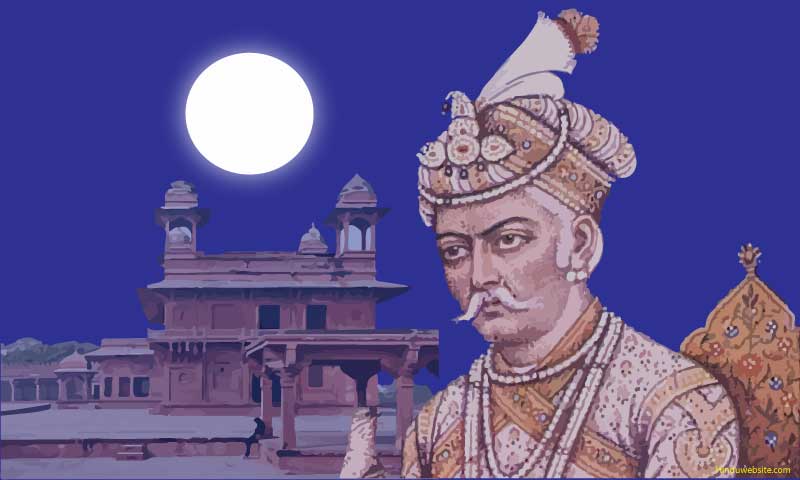
Akbar, the Mughal Emperor with Diwan-i-Khas, Fatehpur Sikri in the background
 AKBAR DIRECTING THE TYING-UP OF A WILD ELEPHANT. Tempera painting
in the Akbar Namahby Abu'l Fazl. Photographed from the original
in the India Museum for The Place of Animals in Human Thought by
the Countess Evelyn Martinengo Cesaresco.
AKBAR DIRECTING THE TYING-UP OF A WILD ELEPHANT. Tempera painting
in the Akbar Namahby Abu'l Fazl. Photographed from the original
in the India Museum for The Place of Animals in Human Thought by
the Countess Evelyn Martinengo Cesaresco.
The student of India who would at the same time be an historian, discovers to his sorrow that the land of his researches is lamentably poor in historical sources. And if within the realm of historical investigation, a more seductive charm lies for him in the analysis of great personalities than in ascertaining the course of historical development, then verily may he look about in vain for such personalities in the antiquity and middle ages of India. Not that the princely thrones were wanting in great men in ancient India, for we find abundant traces of them in Hindu folk-lore and poetry, but these sources do not extend to establishing the realistic element in details and furnishing life-like portraits of the men themselves. That the Hindu has ever been but little interested in historical matters is a generally recognized fact. Religious and philosophical speculations, dreams of other worlds, of previous and future existences, have claimed the attention of thoughtful minds to a much greater degree than has historical reality.
The misty myth-woven veil which hangs over persons and events of earlier times, vanishes at the beginning of the modern era which in India starts with the Mohammedan conquest, for henceforth the history of India is written by foreigners. Now we meet with men who take a decisive part in the fate of India, and they appear as sharply outlined, even though generally unpleasing, personalities.
Islam has justly been characterized as the caricature of a religion. Fanaticism and fatalism are two conspicuously irreligious emotions, and it is exactly these two emotions, which Islam understands how to arouse in savage peoples, to which it owes the part it has played in the history of the world, and the almost unprecedented success of its diffusion in Asia, Africa and Europe.
About 1000 A.D. India was invaded by the Sultan Mahmud of Ghasna. "With Mahmud's expedition into India begins one of the most horrible periods of the history of Hindustan. One monarch dethrones another, no dynasty continues in power, every accession to the throne is accompanied by the murder of kinsmen, plundering of cities, devastation of the lowlands and the slaughter of thousands of men, women and children of the predecessor's adherents; for five centuries northwest and northern India literally reeked with the blood of multitudes."[1] Mohammedan dynasties of Afghan, Turkish and Mongolian origin follow that of Ghasna. This entire period is filled with an almost boundless series of battles, intrigues, imbroglios and political revolutions; nearly all events had the one characteristic in common, that they took place amid murder, pillage and fire.
 AKBAR, EMPEROR OF INDIA.
From Noer's Kaiser Akbar, (Frontispiece
to Vol. II).
The most frightful spectacle throughout these reeking centuries is the terrible Mongolian prince Timur, a successor of Genghis-Khan, who fell upon India with his band of assassins in the year 1398 and before his entry into Delhi the capital, in which he was proclaimed Emperor of India, caused the hundred thousand prisoners whom he had captured in his previous battles in the Punjab, to be slaughtered in one single day, because it was too inconvenient to drag them around with him. So says Timur himself with shameless frankness in his account of the expedition, and he further relates that after his entry into Delhi, all three districts of the city were plundered "according to the will of God."[2] In 1526 Baber, a descendant of Timur, made his entry into Delhi and there founded the dominion of the Grand Moguls (i.e., of the great Mongols). The overthrow of this dynasty was brought about by the disastrous reign of Baber's successor Aurungzeb, a cruel, crafty and treacherous despot, who following the example of his ancestor Timur, spread terror and alarm around him in the second half of the seventeenth and the beginning of the eighteenth centuries. Even to-day Hindus may be seen to tremble when they meet the sinister fanatical glance of a Mohammedan.
Princes with sympathetic qualities were not entirely lacking in the seven centuries of Mohammedan dominion in India, and they shine forth as points of light from the gloomy horror of this time, but they fade out completely before the luminous picture of the man who governed India for half a century (1556-1605) and by a wise, gentle and just reign brought about a season of prosperity such as the land had never experienced in the millenniums of its history. This man, whose memory even to-day is revered by the Hindus, was a descendant of Baber, Abul Fath Jelâleddin Muhammed, known by the surname Akbar "the Great," which was conferred upon the child even when he was named, and completely supplanted the name that properly belonged to him. And truly he justified the epithet, for great, fabulously great, was Akbar as man, general, statesman and ruler,—all in all a prince who deserves to be known by every one whose heart is moved by the spectacle of true human greatness.[3]
When we wish to understand a personality we are in the habit of ascertaining the inherited characteristics, and investigating the influences exercised upon it by religion, family, environment, education, youthful impressions, experience, and so forth. Most men are easily comprehensible as the products of these factors. The more independent of all such influences, or the more in opposition to them, a personality develops, the more attractive and interesting will it appear to us. At the first glance it looks as if the Emperor Akbar had developed his entire character from himself and by his own efforts in total independence of all influences which in other cases are thought to determine the character and nature of a man.
A Mohammedan, a Mongol, a descendant of the monster Timur, the son of a weak incapable father, born in exile, called when but a lad to the government of a disintegrated and almost annihilated realm in the India of the sixteenth century,—which means in an age of perfidy, treachery, avarice, and self-seeking,—Akbar appears before us as a noble man, susceptible to all grand and beautiful impressions, conscientious, unprejudiced, and energetic, who knew how to bring peace and order out of the confusion of the times, who throughout his reign desired the furtherance of his subjects' and not of his own interest, who while increasing the privileges of the Mohammedans, not only also declared equality of rights for the Hindus but even actualized that equality, who in every conceivable way sought to conciliate his subjects so widely at variance with each other in race, customs, and religion, and who finally when the narrow dogmas of his religion no longer satisfied him, attained to a purified faith in God, which was independent of all formulated religions.
A closer observation, however, shows that the contrast is not quite so harsh between what according to our hypotheses Akbar should have been as a result of the forces which build up man, and what he actually became. His predilection for science and art Akbar had inherited from his grandfather Baber and his father Humâyun. His youth, which was passed among dangers and privations, in flight and in prison, was certainly not without a beneficial influence upon Akbar's development into a man of unusual power and energy. And of significance for his spiritual development was the circumstance that after his accession to the throne his guardian put him in the charge of a most excellent tutor, the enlightened and liberal minded Persian Mir Abdullatîf, who laid the foundation for Akbar's later religious and ethical views. Still, however high we may value the influence of this teacher, the main point lay in Akbar's own endowments, his susceptibility for such teaching as never before had struck root with any Mohammedan prince. Akbar had not his equal in the history of Islam. "He is the only prince grown up in the Mohammedan creed whose endeavor it was to ennoble the limitation of this most separatistic of all religions into a true religion of humanity."[4]
Even the external appearance of Akbar appeals to us sympathetically. We sometimes find reproduced a miniature from Delhi which pictures Akbar as seated; in this the characteristic features of the Mongolian race appear softened and refined to a remarkable degree.[B] The shape of the head is rather round, the outlines are softened, the black eyes large, thoughtful, almost dreamy, and only very slightly slanting, the brows full and bushy, the lips somewhat prominent and the nose a tiny bit hooked. The face is beardless except for the rather thin closely cut moustache which falls down over the curve of the month in soft waves. According to the description of his son, the Emperor Jehângir, Akbar's complexion is said to have been the yellow of wheat; the Portuguese Jesuits who came to his court called it plainly white. Although not exactly beautiful, Akbar seemed beautiful to many of his contemporaries, including Europeans, probably because of the august and at the same time kind and winsome expression which his countenance bore. Akbar was rather tall, broad-shouldered, strongly built and had long arms and hands.
Akbar, the son of the dethroned Emperor Humâyun, was born on October 14, 1542, at Amarkot in Sindh, two years after his father had been deprived of his kingdom by the usurper Shêr Chân. After an exile of fifteen years, or rather after an aimless wandering and flight of that length, the indolent pleasure-and opium-loving Humâyun was again permitted to return to his capital in 1555,—not through his own merit but that of his energetic general Bairâm Chân, a Turk who in one decisive battle had overcome the Afghans, at that time in possession of the dominion. But Humâyun was not long to enjoy his regained throne; half a year later he fell down a stairway in his palace and died. In January 1556 Akbar, then thirteen years of age, ascended the throne. Because of his youthful years Bairâm Chân assumed the regency as guardian of the realm or "prince-father" as it is expressed in Hindî, and guided the wavering ship of state with a strong hand. He overthrew various insurgents and disposed of them with cold cruelty. But after a few years he so aroused the illwill of Akbar by deeds of partiality, selfishness and violence that in March 1560 Akbar, then 17 years of age, decided to take the reins of government into his own hand. Deprived of his office and influence Bairâm Chân hastened to the Punjab and took arms against his Imperial Master. Akbar led his troops in person against the rebel and overcame him. When barefooted, his turban thrown around his neck, Bairâm Chân appeared before Akbar and prostrated himself before the throne, Akbar did not do the thing which was customary under such circumstances in the Orient in all ages. The magnanimous youth did not sentence the humiliated rebel to a painful death but bade him arise in memory of the great services which Bairâm Chân had rendered to his father and later to himself, and again assume his old place of honor at the right of the throne. Before the assembled nobility he gave him the choice whether he would take the governorship of a province, or would enjoy the favor of his master at court as a benefactor of the imperial family, or whether, accompanied by an escort befitting his rank, he would prefer to undertake a pilgrimage to Mecca.[5] Bairâm Chân was wise enough to choose the last, but on the way to Mecca he was killed by an Afghan and the news caused Akbar sincere grief and led him to take the four year old son of Bairâm Chân under his special protection.
Mâhum Anâga, the Emperor's nurse, for whom he felt a warm attachment and gratitude, a woman revengeful and ambitious but loyal and devoted to Akbar, had contributed in bringing about the fall of the regent. She had cared for the Emperor from his birth to his accession and amid the confusion of his youth had guarded him from danger; but for this service she expected her reward. She sought nothing less than in the rôle of an intimate confidante of the youthful Emperor to be secretly the actual ruler of India.
Mâhum Anâga had a son, Adham Chân by name, to whom at her suggestion Akbar assigned the task of reconquering and governing the province of Mâlwâ. Adham Chân was a passionate and violent man, as ambitious and avaricious as his mother, and behaved himself in Mâlwâ as if he were an independent prince. As soon as Akbar learned this he advanced by forced marches to Mâlwâ and surprised his disconcerted foster-brother before the latter could be warned by his mother. But Adham Chân had no difficulty in obtaining Akbar's forgiveness for his infringements.
On the way back to Agra, where the Emperor at that time was holding court, a noteworthy incident happened. Akbar had ridden alone in advance of his escort and suddenly found himself face to face with a powerful tigress who with her five cubs came out from the shrubbery across his path. His approaching attendants found the nineteen year old Emperor standing quietly by the side of the slaughtered beast which he had struck to the ground with a single blow of his sword. To how much bodily strength, intrepidity, cold-blooded courage and sure-sightedness this blow of the sword testified which dared not come the fraction of a second too late, may be judged by every one who has any conception of the spring of a raging tigress anxious for the welfare of her young. And we may easily surmise the thoughts which the sight aroused in the minds of the Mohammedan nobles in Akbar's train. At that moment many ambitious wishes and designs may have been carried to their grave.[6]
The Emperor soon summoned his hot-headed foster-brother Adham Chân to court in order to keep him well in sight for he had counted often enough on Akbar's affection for his mother Mâhum Anâga to save him from the consequences of his sins. Now Mâhum Anâga, her son and her adherents, hated the grand vizier with a deadly hatred because they perceived that they were being deprived of their former influence in matters of state. This hatred finally impelled Adham Chân to a senseless undertaking. The embittered man hatched up a conspiracy against the grand vizier and when one night in the year 1562 the latter was attending a meeting of political dignitaries on affairs of state in the audience hall of the Imperial palace, Adham Chân with his conspirators suddenly broke in and stabbed the grand vizier in the breast, whereupon his companions slew the wounded man with their swords. Even now the deluded Adham Chân counted still upon the Emperor's forbearance and upon the influence of his mother. Akbar was aroused by the noise and leaving his apartments learned what had happened. Adham Chân rushed to the Emperor, seized his arm and begged him to listen to his explanations. But the Emperor was beside himself with rage, struck the murderer with his fist so that he fell to the floor and commanded the terrified servants to bind him with fetters and throw him head over heels from the terrace of the palace to the courtyard below. The horrible deed was done but the wretch was not dead. Then the Emperor commanded the shattered body of the dying man to be dragged up the stairs again by the hair and to be flung once more to the ground.[7]
I have related this horrible incident in order to give Akbar's picture with the utmost possible faithfulness and without idealization. Akbar was a rough, strong-nerved man, who was seldom angry but whose wrath when once aroused was fearful. It is a blemish on his character that in some cases he permitted himself to be carried away to such cruel death sentences, but we must not forget that he was then dealing with the punishment of particularly desperate criminals, and that such severe judgments had always been considered in the Orient to be righteous and sensible. Not only in the Orient unfortunately,—even in Europe 200 years after Akbar's time tortures and the rack were applied at the behest of courts of law.
Mahum Anâga came too late to save her son. Akbar sought with tender care to console her for his dreadful end but the heart-broken woman survived the fearful blow of fate only about forty days. The Emperor caused her body to be buried with that of her son in one common grave at Delhi, and he himself accompanied the funeral procession. At his command a stately monument was erected above this grave which still stands to-day. His generosity and clemency were also shown in the fact that he extended complete pardon to the accomplices in the murder of the grand vizier and even permitted them to retain their offices and dignities because he was convinced that they had been drawn into the crime by the violent Adham Chân. In other ways too Akbar showed himself to be ready to grant pardon to an almost incomprehensible extent. Again and again when an insubordinate viceroy in the provinces would surrender after an unsuccessful uprising Akbar would let him off without any penalty, thus giving him the opportunity of revolting again after a short time.
It was an eventful time in which Akbar arrived at manhood in the midst of all sorts of personal dangers.
 MAUSOLEUM OF AKBAR'S FATHER, HUMÂYUN.
I will pass over with but few comments his military expeditions which can have no interest for the general public. When Akbar ascended the throne his realm comprised only a very small portion of the possessions which had been subject to his predecessors. With the energy which was a fundamental characteristic of his nature he once more took possession of the provinces which had been torn from the empire, at the same time undertaking the conquest of new lands, and accomplished this task with such good fortune that in the fortieth year of his reign the empire of India covered more territory than ever before; that is to say, not only the whole of Hindustan including the peninsula Gujerat, the lands of the Indus and Kashmir but also Afghanistan and a larger part of the Dekkhan than had ever been subject to any former Padishah of Delhi. At this time while the Emperor had his residence at Lahore the phrase was current in India, "As lucky as Akbar."[8]
It was apparent often enough in the military expeditions that Akbar far surpassed his contemporaries in generalship. But it was not the love of war and conquest which drove him each time anew to battle; a sincere desire inspired by a mystical spirit impelled him to bring to an end the ceaseless strife between the small states of India by joining them to his realm, and thus to found a great united empire.[9]
More worthy of admiration than the subjugation of such large territories in which of course many others have also been successful, is the fact that Akbar succeeded in establishing order, peace, and prosperity in the regained and newly subjugated provinces. This he brought about by the introduction of a model administration, an excellent police, a regulated post service, and especially a just division of taxes.[10] Up to Akbar's time corruption had been a matter of course in the entire official service and enormous sums in the treasury were lost by peculation on the part of tax collectors.
Akbar first divided the whole realm into twelve and later into fifteen viceregencies, and these into provinces, administrative districts and lesser subdivisions, and governed the revenues of the empire on the basis of a uniformly exact survey of the land. He introduced a standard of measurement, replacing the hitherto customary land measure (a leather strap which was easily lengthened or shortened according to the need of the measuring officer) by a new instrument of measurement in the form of a bamboo staff which was provided with iron rings at definite intervals. For purposes of assessment land was divided into four classes according to the kind of cultivation practiced upon it. The first class comprised arable land with a constant rotation of crops; the second, that which had to lie fallow for from one to two years in order to be productive; the third from three to four years; the fourth that land which was uncultivated for five years and longer or was not arable at all. The first two classes of acreage were taxed one-third of the crop, which according to our present ideas seems an exorbitantly high rate, and it was left to the one assessed whether he would pay the tax in kind or in cash. Only in the case of luxuries or manufactured articles, that is to say, where the use of a circulating medium could be assumed, was cash payment required. Whoever cultivated unreclaimed land was assisted by the government by the grant of a free supply of seed and by a considerable reduction in his taxes for the first four years.
Akbar also introduced a new uniform standard of coinage, but stipulated that the older coins which were still current should be accepted from peasants for their full face value. From all this the Indian peasants could see that Emperor Akbar not only desired strict justice to rule but also wished to further their interests, and the peasants had always comprised the greatest part of the inhabitants, (even according to the latest census in 1903, vol. I, p. 3, 50 to 84 percent of the inhabitants of India live by agriculture). But Akbar succeeded best in winning the hearts of the native inhabitants by lifting the hated poll tax which still existed side by side with all other taxes.
The founder of Islam had given the philanthropical command to exterminate from the face of the earth all followers of other faiths who were not converted to Islam, but he had already convinced himself that it was impossible to execute this law. And, indeed, if the Mohammedans had followed out this precept, how would they have been able to overthrow land upon land and finally even thickly populated India where the so-called unbelievers comprised an overwhelming majority? Therefore in place of complete extermination the more practical arrangement of the poll tax was instituted, and this was to be paid by all unbelievers in order to be a constant reminder to them of the loss of their independence. This humiliating burden which was still executed in the strictest, most inconsiderate manner, Akbar removed in the year 1565 without regard to the very considerable loss to the state's treasury. Nine years later followed the removal of the tax upon religious assemblies and pilgrimages, the execution of which had likewise kept the Hindus in constant bitterness towards their Mohammedan rulers.
Sometime previous to these reforms Akbar had abolished a custom so disgusting that we can hardly comprehend that it ever could have legally existed. At any rate it alone is sufficient to brand Islam and its supreme contempt for followers of other faiths, with one of the greatest stains in the history of humanity. When a tax-collector gathered the taxes of the Hindus and the payment had been made, the Hindu was required "without the slightest sign of fear of defilement" to open his mouth in order that the tax collector might spit in it if he wished to do so.[11] This was much more than a disgusting humiliation. When the tax-collector availed himself of this privilege the Hindu lost thereby his greatest possession, his caste, and was shut out from any intercourse with his equals. Accordingly he was compelled to pass his whole life trembling in terror before this horrible evil which threatened him. That a man of Akbar's nobility of character should remove such an atrocious, yes devilish, decree seems to us a matter of course; but for the Hindus it was an enormous beneficence.
Akbar sought also to advance trade and commerce in every possible way. He regulated the harbor and toll duties, removed the oppressive taxes on cattle, trees, grain and other produce as well as the customary fees of subjects at every possible appointment or office. In the year 1574 it was decreed that the loss which agriculture suffered by the passage of royal troops through the fields should be carefully calculated and scrupulously replaced.
Besides these practical regulations for the advancement of the material welfare, Akbar's efforts for the ethical uplift of his subjects are noteworthy. Drunkenness and debauchery were punished and he sought to restrain prostitution by confining dancing girls and abandoned women in one quarter set apart for them outside of his residence which received the name Shâitânpura or "Devil's City."[12]
The existing corruption in the finance and customs department was abolished by means of a complicated and punctilious system of supervision (the bureaus of receipts and expenditures were kept entirely separated from each other in the treasury department,) and Akbar himself carefully examined the accounts handed in each month from every district, just as he gave his personal attention with tireless industry and painstaking care to every detail in the widely ramified domain of the administration of government. Moreover the Emperor was fortunate in having at the head of the finance department a prudent, energetic, perfectly honorable and incorruptible man, the Hindu Todar Mal, who without possessing the title of vizier or minister of state had assumed all the functions of such an office.
It is easily understood that many of the higher tax officials did not grasp the sudden break of a new day but continued to oppress and impoverish the peasants in the traditional way, but the system established by Akbar succeeded admirably and soon brought all such transgressions to light. Todar Mal held a firm rein, and by throwing hundreds of these faithless officers into prison and by making ample use of bastinado and torture, spread abroad such a wholesome terror that Akbar's reforms were soon victorious.
How essential it was to exercise the strictest control over men occupying the highest positions may be seen by the example of the feudal nobility whose members bore the title "Jâgîrdâr." Such a Jâgîrdâr had to provide a contingent of men and horses for the imperial army corresponding to the size of the estate which was given him in fief. Now it had been a universal custom for the Jâgîrdârs to provide themselves with fewer soldiers and horses on a military expedition than at the regular muster. Then too the men and horses often proved useless for severe service. When the reserves were mustered the knights dressed up harmless private citizens as soldiers or hired them for the occasion and after the muster was over, let them go again. In the same way the horses brought forward for the muster were taken back into private service immediately afterwards and were replaced by worthless animals for the imperial service. This evil too was abolished at one stroke, by taking an exact personal description of the soldiers presented and by branding the heads of horses, elephants and camels with certain marks. By this simple expedient it became impossible to exchange men and animals presented at the muster for worthless material and also to loan them to other knights during muster.
The number of men able to bear arms in Akbar's realm has been given as about four and a half millions but the standing army which was held at the expense of the state was small in proportion. It contained only about twenty-five thousand men, one-half of whom comprised the cavalry and the rest musketry and artillery; Since India does not produce first class horses, Akbar at once provided for the importation of noble steeds from other lands of the Orient which were famed for horse breeding and was accustomed to pay more for such animals than the price which was demanded. In the same way no expense was too great for him to spend on the breeding and nurture of elephants, for they were very valuable animals for the warfare of that day. His stables contained from five to six thousand well-trained elephants. The breeding of camels and mules he also advanced with a practical foresight and understood how to overcome the widespread prejudice in India against the use of mules.
Untiringly did Akbar inspect stables, arsenals, military armories, and shipyards, and insisted on perfect order in all departments. He called the encouragement of seamanship an act of worship[13] but was not able to make India, a maritime power.
Akbar had an especial interest in artillery, and with it a particular gift for the technique and great skill in mechanical matters. He invented a cannon which could be taken apart to be carried more easily on the march and could be put up quickly, apparently for use in mountain batteries. By another invention he united seventeen cannons in such a way that they could be shot off simultaneously by one fuse.[14] Hence it is probably a sort of mitrailleuse. Akbar is also said to have invented a mill cart which served as a mill as well as for carrying freight. With regard to these inventions we must take into consideration the possibility that the real inventor may have been some one else, but that the flatterers at the court ascribed them to the Emperor because the initiative may have originated with him.
(II, 372) because of the so-called "organ cannons" which were in use in Europe as early as the 15th century.
The details which I have given will suffice to show what perfection the military and civil administration attained through Akbar's efforts. Throughout his empire order and justice reigned and a prosperity hitherto unknown. Although taxes were never less oppressive in India than under Akbar's reign, the imperial income for one year amounted to more than $120,000,000, a sum at which contemporary Europe marveled, and which we must consider in the light of the much greater purchasing power of money in the sixteenth century.[15] A large part of Akbar's income was used in the erection of benevolent institutions, of inns along country roads in which travelers were entertained at the imperial expense, in the support of the poor, in gifts for pilgrims, in granting loans whose payment was never demanded, and many similar ways. To his encouragement of schools, of literature, art and science I will refer later.
Of decided significance for Akbar's success was his patronage of the native population. He did not limit his efforts to lightening the lot of the subjugated Hindus and relieving them of oppressive burdens; his efforts went deeper. He wished to educate the Mohammedans and Hindus to a feeling of mutual good-will and confidence, and in doing so he was obliged to contend in the one case against haughtiness and inordinate ambition, and in the other against hate and distrustful reserve. If with this end in view he actually favored the Hindus by keeping certain ones close to him and advancing them to the most influential positions in the state, he did it because he found characteristics in the Hindus (especially in their noblest race, the Rajputs) which seemed to him most valuable for the stability of the empire and for the promotion of the general welfare. He had seen enough faithlessness in the Mohammedan nobles and in his own relatives. Besides, Akbar was born in the house of a small Rajput prince who had shown hospitality to Akbar's parents on their flight and had given them his protection.
The Rajputs are the descendants of the ancient Indian warrior race and are a brave, chivalrous, trustworthy people who possess a love of freedom and pride of race quite different in character from the rest of the Hindus. Even to-day every traveler in India thinks he has been set down in another world when he treads the ground of Rajputâna and sees around him in place of the weak effeminate servile inhabitants of other parts of the country powerful upright men, splendid warlike figures with blazing defiant eyes and long waving beards.
While Akbar valued the Rajputs very highly his own personality was entirely fitted to please these proud manly warriors. An incident which took place before the end of the first year of Akbar's reign is characteristic of the relations which existed on the basis of this intrinsic relationship.[16]
 VIEW OF FATHEPUR
Bihâri Mal was a prince of the small Rajput state Ambir, and possessed sufficient political comprehension to understand after Akbar's first great successes that his own insignificant power and the nearness of Delhi made it advisable to voluntarily recognize the Emperor as his liege lord. Therefore he came with son, grandson and retainers to swear allegiance to Akbar. Upon his arrival at the imperial camp before Delhi, a most surprising sight met his eyes. Men were running in every direction, fleeing wildly before a raging elephant who wrought destruction to everything that came within his reach. Upon the neck of this enraged brute sat a young man in perfect calmness belaboring the animal's head with the iron prong which is used universally in India for guiding elephants. The Rajputs sprang from their horses and came up perfectly unconcerned to observe the interesting spectacle, and broke out in loud applause when the conquered elephant knelt down in exhaustion. The young man sprang from its back and cordially greeted the Rajput princes (who now for the first time recognized Akbar in the elephant-tamer) bidding them welcome to his red imperial tent. From this occurrence dates the friendship of the two men. In later years Bihâri Mai's son and grandson occupied high places in the imperial service, and Akbar married a daughter of the Rajput chief who became the mother of his son and successor Selim, afterwards the Emperor Jehângir. Later on Akbar received a number of other Rajput women in his harem.
Not all of Akbar's relations to the Rajputs however were of such a friendly kind. As his grandfather Baber before him, he had many bitter battles with them, for no other Indian people had opposed him so vigorously as they. Their domain blocked the way to the south, and from their rugged mountains and strongly fortified cities the Rajputs harassed the surrounding country by many invasions and destroyed order, commerce and communication quite after the manner of the German robber barons of the Middle Ages. Their overthrow was accordingly a public necessity.
The most powerful of these Rajput chiefs was the Prince of Mewâr who had particularly attracted the attention of the Emperor by his support of the rebels. The control of Mewâr rested upon the possession of the fortress Chitor which was built on a monstrous cliff one hundred and twenty meters high, rising abruptly from the plain and was equipped with every means of defence that could be contrived by the military skill of that time for an incomparably strong bulwark. On the plain at its summit which measured over twelve kilometers in circumference a city well supplied with water lay within the fortification walls. There an experienced general, Jaymal, "the Lion of Chitor," was in command. I have not time to relate the particulars of the siege, the laying of ditches and mines and the uninterrupted battles which preceded the fall of Chitor in February, 1568. According to Akbar's usual custom he exposed himself to showers of bullets without once being hit (the superstition of his soldiers considered him invulnerable) and finally the critical shot was one in which Akbar with his own hand laid low the brave commander of Chitor. Then the defenders considered their cause lost, and the next night saw a barbarous sight, peculiarly Indian in character: the so-called Jauhar demanded his offering according to an old Rajput custom. Many great fires gleamed weirdly in the fortress. To escape imprisonment and to save their honor from the horrors of captivity, the women mounted the solemnly arranged funeral pyres, while all the men, clad in saffron hued garments, consecrated themselves to death. When the victors entered the city on the next morning a battle began which raged until the third evening, when there was no one left to kill. Eight thousand warriors had fallen, besides thirty thousand inhabitants of Chitor who had participated in the fight.
With the conquest of Chitor which I have treated at considerable length because it ended in a typically Indian manner, the resistance of the Rajputs broke down. After Akbar had attained his purpose he was on the friendliest terms with the vanquished. It testifies to his nobility of character as well as to his political wisdom that after this complete success he not only did not celebrate a triumph, but on the contrary proclaimed the renown of the vanquished throughout all India by erecting before the gate of the imperial palace at Delhi two immense stone elephants with the statues of Jaymal, the "Lion of Chitor," and of the noble youth Pata who had performed the most heroic deeds in the defense of Chitor. By thus honoring his conquered foes in such a magnanimous manner Akbar found the right way to the heart of the Rajputs. By constant bestowal of favors he gradually succeeded in so reconciling the noble Rajputs to the loss of their independence that they were finally glad and proud to devote themselves to his service, and, under the leadership of their own princes, proved themselves to be the best and truest soldiers of the imperial army, even far from their home in the farthest limits of the realm.
The great masses of the Hindu people Akbar won over by lowering the taxes as we have previously related, and by all the other successful expedients for the prosperity of the country, but especially by the concession of perfect liberty of faith and worship and by the benevolent interest with which he regarded the religious practices of the Hindus. A people in whom religion is the ruling motive of life, after enduring all the dreadful sufferings of previous centuries for its religion's sake, must have been brought to a state; of boundless reverence by Akbar's attitude. And since the Hindus were accustomed to look upon the great heroes and benefactors of humanity as incarnations of deity we shall not be surprised to read from an author of that time[17] that every morning before sunrise great numbers of Hindus crowded together in front of the palace to await the appearance of Akbar and to prostrate themselves as soon as he was seen at a window, at the same time singing religious hymns. This fanatical enthusiasm of the Hindus for his person Akbar knew how to retain not only by actual benefits but also by small, well calculated devices.
It is a familiar fact that the Hindus considered the Ganges to be a holy river and that cows were sacred animals. Accordingly we can easily understand Akbar's purpose when we learn that at every meal he drank regularly of water from the Ganges (carefully filtered and purified to be sure) calling it "the water of immortality,"[18] and that later he forbade the slaughtering of cattle and eating their flesh.[19] But Akbar did not go so far in his connivance with the Hindus that he considered all their customs good or took them under his protection. For instance he forbade child marriages among the Hindus, that is to say the marriage of boys under sixteen and of girls under fourteen years, and he permitted the remarriage of widows. The barbaric customs of Brahmanism were repugnant to his very soul. He therefore most strictly forbade the slaughtering of animals for purposes of sacrifice, the use of ordeals for the execution of justice, and the burning of widows against their will, which indeed was not established according to Brahman law but was constantly practiced according to traditional custom.[20] To be sure neither Akbar nor his successor Jehângir were permanently successful in their efforts to put an end to the burning of widows. Not until the year 1829 was the horrible custom practically done away with through the efforts of the English.
Throughout his entire life Akbar was a tirelessly industrious, restlessly active man. By means of ceaseless activity he struggled successfully against his natural tendency to melancholy and in this way kept his mind wholesome, which is most deserving of admiration in an Oriental monarch who was brought in contact day by day with immoderate flattery and idolatrous veneration. Well did Akbar know that no Oriental nation can be governed without a display of dazzling splendor; but in the midst of the fabulous luxury with which Akbar's court was fitted out and his camp on the march, in the possession of an incomparably rich harem which accompanied the Emperor on his expeditions and journeys in large palatial tents, Akbar always showed a remarkable moderation. It is true that he abolished the prohibition of wine which Islam had inaugurated and had a court cellar in his palace, but he himself drank only a little wine and only ate once a day and then did not fully satisfy his hunger at this one meal which he ate alone and not at any definite time.[21] Though he was not strictly a vegetarian yet he lived mainly on rice, milk, fruits and sweets, and meat was repulsive to him. He is said to have eaten meat hardly more than four times a year.[22]
Akbar was very fond of flowers and perfumes and especially enjoyed blooded doves whose care he well understood. About twenty thousand of these peaceful birds are said to have made their home on the battlements of his palace. His historian[23] relates: "His Majesty deigned to improve them in a marvelous manner by crossing the races which had not been done formerly."
Akbar was passionately fond of hunting and pursued the noble sport in its different forms, especially the tiger hunt and the trapping of wild elephants,[24] but he also hunted with trained falcons and leopards, owning no less than nine hundred hunting leopards. He was not fond of battue; he enjoyed the excitement and exertion of the actual hunt as a means for exercise and recreation, for training the eye and quickening the blood. Akbar took pleasure also in games. Besides chess, cards and other games, fights between animals may especially be mentioned, of which elephant fights were the most common, but there were also contests between camels, buffaloes, cocks, and even frogs, sparrows and spiders.
Usually, however, the whole day was filled up from the first break of dawn for Akbar with affairs of government and audiences, for every one who had a request or a grievance to bring forward could have access to Akbar, and he showed the same interest in the smallest incidents as in the greatest affairs of state. He also held courts of justice wherever he happened to be residing. No criminal could be punished there without his knowledge and no sentence of death executed until Akbar had given the command three times.[25]
Not until after sunset did the Emperor's time of recreation begin. Since he only required three hours of sleep[26] he devoted most of the night to literary, artistic and scientific occupations. Especially poetry and music delighted his heart. He collected a large library in his palace and drew the most famous scholars and poets to his court. The most important of these were the brothers Abul Faiz (with the nom de plume Faizî) and Abul Fazl who have made Akbar's fame known to the whole world through their works. The former at Akbar's behest translated a series of Sanskrit works into Persian, and Abul Fazl, the highly gifted minister and historian of Akbar's court (who to be sure can not be exonerated from the charge of flattery) likewise composed in the Persian language a large historical work written in the most flowery style which is the main source of our knowledge of that period. This famous work is divided in two parts, the first one of which under the title Akbarnâme, "Akbar Book," contains the complete history of Akbar's reign, whereas the second part, the Aîn î Akbarî, "The Institutions of Akbar," gives a presentation of the political and religious constitution and administration of India under Akbar's reign. It is also deserving of mention in this connection that Akbar instituted a board for contemporary chronicles, whose duty it was to compose the official record of all events relating to the Emperor and the government as well as to collect all laws and decrees.[27]
When Akbar's recreation hours had come in the night the poets of his court brought their verses. Translations of famous works in Sanskrit literature, of the New Testament and of other interesting books were read aloud, all of which captivated the vivacious mind of the Emperor from which nothing was farther removed than onesidedness and narrow-mindedness. Akbar had also a discriminating appreciation for art and industries. He himself designed the plans for some extremely beautiful candelabra, and the manufacture of tapestry reached such a state of perfection in India under his personal supervision that in those days fabrics were produced in the great imperial factories which in beauty and value excelled the famous rugs of Persia. With still more important results Akbar influenced the realm of architecture in that he discovered how to combine two completely different styles. For indeed, the union of Mohammedan and Indian motives in the buildings of Akbar (who here as in all other departments strove to perfect the complete elevation of national and religious details) to form an improved third style,[28] is entirely original.
Among other ways Akbar betrayed the scientific trend of his mind by sending out an expedition in search of the sources of the Ganges.[29] That a man of such a wonderful degree of versatility should have recognized the value of general education and have devoted himself to its improvement, we would simply take for granted. Akbar caused schools to be erected throughout his whole kingdom for the children of Hindus and Mohammedans, whereas he himself did not know how to read or write.[30] This remarkable fact would seem incredible to us after considering all the above mentioned facts if it was not confirmed by the express testimony of his son, the Emperor Jehângir. At any rate for an illiterate man Akbar certainly accomplished an astonishing amount. The universal character of the endowments of this man could not have been increased by the learning of the schools.
 AKBAR'S GRAVE.
I have now come to the point which arouses most strongly the universal human interest in Akbar, namely, to his religious development and his relation to the religions, or better to religion. But first I must protest against the position maintained by a competent scholar[31] that Akbar himself was just as indifferent to religious matters as was the house of Timur as a whole. Against this view we have the testimony of the conscientiousness with which he daily performed his morning and evening devotions, the value which he placed upon fasting and prayer as a means of self-discipline, and the regularity with which he made yearly pilgrimages to the graves of Mohammedan saints. A better insight into Akbar's heart than these regular observances of worship which might easily be explained by the force of custom is given by the extraordinary manifestations of a devout disposition. When we learn that Akbar invariably prayed at the grave of his father in Delhi[32] before starting upon any important undertaking, or that during the siege of Chitor he made a vow to make a pilgrimage to a shrine in Ajmir after the fall of the fortress, and that after Chitor was in his power he performed this journey in the simplest pilgrim garb, tramping barefooted over the glowing sand,[33] it is impossible for us to look upon Akbar as irreligious. On the contrary nothing moved the Emperor so strongly and insistently as the striving after religious truth. This effort led to a struggle against the most destructive power in his kingdom, against the Mohammedan priesthood. That Akbar, the conqueror in all domains, should also have been victorious in the struggle against the encroachments of the Church (the bitterest struggle which a ruler can undertake), this alone should insure him a place among the greatest of humanity.
The Mohammedan priesthood, the community of the Ulemâs in whose hands lay also the execution of justice according to the dictates of Islam, had attained great prosperity in India by countless large bequests. Its distinguished membership formed an influential party at court. This party naturally represented the Islam of the stricter observance, the so-called Sunnitic Islam, and displayed the greatest severity and intolerance towards the representatives of every more liberal interpretation and towards unbelievers. The chief judge of Agra sentenced men to death because they were Shiites, that is to say they belonged to the other branch of Islam, and the Ulemâs urged Akbar to proceed likewise against the heretics.[34] That arrogance and vanity, selfishness and avarice, also belonged to the character of the Ulemâs is so plainly to be taken for granted according to all analogies that it need hardly be mentioned. The judicature was everywhere utilized by the Ulemâs as a means for illegitimate enrichment.
This ecclesiastical party which in its narrow-minded folly considered itself in possession of the whole truth, stands opposed to the noble skeptic Akbar, whose doubt of the divine origin of the Koran and of the truth of its dogmas began so to torment him that he would pass entire nights sitting out of doors on a stone lost in contemplation. The above mentioned brothers Faizî and Abul Fazl introduced to his impressionable spirit the exalted teaching of Sûfism, the Mohammedan mysticism whose spiritual pantheism had its origin in, or at least was strongly influenced by, the doctrine of the All-One, held by the Brahman Vedânta system. The Sûfi doctrine teaches religious tolerance and has apparently strengthened Akbar in his repugnance towards the intolerant exclusiveness of Sunnitic Islam.
The Ulemâs must have been horror-stricken when they found out that Akbar even sought religious instruction from the hated Brahmans. We hear especially of two, Purushottama and Debî by name, the first of whom taught Sanskrit and Brahman philosophy to the Emperor in his palace, whereas the second was drawn up on a platform to the wall of the palace in the dead of the night and there, suspended in midair, gave lessons on profound esoteric doctrines of the Upanishads to the emperor as he sat by the window. A characteristic bit of Indian local color! The proud Padishah of India, one of the most powerful rulers of his time, listening in the silence of night to the words of the Brahman suspended there outside, who himself as proud as the Emperor would not set foot inside the dwelling of one who in his eyes was unclean, but who would not refuse his wisdom to a sincere seeker after truth.
Akbar left no means untried to broaden his religious outlook. From Gujerat he summoned some Parsees, followers of the religion of Zarathustra, and through them informed himself of their faith and their highly developed system of ethics which places the sinful thought on the same level with the sinful word and act.
From olden times the inhabitants of India have had a predisposition for religious and philosophical disputations. So Akbar, too, was convinced of the utility of free discussion on religious dogmas. Based upon this idea, and perhaps also in the hope that the Ulemâs would be discomfited Akbar founded at Fathpur Sikrî, his favorite residence in the vicinity of Agra, the famous Ibâdat Khâna, literally the "house of worship," but in reality the house of controversy. This was a splendid structure composed of four halls in which scholars and religious men of all sects gathered together every Thursday evening and were given an opportunity to defend their creeds in the presence and with the cooperation of the Emperor. Akbar placed the discussion in charge of the wise and liberal minded Abul Fazl. How badly the Ulemâs, the representatives of Mohammedan orthodoxy, came off on these controversial evenings was to be foreseen. Since they had no success with their futile arguments they soon resorted to cries of fury, insults for their opponents and even to personal violence, often turning against each other and hurling curses upon their own number. In these discussions the inferiority of the Ulemâs, who nevertheless had always put forth such great claims, was so plainly betrayed that Akbar learned to have a profound contempt for them.
In addition to this, the fraud and machinations by means of which the Ulemâs had unlawfully enriched themselves became known to the Emperor. At any rate there was sufficient ground for the chastisement which Akbar now visited upon the high clergy. In the year 1579 a decree was issued which assigned to the Emperor the final decision in matters of faith, and this was subscribed to by the chiefs of the Ulemâs,—with what personal feelings we can well imagine. For by this act the Ulemâs were deprived of their ecclesiastical authority which was transferred to the Emperor. That the Orient too possesses its particular official manner of expression in administrative matters is very prettily shown by a decree in which Akbar "granted the long cherished wish" of these same chiefs of the Ulemâs to undertake the pilgrimage to Mecca, which of course really meant a banishment of several years. Other unworthy Ulemâs were displaced from their positions or deprived of their sinecures; others who in their bitterness had caused rebellion or incited or supported mutiny were condemned for high treason. The rich property of the churches was for the most part confiscated and appropriated for the general weal. In short, the power and influence of the Ulemâs was completely broken down, the mosques stood empty and were transformed into stables and warehouses.
Akbar had long ceased to be a faithful Moslem. Now after the fall of the Ulemâs he came forward openly with his conviction, declared the Koran to be a human compilation and its commands folly, disputed the miracles of Mohammed and also the value of his prophecies, and denied the doctrine of recompense after death. He professed the Brahman and Sûfistic doctrine that the soul migrates through countless existences and finally attains divinity after complete purification.
The assertion of the Ulemâs that every person came into the world predisposed towards Islam and that the natural language of mankind was Arabic (the Jews made the same claim for Hebrew and the Brahmans for Sanskrit), Akbar refuted by a drastic experiment which does not correspond with his usual benevolence, but still is characteristic of the tendency of his mind. In this case a convincing demonstration appeared to him so necessary that some individuals would have to suffer for it. Accordingly in the year 1579 he caused twenty infants to be taken from their parents in return for a compensation and brought up under the care of silent nurses in a remote spot in which no word should be spoken. After four years it was proved that as many of these unhappy children as were still alive were entirely dumb and possessed no trace of a predisposition for Islam.[35] Later the children are said to have learned to speak with extraordinary difficulty as was to be expected.
Akbar's repugnance to Islam developed into a complete revulsion against every thing connected with this narrow religion and made the great Emperor petty-souled in this particular. The decrees were dated from the death of Mohammed and no longer from the Hejra (the flight from Mecca to Medina). Books written in Arabic, the language of the Koran were given the lowest place in the imperial library. The knowledge of Arabic was prohibited, even the sounds characteristically belonging to this language were avoided.[36] Where formerly according to ancient tradition had stood the word Bismilâhi, "in the name of God," there now appeared the old war cry Allâhu akbar "God is great," which came into use the more generally—on coins, documents, etc.—the more the courtiers came to reverse the sense of the slogan and to apply to it the meaning, "Akbar is God."
Before I enter into the Emperor's assumption of this flattery and his conception of the imperial dignity as conferred by the grace of God, I must speak of the interesting attempts of the Jesuits to win over to Christianity the most powerful ruler of the Orient.
As early as in the spring of 1578 a Portuguese Jesuit who worked among the Bengals as a missionary appeared at the imperial court and pleased Akbar especially because he got the better of the Ulemâs in controversy. Two years later Akbar sent a very polite letter to the Provincial of the Jesuit order in Goa, requesting him to send two Fathers in order that Akbar himself might be instructed "in their faith and its perfection." It is easy to imagine how gladly the Provincial assented to this demand and how carefully he proceeded with the selection of the fathers who were to be sent away with such great expectations. As gifts to the Emperor the Jesuits brought a Bible in four languages and pictures of Christ and the Virgin Mary, and to their great delight when Akbar received them he laid the Bible upon his head and kissed the two pictures as a sign of reverence.[37]
In the interesting work of the French Jesuit Du Jarric, published in 1611, we possess very detailed accounts of the operations of these missionaries who were honorably received at Akbar's court and who were invited to take up their residence in the imperial palace. The evening assemblies in the 'Ibâdat Khâna' in Fathpur Sikrî at once gave the shrewd Jesuits who were schooled in dialectics, an opportunity to distinguish themselves before the Emperor who himself presided over this Religious Parliament in which Christians, Jews, Mohammedans, Brahmans, Buddhists and Parsees debated with each other. Abul Fazl speaks with enthusiasm in the Akbarnâme of the wisdom and zealous faith of Father Aquaviva, the leader of this Jesuit mission, and relates how he offered to walk into a fiery furnace with a New Testament in his hand if the Mullahs would do the same with the Koran in their hand, but that the Mohammedan priests withdrew in terror before this test by fire. It is noteworthy in this connection that the Jesuits at Akbar's court received a warning from their superiors not to risk such rash experiments which might be induced by the devil with the view of bringing shame upon Christianity.[38] The superiors were apparently well informed with regard to the intentions of the devil.
In conversation with the Jesuits Akbar proved to be favorably inclined towards many of the Christian doctrines and met his guests half way in every manner possible. They had permission to erect a hospital and a chapel and to establish Christian worship in the latter for the benefit of the Portuguese in that vicinity. Akbar himself occasionally took part in this service kneeling with bared head, which, however, did not hinder him from joining also in the Mohammedan ritual or even the Brahman religious practices of the Rajput women in his harem. He had his second son Murâd instructed by the Jesuits in the Portuguese language and in the Christian faith.
The Jesuits on their side pushed energetically toward their goal and did not scorn to employ flattery in so far as to draw a parallel between the Emperor and Christ, but no matter how slyly the fathers proceeded in the accomplishment of their plans Akbar was always a match for them. In spite of all concessions with regard to the excellence and credibility of the Christian doctrines the Emperor never seemed to be entirely satisfied. Du Jarric "complains bitterly of his obstinacy and remarks that the restless intellect of this man could never be quieted by one answer but must constantly make further inquiry."[39] The clever historian of Islam makes the following comment: "Bad, very bad;—perhaps he would not even be satisfied with the seven riddles of the universe of the latest natural science."[40]
To every petition and importunity of the Jesuits to turn to Christianity Akbar maintained a firm opposition. A second and third embassy which the order at Goa sent out in the nineties of the sixteenth century, also labored in vain for Akbar's conversion in spite of the many evidences of favor shown by the Emperor. One of the last Jesuits to come, Jerome Xavier of Navarre, is said to have been induced by the Emperor to translate the four Gospels into Persian which was the language of the Mohammedan court of India. But Akbar never thought of allowing himself to be baptized, nor could he consider it seriously from political motives as well as from reasons of personal conviction. A man who ordered himself to be officially declared the highest authority in matters of faith—to be sure not so much in order to found an imperial papacy in his country as to guard his empire from an impending religious war—at any rate a man who saw how the prosperity of his reign proceeded from his own personal initiative in every respect, such a man could countenance no will above his own nor subject himself to any pangs of conscience. To recognize the Pope as highest authority and simply to recognize as objective truth a finally determined system in the realm in which he had spent day and night in a hot pursuit after a clearer vision, was for Akbar an absolute impossibility.
Then too Akbar could not but see through the Jesuits although he appreciated and admired many points about them. Their rigid dogmatism, their intolerance and inordinate ambition could leave him no doubt that if they once arose to power the activity of the Ulemâs, once by good fortune overthrown, would be again resumed by them to a stronger and more dangerous degree. It is also probable that Akbar, who saw and heard everything, had learned of the horrors of the Inquisition at Goa. Moreover, the clearness of Akbar's vision for the realities of national life had too often put him on his guard to permit him to look upon the introduction of Christianity, however highly esteemed by him personally, as a blessing for India. He had broken the power of Islam in India; to overthrow in like manner the second great religion of his empire, Brahmanism, to which the great majority of his subjects clung with body and soul, and then in place of both existing religions to introduce a third foreign religion inimically opposed to them—such a procedure would have hurled India into an irremediable confusion and destroyed at one blow the prosperity of the land which had been brought about by the ceaseless efforts of a lifetime. For of course it was not the aim of the Jesuits simply to win Akbar personally to Christianity but they wished to see their religion made the state religion of this great empire.
As has been already suggested, submission to Christianity would also have been opposed to Akbar's inmost conviction. He had climbed far enough up the stony path toward truth to recognize all religions as historically developed and as the products of their time and the land of their origin. All the nobler religions seemed to him to be radiations from the one eternal truth. That he thought he had found the truth with regard to the fate of the soul in the Sûfi-Vedântic doctrine of its migration through countless existences and its final ascension to deity has been previously mentioned. With such views Akbar could not become a Catholic Christian.
The conviction of the final reabsorption into deity, conditions also the belief in the emanation of the ego from deity. But Akbar's relation to God is not sufficiently identified with this belief. Akbar was convinced that he stood nearer to God than other people. This is already apparent in the title "The Shadow of God" which he had assumed. The reversed, or rather the double, meaning of the sentence Allâhu akbar, "Akbar is God," was not displeasing to the Emperor as we know. And when the Hindus declared him to be an incarnation of a divinity he did not disclaim this homage. Such a conception was nothing unusual with the Hindus and did not signify a complete apotheosis. Although Akbar took great pains he was not able to permanently prevent the people from considering him a healer and a worker of miracles. But Akbar had too clear a head not to know that he was a man,—a man subject to mistakes and frailties; for when he permitted himself to be led into a deed of violence he had always experienced the bitterest remorse. Not the slightest symptom of Cæsaromania can be discovered in Akbar.
Akbar felt that he was a mediator between God and man and believed "that the deity revealed itself to him in the mystical illumination of his soul."[41] This conviction Akbar held in common with many rulers of the Occident who were much smaller than he. Idolatrous marks of veneration he permitted only to a very limited degree. He was not always quite consistent in this respect however, and we must realize how infinitely hard it was to be consistent in this matter at an Oriental court when the customary servility, combined with sincere admiration and reverence, longed to actively manifest itself.
Akbar, as we have already seen, suffered the Hindu custom of prostration, but on the other hand we have the express testimony to the contrary from the author Faizî, the trusted friend of the Emperor, who on the occasion of an exaggerated homage literally says: "The commands of His Majesty expressly forbid such devout reverence and as often as the courtiers offer homage of this kind because of their loyal sentiments His Majesty forbids them, for such manifestations of worship belong to God alone,"[42] Finally however Akbar felt himself moved to forbid prostration publicly, yet to permit it in a private manner, as appears in the following words of Abul Fazl[43]:
"But since obscurantists consider prostration to be a blasphemous adoration of man, His Majesty in his practical wisdom has commanded that it be put an end to with ignorant people of all stations and also that it shall not be practiced even by his trusted servants on public court days. Nevertheless if people upon whom the star of good fortune has shone are in attendance at private assemblies and receive permission to be seated, they may perform the prostration of gratitude by bowing their foreheads to the earth and so share in the rays of good fortune. So forbidding prostration to the people at large and granting it to the select the Emperor fulfils the wishes of both and gives the world an example of practical wisdom."
The desire to unite his subjects as much as possible finally impelled Akbar to the attempt to equalize religious differences as well. Convinced that religions did not differ from each other in their innermost essence, he combined what in his opinion were the essential elements and about the year 1580 founded a new religion, the famous Dîn i Ilâhi, the "religion of God." This religion recognizes only one God, a purely spiritual universally efficient being from whom the human soul is derived and towards which it tends. The ethics of this religion comprises the high moral requirements of Sufism and Parsism: complete toleration, equality of rights among all men, purity in thought, word and deed. The demand of monogamy, too, was added later. Priests, images and temples,—Akbar would have none of these in his new religion, but from the Parsees he took the worship of the fire and of the sun as to him light and its heat seemed the most beautiful symbol of the divine spirit.[44] He also adopted the holy cord of the Hindus and wore upon his forehead the colored token customary among them. In this eclectic manner he accommodated himself in a few externalities to the different religious communities existing in his kingdom.
Doubtless in the foundation of his Dîn i Ilâhi Akbar was not pursuing merely ideal ends but probably political ones as well, for the adoption of the new religion signified an increased loyalty to the Emperor. The novice had to declare himself ready to yield to the Emperor his property, his life, his honor, and his former faith, and in reality the adherents of the Dîn i Ilâhi formed a clan of the truest and most devoted servitors of the Emperor. It may not be without significance that soon after the establishment of the Dîn i Ilâhi a new computation of time was introduced which dated from the accession of Akbar to the throne in 1556.
After the new religion had been in existence perhaps five years the number of converts began to grow by the thousands but we can say with certainty that the greater portion of these changed sides not from conviction but on account of worldly advantage, since they saw that membership in the new religion was very advantageous to a career in the service of the state.[45] By far the greatest number of those who professed the Dîn i Ilâhi observed only the external forms, privately remaining alien to it.
 MAUSOLEUM OF AKBAR AT SIKANDRA.
In reality the new religion did not extend outside of Akbar's court and died out at his death. Hence if failure here can be charged to the account of the great Emperor, yet this very failure redounds to his honor. Must it not be counted as a great honor to Akbar that he considered it possible to win over his people to a spiritual imageless worship of God? Had he known that the religious requirements of the masses can only be satisfied by concrete objects of worship and by miracles (the more startling the better), that a spiritualized faith can never be the possession of any but a few chosen souls, he would not have proceeded with the founding of the Dîn i Ilâhi. And still we cannot call its establishment an absolute failure, for the spirit of tolerance which flowed out from Akbar's religion accomplished infinite good and certainly contributed just as much to lessening the antagonisms in India as did Akbar's social and industrial reforms.
A man who accomplished such great things and desired to accomplish greater, deserves a better fortune than was Akbar's towards the end of life. He had provided for his sons the most careful education, giving them at the same time Christian and orthodox Mohammedan instructors in order to lead them in their early years to the attainment of independent views by means of a comparison between contrasts; but he was never to have pleasure in his sons. It seems that he lacked the necessary severity. The two younger boys of this exceedingly temperate Emperor, Murâd and Daniâl, died of delirium tremens in their youth even before their father. The oldest son, Selim, later the Emperor Jehângir, was also a drunkard and was saved from destruction through this inherited vice of the Timur dynasty only by the wisdom and determination of his wife. But he remained a wild uncontrolled cruel man (as different as possible from his father and apparently so by intention) who took sides with the party of the vanquished Ulemâs and stepped forth as the restorer of Islam. In frequent open rebellion against his magnanimous father who was only too ready to pardon him, he brought upon this father the bitterest sorrow; and especially by having the trustworthy minister and friend of his father, Abul Fazl, murdered while on a journey. Very close to Akbar also was the loss of his old mother to whom he had clung his whole life long with a touching love and whom he outlived only a short time.
Akbar lost his best friends and his most faithful servants before he finally succumbed to a very painful abdominal illness, which at the last changed him also mentally to a very sad extent, and finally carried him off on the night of the fifteenth of October, 1605. He was buried at Sikandra near Agra in a splendid mausoleum of enormous proportions which he himself had caused to be built and which even to-day stands almost uninjured.
This in short is a picture of the life and activities of the greatest ruler which the Orient has ever produced. In order to rightly appreciate Akbar's greatness we must bear in mind that in his empire he placed all men on an equality without regard to race or religion, and granted universal freedom of worship at a time when the Jews were still outlaws in the Occident and many bloody persecutions occurred from time to time; when in the Occident men were imprisoned, executed or burnt at the stake for the sake of their faith or their doubts; at a time when Europe was polluted by the horrors of witch-persecution and the massacre of St. Bartholemew.[46] Under Akbar's rule India stood upon a much higher plane of civilization in the sixteenth century than Europe at the same time.
Germany should be proud that the personality of Akbar who according to his own words "desired to live at peace with all humanity, with every creature of God," has so inspired a noble German of princely blood in the last century that he consecrated the work of his life to the biography of Akbar. This man is the Prince Friedrich August of Schleswig-Holstein, Count of Noer, who wandered through the whole of Northern India on the track of Akbar's activities, and on the basis of the most careful investigation of sources has given us in his large two-volumed work the best and most extensive information which has been written in Europe about the Emperor Akbar. How much his work has been a labor of love can be recognized at every step in his book but especially may be seen in a touching letter from Agra written on the 24th of April, 1868, in which he relates that he utilized the early hours of this day for an excursion to lay a bunch of fresh roses on Akbar's grave and that no visit to any other grave had ever moved him so much as this.[47]
 The Chakra, the Indian Emblem of Empire
Suggestions for Further Reading
- The Chronology of Afghanistan's history
- A brief history of Afghanistan
- Afghanistan - Origin and history of name
- The idol haters
- Travelling to Afghanistan
- Hinduism, ancient history
- History of Hinduism, medieval period
- Hinduism, modern history
- The Aryan invasion
- Battle over history
- The biggest holocaust in world history
- Essays On Dharma
- Esoteric Mystic Hinduism
- Introduction to Hinduism
- Hindu Way of Life
- Essays On Karma
- Hindu Rites and Rituals
- The Origin of The Sanskrit Language
- Symbolism in Hinduism
- Essays on The Upanishads
- Concepts of Hinduism
- Essays on Atman
- Hindu Festivals
- Spiritual Practice
- Right Living
- Yoga of Sorrow
- Happiness
- Mental Health
- Concepts of Buddhism
- General Essays
FOOTNOTES:
[A] This essay is art enlarged form of an address delivered on the occasion of the birthday of King Wilhelm II of Württemberg, on February 25, 1909.
[1] E. Schlagintweit, Indien in Wort und Bild, II, 26 f.
[2] A. Müller, Der Islam im Morgen-und Abendland, II, 300 f.
[3] From the literature on Emperor Akbar the following works deserve special mention: J. Talboys Wheeler, The History of India from the Earliest Ages. Vol. IV, Pt. I, "Mussulman Rule," London, 1876 (judges Akbar very unfairly in many places, but declares at the bottom of page 135, "The reign of Akbar is one of the most important in the history of India; it is one of the most important in the history of the world"); Mountstuart Elphinstone, History of India, the Hindu and Mahometan Periods, with notes and additions by E.B. Cowell, 9th ed., London, 1905; G.B. Malleson, Akbar and the Rise of the Mughal Empire, Oxford, 1890 (in W.W. Hunter's Rulers of India); A. Müller, Der Islam im Morgen-und Abendland, Vol. II, Berlin, 1887; but especially Count F.A. von Noer, Kaiser Akbar, ein Versuch über die Geschichte Indiens im sechzehnten Jahrhundert, Vol. I, Leyden, 1880; Vol. II, revised from the author's manuscript by Dr. Gustav von Buchwald, Leyden, 1885. In the preface to this work the original sources are listed and described; compare also M. Elphinstone, pp. 536, 537, note 45.
[4] A. Müller, II, 416.
[B] Noer, II as frontispiece (comp. also pp. 327, 328); A. Müller, II, 417.
[5] Noer, I, 131.
[6] Noer, I, 141.
[7] J.T. Wheeler, IV, I, 139, 140; Noer, I, 143, 144.
[8] J.T. Wheeler, IV, I, 180.
[9] Noer, II, 8, 390, 423.
[10] For the following compare Noer I, 391 ff.; M. Elphinstone, 529 ff.; G.B. Malleson, 172 ff., 185 ff.
[11] Noer, II, 6, 7; G.B. Malleson, 174, 175.
[12] J.T. Wheeler, IV, I, 173; Noer, I, 438 n.
[13] Noer, II, 378.
[14] Noer, I, 429. The second invention, however, is questioned by Buchwald.
[15] Noer, I, 439.
[16] Noer, I, 224-226
[17] Badâoni in Noer, II, 320.
[18] Noer, II, 317, 318.
[19] Ibid. 376, 317.
[20] J.T. Wheeler, IV, I, 173; M. Elphinstone, 526; G.B. Malleson, 170.
[21] Noer, II, 355-
[22] J.T. Wheeler, IV, I, 169, following the old English geographer Samuel Purchas.
[23] Abul Fazl in Noer, I, 511.
[24] M. Elphinstone, 519
[25] J.T. Wheeler, IV, I, 168.
[26] Loc. cit., 169.
[27] Noer, I, 432, 433.
[28] A. Müller, II, 386.
[29] J.T. Wheeler, IV, I, 174
[30] J.T. Wheeler, loc. cit., 141; Noer, I, 193; II, 324, 326
[31] A. Müller, II, 418
[32] Noer, I, 262
[33] Noer, I, 259.
[34] J.T. Wheeler, IV, I, 156.
[35] J.T. Wheeler, IV, I, 174; Noer, I, 511, 512. A familiar classical parallel to this incident is the experiment recorded by Herodotus (II, 2) which the Egyptian king Psammetich is said to have performed with two infants. It is related that after being shut up in a goat's stable for two years separated from all human intercourse these children repeatedly cried out the alleged Phrygian word βεκὁς [Greek: bekhos], "bread," which in reality was probably simply an imitation of the bleating of the goats. Compare Edward B. Tyler, Researches into the Early History of Mankind. 2nd edition, (London, 1870), page 81: "It is a very trite remark that there is nothing absolutely incredible in the story and that Bek, bek is a good imitative word for bleating as in βληχἁομαι, μηκἁομαι [Greek: blêchhaomai, mêkhaomai,], blöken, meckern, etc." Farther on we find the account of a similar attempt made by James IV of Scotland as well as the literature with regard to other historical and legendary precedents of this sort in both Orient and Occident.
[36] Noer, II, 324, 325. Beards which the Koran commanded to be worn Akbar even refused to allow in his presence. M. Elphinstone, 525; G.B. Malleson, 177.
[37] J.T. Wheeler, IV, I,162; Noer, I, 481.
[38] J.T. Wheeler, IV, I, 165, note, 47; M. Elphinstone, 523, note 8; G.B. Malleson, 162.
[39] In Noer, I, 485.
[40] A. Müller, II, 420 n.
[41] Noer, II, 314, 355.
[42] In Noer, II, 409.
[43] In Noer, II, 347, 348.
[44] M. Elphinstone, 524.
[45] Noer, I, 503.
[46] Noer, I, 490 n.
[47] Noer, II, 564, 572.
Source: Emperor Of India A Picture Of Life And Customs From The Sixteenth Century By Dr. Richard Von Garbe Rector Of The University Of Tubingen Translated From The German By Lydia G. Robinson. Reprinted from "The Monist" of April, 1909 Chicago. The Open Court Publishing Company 1909. While every effort has been taken to reproduce this text accurately no responsibility is accepted for the accuracy or the authenticity of the text reproduced. Interested readers may read the original text for research purposes.