
Why do we need God? A Lesson From the Mahabharata
The epics, the Ramayana and the Mahabharata contain many morals, from which we can learn how to live and conduct ourselves in various situations. The epics are meant for the laymen, people who are serious about their religious duties and salvation, but not enough to make it the single most important thing in their lives and pursue it steadfastly.
Since they are in narrative form, their messages, morals and lessons are easy to understand and remember. For the last several centuries, both the epics served people well by inculcating in them a deep sense of reverence, devotion, commitment to the path of righteousness and belief and interest in the life beyond. Usually this is the first stage that ultimately leads to a more intense spiritual aspiration, culminating in one's salvation.
By drawing a clear distinction between the good and the evil, the right and the wrong, the appropriate and inappropriate, and by personifying these concepts and moral percepts clearly into appealing characters and personalities, these epics help men develop insight into our religion and cultivate buddhi or discriminating intelligence, which would otherwise require years of dedicated study and religious practice.
Truly speaking the epics are illustrative of the divine knowledge contained in the smriti texts such as the Vedas and the Upanishads, in a language and idiom familiar to the masses. In following paragraphs we will discuss one important lesson contained in the Mahabharata that is relevant to our times.
The eldest of the Pandava brothers was Dharmaraja, who was known for his sense of justice and fair play, but with a weakness for gambling. He was clear in his conscience and soft in his heart and action, which was often misunderstood by his rivals as his weakness. The eldest of the Kaurava brothers was Duryodhana, known for his physical power, pride, arrogance, envy, greed and lust for power. He personified unbridled ambition, aggression, egoism and complete disrespect for tradition and seniority in his own family.
Both were cousins, but certain events in their lives made them become arch enemies. According to the laws of inheritance as prescribed in our Dharmashastras, Dharmaraja was supposed to become the ruler of the Kuru kingdom. But Duryodhana was intent upon becoming the ruler by whatever means. For him end justified the means. So he enticed his cousin to play a game of dice with him and used deceptive means to snatch the kingdom from him.
By falling into the trap laid our for him, Dharmaraja not only lost his kingdom, his self-respect and his wife, but also had to force his brothers and himself into an ignominious exile for 12 long years as a part of his irresponsible wager. Finally after returning from the long exile, when they requested Duryodhana to return their kingdom, they were flatly refused. In a desperate move, they requested him to at least grant them five villages.
So arrogant and drunk with power Duryodhana was that he closed all doors of negotiation by telling them point blank that he would not grant them even that much land where they could pin a needle. With that it became clear to the Pandavas that the only way they could settle the dispute was through a war. It was what exactly Duryodhana wanted. His anger and jealously towards his cousins was so intense that he wanted to destroy all of them through a deadly war and settle the issue of succession once and for all.
Lord Krishna who was related to both sides through many alliances, tried to reconcile both sides. But when a person was drunk with power and blinded by egoism and ignorance, how could any one put sense into his mind? Duryodhana was not only stubborn, but dangerously destructive and egoistic. The sensible advice of his elders and Lord Krishna fell upon his deaf ears.
Once it became clear to both sides that their differences could be resolved only through a prolonged and destructive war, they began making preparations for it. Emissaries and messengers were dispatched by both parties in all directions to muster support.
It was a war in which almost every ruler of the Indian subcontinent was destined to take part. It was also a war on whose outcome the effectiveness of Dharma upon earth depended. Everything was at stake, our religion, tradition, family values and the very future of the land of the Bharata. Hence the title, the great war of India or Mahabharata yuddham.
Those who were sympathetic to the cause of the Pandavas and came forward to lend their support and participate in the war on their side were actually less in number because it was a time during which evil was on the rise and Dharma or righteousness was on the wane.
Many rulers agreed to support Duryodhana either because they were impressed by him personally, for evil attracts evil or because they were afraid of incurring his wrath by refusing to support him. Some warriors supported him, though with great reluctance, because they were duty bound to their king, who at that time was Duryodhana.
As a result of these developments, compared to Dharmaraja, Duryodhana succeeded in securing the support of a great majority of the acclaimed warriors of his time. It seemed as if the fate of the war was already sealed and Duryodhana was about to win. It was at this crucial juncture that Duryodhana made one major blunder which cost him dearly in the end.
What changed the course of the war and its ultimate outcome was the participation of Lord Krishna in it. At that time Lord Krishna was the ruler of a powerful kingdom, that stretched all the way from Mathura in the east to Dwaraka on the Arabian coast, with a formidable army of Yadus, who under his leadership, got the acclaim as fearless and unstoppable warriors. Lord Krishna also had a family relationship with the Pandavas, since his sister was married to Arjuna at his own initiative, much to the displeasure of some close members of his own family.
Besides he considered Draupadi, the joint wife of Pandavas, as his own sister. He had no particular enmity with the Kauravas, although he was well aware of their evil nature and their unbridled political ambition. Being a close relative and well wisher of the Kuru family, he wanted the cousins to settle their differences amicably through peaceful means and live in peace and happiness.
So he remained neutral for as long as possible and used every possible opportunity to reconcile both sides. Being an incarnation of God, it was not that the situation was beyond his control or that he could not have resolved the differences or prevented the war had he willed.
The Mahabharata war was part of the divine plan to restore dharma and order upon earth through a very drastic measure just like the modern second world war. Its happening was necessary to bring together all the evil powers of the earth into one place, so that they could be destroyed summarily and relieve the earth from their oppression.
The war was therefore part of the purpose of God's incarnation upon earth as Lord Krishna. As the knower of the past, the present and the future, Krishna knew what was coming and what fate was awaiting each of those who participated in it. Therefore, as a part of his leela (divine game), he decided to play his dutiful role by remaining neutral and let the events unfold themselves one after another as he willed.
Just as they approached other rulers, both sides decided to secure the support of Lord Krishna. So both Dharmaraja and Duryodhana rushed to the city of Dwaraka to meet Lord Krishna and present him with their respective proposals. Lord Krishna, knowing the nature of both, offered them a rather difficult choice. He told them that they could either choose his moral and personal support or his material support in the form of his well trained army. They could choose only one of the two, but not both.
It was a clever ploy in which he put to test the buddhi (discriminating intelligence) of both his relations. True to his nature, Duryodhana chose the army. Being ignorant and egoistic, who believed in his own prowess rather than that of God, he believed that Lord Krishna's power and stature stemmed from the Yadu warriors and that they were more powerful than him. Wicked as he was in his thoughts and intentions, he thought that having them on his side would be a clever strategy in his plans for further aggression. By fighting against each other, the Yadus and the Pandavas would self-destruct each other, resulting in the weakening of the political sway of Lord Krishna and his Yadu clan.
Thus once the issue with the Pandavas was settled, he could deal with Lord Krishna appropriately from a point of strength rather than weakness. Dharmaraja on the other hand chose Lord Krishna himself. He believed that Lord Krishna was greater than all the armies put together and having him on their side would tilt the balance of power significantly. He had greater faith in the intelligence and wisdom of Lord Krishna than the might of his army. Being spiritual in nature, he believed in the unlimited potentialities of spiritual power rather than in the limited capabilities of physical power.
Besides, he knew Lord Krishna was not an ordinary person. He saw him personally helping Draupadi, after he lost his gamble, when the Kauravas dragged her into the court in a show of strength and try to disrobe her in front of all people. Being a wise person himself, he was able to discern clearly the divinity in the person of Lord Krishna. In doing so, Dharmaraja changed the very character of war from a family war to a war between the good and the evil forces, with God actively participating on the side of the good.
Most of us know what happened afterwards. The Pandavas were greatly benefited by the presence of Lord Krishna amidst them. The entire army of the Kauravas consisting of millions of soldiers and legendary warriors was wiped out in the battle field and Duryodhana himself met with an ignominious death.
Lord Krishna stayed with the Pandavas throughout the war and proved indispensable. He gave them valuable advice and guidance on every challenging occasion and helped them deal with many formidable opponents like Bhishma, Karna, Dronacharya, Asvatthama and so on.
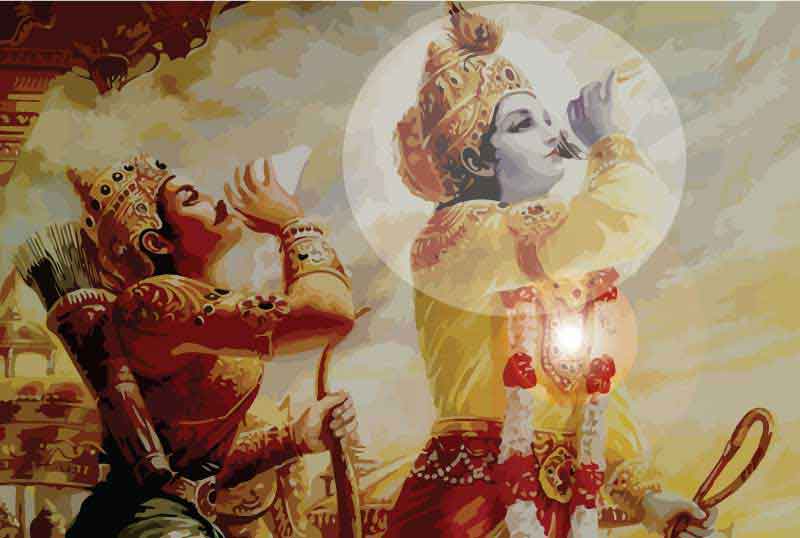
He personally served as the charioteer of Arjuna and boosted his morale in the battlefield with his divine discourse (Bhagavadgita), when the later lost his heart and refused to fight with his own kinsmen on the grounds of moral dilemma. Without him, Arjuna would have probably lost either the battle or his nerve or both.
The moral of the story
The moral of the story is in whatever we do we should always seek the help and guidance of God and make him a partner in all our endeavors. It does not matter whether we are rich or poor or weak or powerful. What is important is whether we have God on our side or not. Of what use all the power and riches in the world, if God is not with us and God is not part of our effort?
Duryodhana had everything he wanted. But he lacked faith. He ignored the support of God. He thought he had the necessary power and resources to deal with his enemies. He thought unwisely that he could do everything by himself. He did not care to stand against God in the battle field and fight with Him.
He believed in himself and that he was the master of his own fate. He would win, if necessary by fighting against God. He would take the help of God in securing the assets and the resources, but would not personally want Him on his side. Such attitude and thinking proved his undoing.
There is an important lesson in all this, which is very relevant today and which we can learn to save ourselves from the consequences of our selfish actions. If you look carefully you will see that in the present day world there are more Duryodhanas amidst us than Dharmarajas.
We have people among us who would go to any length and resort to any means to achieve success and popularity in their lives. It does not matter to them whether God is with them or against them. They do not care whether they are righteous or otherwise. They have scant respect for relationships, family, tradition and moral values.
What matters to them is material success in the form of money, power and wealth. They feed upon their own pride and revel in their own glory. They may use the name and power of God, but only with a selfish intent and for a selfish purpose, without ever acknowledging it. If necessary they do not mind to defy Him or His Law to achieve their goals. Seeing but themselves and living and acting for themselves, they live under the illusion that their personal efforts are responsible for their achievements and they are masters of their own fate.
Their obsession with power, name and fame is so strong that they may take credit for the work done by others, but rarely come forward to appreciate others. In a similar vein, they show no gratitude for the silent support rendered by God. This is unfortunate because in doing so they are exposing themselves to the consequences of their own actions (kama) and also alienating themselves from their own inner divinity.
If we want to be free from the excesses of our own successes, we have to make God our guide and guru and seek His assistance in every thing we do. Most importantly, we have to invite him wholeheartedly into our lives and give Him the rightful place by making Him the charioteer of our lives. It does not matter whether we have the material comforts or not.
What matters is whether we are with God and on His side in our commitment to follow Dharma. We have to repose faith in Him and seek His blessings in all our actions. Instead of taking pride in what we do or what we have accomplished, we have to show humility by acknowledging His role in our lives and all our successes and failures.
This is the path of surrender and devotion, in which there is no failure, no disappointment, no fear and no ignominy, but only success, happiness and ultimate victory against our own demons. It surely is the path of superior knowledge and eternal freedom. It is a path on which we are never alone and never left out or let down.
How can you make God your partner, mentor, guide and guru?
It is by acknowledging His presence in your life and by expressing your gratitude.
It is by remaining on the right side of things and not being tempted into evil ways and shortcuts to achieve success in your life.
It is by associating yourself with the good and staying away from all that is morally bad for you and for others.
It is by doing good things and offering all your actions to God with a sense of sacrifice.
It is by cultivating detachment, discipline and charity.
Finally, give at least a little percent of your income as a charity for a good cause, in return for the help and the blessings you have received from God.
Suggestions for Further Reading
- Om, Aum, Pranava or Nada in Mantra and Yoga Traditions
- Brahmacharya or Celibacy in Hinduism
- Atheism and Materialism in Ancient India
- Solving the Hindu Caste System
- How To Choose Your Spiritual Guru?
- Creation in Hinduism As a Transformative Evolutionary Process
- Wealth and Duty in Hinduism
- Do You Have Any Plans For Your Rebirth or Reincarnation?
- Understanding Death and Impermanence
- Lessons from the Dance of Kali, the Mother Nature
- Letting your God live in You - The True Essence of the Hindu Way of Life
- prajnanam brahma - Brahman is Intelligence
- Maslow's Hierarchy Of Needs From The Perspective Of Hinduism
- The Defintion and Concept of Maya in Hinduism
- The Meaning of Nirvana
- Self-knowledge, Difficulties in Knowing Yourself
- Hinduism - Sex and Gurus
- The Construction of Hinduism
- The Meaning and Significance of Heart in Hinduism
- The Origin and Significance of the Epic Mahabharata
- The True Meaning of Prakriti in Hinduism
- Three Myths about Hinduism
- What is Your Notion of God?
- Why Hinduism is a Preferred Choice for Educated Hindus
- Essays On Dharma
- Esoteric Mystic Hinduism
- Introduction to Hinduism
- Hindu Way of Life
- Essays On Karma
- Hindu Rites and Rituals
- The Origin of The Sanskrit Language
- Symbolism in Hinduism
- Essays on The Upanishads
- Concepts of Hinduism
- Essays on Atman
- Hindu Festivals
- Spiritual Practice
- Right Living
- Yoga of Sorrow
- Happiness
- Mental Health
- Concepts of Buddhism
- General Essays