
Hinduism Concepts, Beliefs and Practices
"After a study of some forty years and more of the great religions of the world, I find none so perfect, none so scientific, none so philosophical and none so spiritual than the great religion known by the name of Hinduism."-Annie Wood Besant
"That which we call the Hindu religion is really the eternal religion because it embraces all others." - Sri Aurobindo
Hinduism is the oldest, living religion of the world. It is also the largest, surviving religion from the pre-Christian era. Hinduism has no founder. It has no specific date of origin. It represents a set of beliefs and practices which originated in India at different times. Hinduism has many sects, sub-sects, schools of philosophy, rural and folk traditions. Some of them may be traced back to the Indus times or even prehistoric times (5000 BC).
Hinduism developed entirely in the Indian subcontinent. Hence, it is deeply ingrained in the culture of India, which is also unique, despite that it is shaped by many ethnic groups and rural communities who practiced primitive faiths and local traditions, which are today integrated into Hinduism. Unlike other religions, its doctrine is not derived from a single scripture, teacher, messenger or single source. It has no central institution which controls its doctrine or practice. It has not core mission other than helping the people escape from suffering.
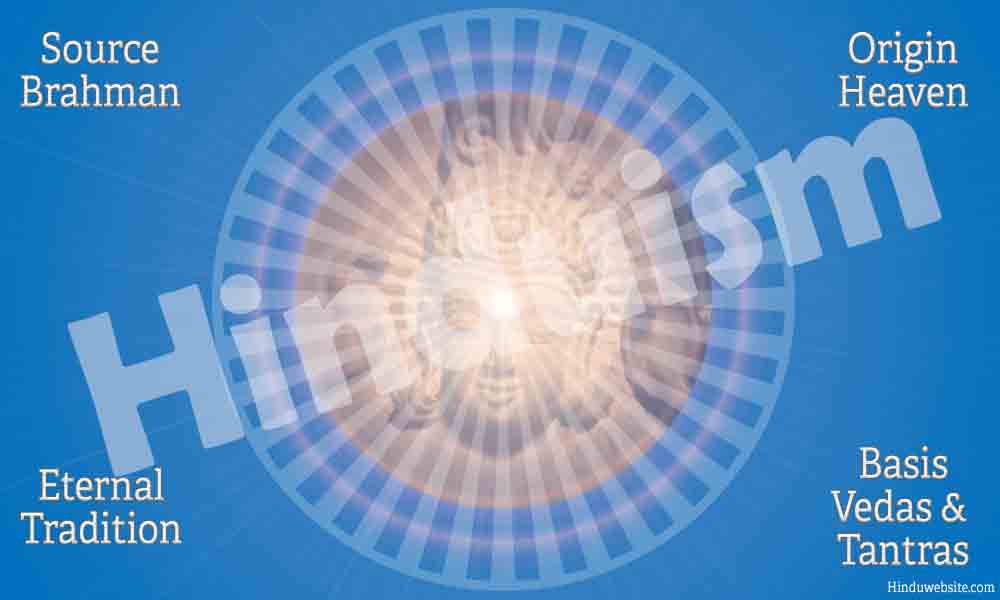
Its core knowledge, which has survived the ravages of time, is believed to be eternal, existing forever in the highest heaven, and God is said to be its primary source. The diverse aspects of Hinduism which impart to its complex and composite character, share a common history, some differences and some similarities. Some which contributed to its growth in the past might have also disappeared.
Hinduism is difficult to understand without practicing it. It is difficult to understand even for Hindus, unless they study it and practice it for several years Contemporary Hinduism or what people understand as popular Hinduism has a diverse range of beliefs and practices, sects and schools of philosophy, some of which may stand in their own right as religions themselves. Due to its peculiar history, unique features and absence of organized leadership, Hinduism acquired a distinct and exceptional character or its own. For the same reason, Hinduism is difficult to define and cannot be equated with other world religions such as Christianity, Buddhism or Islam.
Truly, Hinduism is a collection of faiths rather than a single faith. It has many layers, which cannot be easily understood unless one is conversant with its archaic expression and deeper symbolism. It is why many foreigners, who write about Hinduism without practicing it, often find themselves in deep controversy. Currently, main stream Hinduism consists of all the religious sects, traditions, philosophies, beliefs and practices that originated in India, except Buddhism, Jainism and Sikhism. Although it is difficult to summarize essential Hinduism in brief essay, without compromising its true character, the following is an attempt to present the essential beliefs and practices of Hinduism.
1. Brahman, God
Hinduism is a theistic religion which believes in the existence of an eternal, formless, supreme, infinite, indestructible, indivisible, all-pervading supreme God. However, he also manifests in the worlds in association with Nature in diverse forms. The One becomes many as a part of creation, and they eventually return to him at the end of each time cycle. The one is hidden in all as their essential Self. He envelops them as well as pervades them. He also goes by many names and has many aspects, such as Isvara, Hiranyagarbha, Kala, Viraj, etc. While he is independent and eternal, his creation is diverse, dependent and destructible.
2. Srishti, creation
Unlike Buddhism and Jainism which do not believe in God, Hinduism believes that God is the creator and source of all. He creates the worlds either out of himself or by awakening Nature. Therefore, he is considered both the efficient and the material cause of creation. Creation in Hinduism is cyclical. Each cycle of creation has four epochs namely Satyug, Tretayug, Dwaparayug and Kaliyug. Starting with the first, Dharma and righteousness progressively decline while evil gradually gains upper hand to the point where life becomes extremely difficult for people of faith and devotion. At the end of the fourth epoch, God withdraws all the worlds and beings into himself and starts another cycle of creation after a period of rest.
3. Atman, the individual Self
Hinduism believes in the existence of an eternal, indestructible, infinite, pure, all knowing, indivisible and blissful soul as an aspect of God or as an eternally independent entity by itself. When a soul becomes associated with Nature, it assumes a body, name and form and becomes bound. In its pure state, each soul is essentially the same as God in all aspects, or perhaps slightly different. The souls in all beings are the same. Since they are formless, infinite and without any qualities or attributes, each soul is usually called the Self rather than a soul. The souls take birth in different bodies according to their karma. The bodies are like clothes to them, which they discard at the time of death. Human birth is attained after countless births and deaths. It is a precious opportunity to work for liberation and escape from the cycle of births and deaths.
3. Devas, gods and goddesses
Hinduism not only believes in one, supreme God but also in numerous gods and goddesses who inhabit the higher worlds and play an important role in upholding Dharma and ensuring the order and regularity of the world. The gods are all not the same, since they occupy different sphere and possess different powers and qualities. However, they are neither separate nor different from the Supreme Being in their highest aspect. They partake his essential nature and hare his duties and responsibilities to keep the worlds in control and free from chaos. Hindus revere them according to their knowledge, nature and aspiration. According to the scriptures, if they worship them as distinct gods, they go to them or their sphere at the time of death. However, if they worship them as aspects of the Supreme God, they go to him only.
4. Dharma, Obligatory moral duty
Dharma is central Hinduism. It is a complex word, with many meanings. In a simple sense, Dharma means moral duty or obligatory duty, which one has to perform to keep the world going. The practice of Dharma ensures the order and regularity of one’s own life, family and society. By honoring their duties and moral commitments, humans can establish a just world in which one can live happily and strive liberation. The duties of humans arise from God only. As the creator and preserver of the worlds, he performs many duties and enforces many laws, which are collectively known as Dharma. He delegates the same duties to humans in this world and to gods in heaven so that they can participate in his creation as his devotees (Bhagavatas). Since upholding the Dharma of God in all aspects of life is central to Hinduism, it is called a way of life.
5. Yajna, the sacrifice
Hinduism views sacrifice as the basis for all existence. Hindus are expected to perform various sacrifices in their lives as part of their Dharma or religious duty. Certain sacrifices are obligatory. They constitute karma as well as Dharma. However, ritual sacrifices are just one outer aspect of the Sacrifice, which according to the Vedas is Brahman himself in his dynamic aspect. A sacrifice usually involves an offered or sacrificer (the host), his offering or sacrifice (hutam, ajyam or tarpanam) and one or more recipients, who may gods or humans or both. Thus, each sacrifice facilitates the exchange, circulation or transfer of things from one entity to another or one world to another or one end to another. Thus, Hinduism envisions sacrifice in every action and movement. Actions such as creation, destruction, sleeping, eating, walking, birth, marriage, breathing, digestion, meditation, war, selling, buying, giving, taking, sexual intercourse and many other actions constitute sacrificial actions only.
6. Belief in Samsara
According to Hinduism, souls in the mortal world are caught in the cycle of births and deaths, which is called the Samsara. They cannot easily escape from it ,since they are subject to desires, attraction and aversion, attachments, delusion, ignorance, egoism and other impurities. As they engage in desire-ridden, selfish actions, they attract sinful karma and remain bound. To escape from Samsara, they have to overcome the impurities, by cultivating purity, equanimity, detachment through renunciation and self-transformative practices such as jnana, karma, sanyasa yoga and devotion.
7. Belief in karma
Karma is one of the fundamental doctrines of Hinduism, according to which all actions produce positive or negative consequences, especially when they are performed with desires and attachments, and determine our fate and our future lives. While desire-ridden actions lead to bondage and suffering, actions, which are performed without desire and as an offering to God, do not bind us. One should therefore perform all actions selflessly without desire for their fruit and offer them to God as a sacrificial offering.
7. Belief in Maya
Hinduism considers the world in which we live is unreal and an illusion. It is unreal because it is a projection that lasts for the duration of a time cycle and disappears, just like a dream. Because of the desires, ignorance, and delusion, human beings mistakenly believe it to be true and become involved with it. The involvement is a trap, and until they realize what it is truly, they will remain bound to it and to mortality. The concept that the world is a projection, illusion, or idea, is known as Maya.
8. Belief in rebirth
Hinduism believes in the rebirth, reincarnation, or transmigration (punarjanma) of souls. Souls are born upon earth repeatedly until they achieve liberation. Death is a temporary phase, during which the souls travel to the ancestral heaven and stay there, until they exhaust their karma. Then they fall down to earth and take rebirth. One should therefore not grieve for the dead. Instead, they should make them offerings and help them build their astral bodies in the ancestral heaven. What dies in death is the body not the soul. The body is like a garment, which is worn afresh by the soul, whenever it takes birth. The body is perishable, while the Self is imperishable. Therefore, human beings should cultivate a soul-centric attitude and live responsibly to liberate themselves from the mortal world.
9. Belief in liberation
According to Hinduism life in any of the world is temporary and fraught with suffering and innumerable risks. One may enjoy pleasures in the higher worlds or in the ancestral world but eventually they souls have to return to the earth to take another birth, having exhausted their karma. A householder may uphold Dharma and live righteously, fulfilling his obligatory duties, but it will not save him from rebirth. One can escape rebirth and worldly suffering only by attaining liberation or Moksha by renouncing the world and engaging in spiritual practice.
10. Belief in the freedom of choice
Hinduism acknowledges the diversity and inequality which characterizes creation. Although all beings possess the same souls, they are all not alike. The gunas play an important role in influencing their thinking and actions and inducing in them different desires, likes and dislikes and attitudes. They are also subject to ignorance, egoism and delusions. Because of these inherent differences, you cannot make them all worship the same God, think alike or act alike. Therefore, Hinduism believes that people should be given a choice to choose their own paths to worship gods or strive for liberation. Because of the diversity in creation, the paths to God are many and each lead to him only. Some circuitous, and one may caution people about them, but the final choice should be left to them only. Hinduism therefore believes people should not be confused or disturbed with the knowledge which they cannot understand and for which they are not prepared, one’s own Dharma is better than that of another, however superior it may be.
11. Nonviolence
In Hinduism, nonviolence is the highest virtue. The state of nonviolence is the culmination of all the yogas and self-purification. Without nonviolent attitude, the mind cannot be rested in peace or prepared for Self-realization. Hinduism acknowledges violence, which is inherent in existence, and which is imperative for the beings to survive. It is part of God’s play and Nature’s design to keep the beings bound to the mortal world. It is difficult to be at peace with oneself or with others and avoid conflicts when one is afflicted with desires and the impurities of egoism, selfishness, envy, pride, etc. Therefore, the scriptures rightly advise people to cultivate nonviolence as an essential part of their spiritual practice to attain liberation. Nonviolence means not only not killing and not injuring but also not disturbing others and not becoming disturbed by them. Therefore, it should be practiced in all aspects of life.
12. Respect for diversity
Hinduism is not a dogmatic religion, not does it believe in the aggressive conversion of people other faiths unless they willingly come forward. It acknowledges diversity 1 and individual differences as the manifestation of God’s will. People should be allowed to live their lives and make their own choices according to their karma. Others may help them with knowledge, service or charity, but it should be done so with the right attitude as a sacrifice or service to God. No one can take responsibility for the life of another, unless the person is dependent, or there is a moral obligation. God is the supreme controller. No one should step into his shoes and try to reform the world, without his permission. If one wants to do it, it should be done with the right attitude, as part of one’s karma, sanyasa yoga, in which one has to renounce desires and expectations and offer the fruit of his actions to God only as a sacrifice.
The universality of Hinduism
In Hinduism, every human being is a creation of God and an aspect of God. He has duties and obligations as an individual and as part of God's creation. Even when engaged in doing them, he should never forget who he is and his deeper connection with God. As God's manifestation upon earth and upholder of Dharma, he must understand that unique connection and strive for liberation. For that he must first acknowledge his own spiritual nature, his undeniable divinity and his inseparable connection with God. The objective reality is a distraction. One must focus upon the subjective reality and becomes firmly established in it so that one enters the transcendental state of pure consciousness.
Truly speaking, a Hindu is not just a follower of Hinduism or a particular religion. It does not even matter, whether he is a follower of Hinduism or not. Any person who is a seeker of truth and who is interested in knowing the truth of himself and his existence is a Hindu, whether he believes in God or not, whether he is a Hindu or a Buddhist or a person of some other faith. A Hindu is an individual soul who has been separated from God, is under illusion and has been in the process of rejoining God someday. No one need to force him to become a Hindu in the physical sense, because one day, in some birth, he will become aware of what he is or who he is. What he does in between is all part of a Divine Play.
Suggestions for Further Reading
- Hinduism in a Nutshell For the Beginners
- The Origin and Definition of the Name Hindu
- The History, Antiquity and Chronology of Hinduism
- Main Beliefs and Practices of Hinduism
- Hinduism and Caste System
- What is Hinduism?
- Moksha or Liberation in Hinduism
- What is Karma in Hinduism?
- God and Soul, Atma and Paramatma, in Hinduism
- Hinduism - The Faith Eternal
- Hinduism and Religious Tolerance
- Hinduism and Diversity
- Scriptures of Hinduism
- Gods and Goddesses of Hinduism
- Significance of Death in Hinduism
- Significance of Happiness in Hinduism
- Theism and Atheism in Hinduism
- Origin, Definition and Introduction to Hinduism
- The Definition of Hindu and Hinduism
- The Hindu Way Of Life, Living According To Hindu Dharma For Self Realization
- Essays On Dharma
- Esoteric Mystic Hinduism
- Introduction to Hinduism
- Hindu Way of Life
- Essays On Karma
- Hindu Rites and Rituals
- The Origin of The Sanskrit Language
- Symbolism in Hinduism
- Essays on The Upanishads
- Concepts of Hinduism
- Essays on Atman
- Hindu Festivals
- Spiritual Practice
- Right Living
- Yoga of Sorrow
- Happiness
- Mental Health
- Concepts of Buddhism
- General Essays
1. Please check the following essay: The Diversity and Contradictions Of Hinduism