
The Buddha's method of Teaching
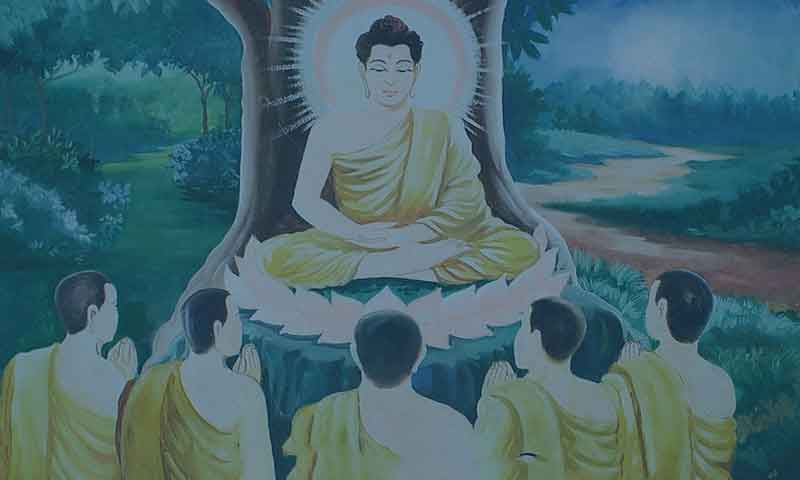
The Dhamma, the truth taught by the Buddha, unfolds gradually. The Buddha made clear many times that Awakening does not occur like a bolt out of the blue to the untrained and unprepared mind. Rather, it culminates a long journey of many stages:1
Just as the ocean has a gradual shelf, a gradual slope, a gradual inclination, with a sudden drop-off only after a long stretch, in the same way this Doctrine and Discipline (dhamma-vinaya) has a gradual training, a gradual performance, a gradual progression, with a penetration to gnosis only after a long stretch. — Ud V.5
Monks, I do not say that the attainment of gnosis is all at once. Rather, the attainment of gnosis is after gradual training, gradual action, gradual practice. And how is there the attainment of gnosis after gradual training, gradual action, gradual practice? There is the case where, when conviction has arisen, one visits [a teacher]. Having visited, one grows close. Having grown close, one lends ear. Having lent ear, one hears the Dhamma. Having heard the Dhamma, one remembers it. Remembering, one penetrates the meaning of the teachings. Penetrating the meaning, one comes to an agreement through pondering the teachings. There being an agreement through pondering the teachings, desire arises. When desire has arisen, one is willing. When one is willing, one contemplates. Having contemplated, one makes an exertion. Having made an exertion, one realizes with the body the ultimate truth and, having penetrated it with discernment, sees it. — MN 70
In more practical terms, the Buddha taught this "gradual training" (anupubbi-katha) as a process that unfolds in six stages, guiding newcomers from first principles through progressively more advanced teachings, all the way to the fulfillment of the Four Noble Truths and the full realization of nibbana:
Then the Blessed One, having encompassed the awareness of the entire assembly with his awareness, asked himself, "Now who here is capable of understanding the Dhamma?" He saw Suppabuddha the leper sitting in the assembly, and on seeing him the thought occurred to him, "This person here is capable of understanding the Dhamma." So, aiming at Suppabuddha the leper, he gave a step-by-step talk, i.e., a talk on giving, a talk on virtue, a talk on heaven; he declared the drawbacks, degradation, & corruption of sensual passions, and the rewards of renunciation.
Then when he saw that Suppabuddha the leper's mind was ready, malleable, free from hindrances, elated, & bright, he then gave the Dhamma-talk peculiar to Awakened Ones, i.e., stress, origination, cessation, & path. And just as a clean cloth, free of stains, would properly absorb a dye, in the same way, as Suppabuddha the leper was sitting in that very seat, the dustless, stainless Dhamma eye arose within him, "Whatever is subject to origination is all subject to cessation." - Ud v.3
At each stage of the training the practitioner discovers a new and important dimension of the law of cause-and-effect — kamma, the cornerstone of Right View. It is thus a very useful organizing framework with which to view the entirety of the Buddha's teachings.
The gradual training begins with the practice of generosity, which helps begin the long process of weakening the unawakened practitioner's habitual tendencies to cling — to views, to sensuality, and to unskillful modes of thought and behavior. This is followed by the development of virtue, the basic level of sense-restraint that helps the practitioner develop a healthy and trustworthy sense of self. The peace of mind born from this level of self-respect provides the foundation for all further progress along the path.
The practitioner now understands that some kinds of happiness are deeper and more dependable than anything that sense-gratification can ever provide; the happiness born of generosity and virtue can even lead to rebirth in heaven — either literal or metaphorical. But eventually the practitioner begins to recognize the intrinsic drawbacks of even this kind of happiness: as good as rebirth in wholesome states may be, the happiness it brings is not a true and lasting one, for it relies on conditions over which he or she ultimately has no control.
This marks a crucial turning point in the training, when the practitioner begins to grasp that true happiness will never be found in the realm of the physical and sensual world. The only possible route to an unconditioned happiness lies in renunciation, in turning away from the sensual realm, by trading the familiar, lower forms of happiness for something far more rewarding and noble. Now, at last, the practitioner is ripe to receive the teachings on the Four Noble Truths, which spell out the course of mental training required to realize the highest happiness: nibbana.
Many Westerners first encounter the Buddha's teachings on meditation retreats, which typically begin with instructions in how to develop the skillful qualities of right mindfulness and right concentration. It is worth noting that, as important as these qualities are, the Buddha placed them towards the very end of his gradual course of training. The meaning is clear: to reap the most benefit from meditation practice, to bring to full maturity all the qualities needed for Awakening, the fundamental groundwork must not be overlooked. There is no short-cutting this process.
Here is the Buddha's six-stage gradual training in more detail:
I. Generosity (dana)
II. Virtue (sila)
1. The 5 Precepts
2. The 8 Precepts
3. The 10 Precepts
4. Uposatha observance days (including this year's calendar of Uposatha days)
III. Heaven (sagga)
1. The Thirty-one Planes of Existence
IV. Drawbacks (adinava)
V. Renunciation (nekkhamma)
VI. The Four Noble Truths (cattari ariya saccani)
1. The Noble Truth of Dukkha (dukkha ariya sacca)
i. Dukkha
ii. The round of rebirth (samsara)
2. The Noble Truth of the Cause of Dukkha (dukkha samudayo ariya sacca)
i. Craving (tanha)
ii. Ignorance (avijja)
3. The Noble Truth of the Cessation of Dukkha (dukkha nirodho ariya sacca)
i. Nibbana
4. The Noble Truth of the Path Leading to the Cessation of Dukkha (dukkha nirodha gamini patipada ariya sacca) — The Noble Eightfold Path:
Suggestions for Further Reading
- Auspicious and Admirable Friendship, Kalyanamittata
- Practical advice for meditators
- Buddhism - Guidelines for Meditation
- Code of Conduct and Discipline For the Buddhist Monks
- Rules For Monks in Theravada Buddhism
- Bodhinyana A Collection of Dhamma Talks
- Buddhism - Meditation Upon the Body
- Principles of Lay Buddhism
- The Buddha's Method of Teaching
- About The Buddhist Meditation
- Dana - Charity and Generosity in Buddhism
- Dana, The Practice of Giving
- The Role of Meditation Pain, Illness and Death
- Dhamma Vinaya - Training Rules for the Monks
- Duties of the Buddhist Sangha
- Giving Gifts and Money to the Buddhist Monks
- The Buddha On How The World Will End
- An Anthology of The Teachings of Ajaan Lee Dhammadharo
- Ajan Suwat Suvaco on The Dhamma Practice
- Talks on the Dhamma Practice For the Buddhist Monks
- Food Rules For Buddhist Monks
- Training the Mind With Mindfulness
- Pabajja, Entering Into to Buddhist Monkhood
- Understanding Anicca, Dukkha, and Anatta
- Buddhism For Lay Buddhists
- Buddhism - Stages in the Practice of Dhamma
- Suda Sutta - Meditation and Cooking
- Anapana Sati, Meditation on Breathing
- Buddhist Meditation and Depth Psychology
- Forty Dhamma Talks on Meditation
- Buddhism: A Method of Mind Training
- Anapanasati Sutta Mindfulness of Breathing
- The Place of Vipassana Meditation in Buddhism
- Buddhism - The Power of Mindfulness
- A Modern Treatise on Buddhist Satipatthana Meditation
- A Teaching on Satipatthana Vipassana Meditation
- Talks for Beginning Meditators
- Buddhism - Talks on the Training of the Mind
- Essays On Dharma
- Esoteric Mystic Hinduism
- Introduction to Hinduism
- Hindu Way of Life
- Essays On Karma
- Hindu Rites and Rituals
- The Origin of The Sanskrit Language
- Symbolism in Hinduism
- Essays on The Upanishads
- Concepts of Hinduism
- Essays on Atman
- Hindu Festivals
- Spiritual Practice
- Right Living
- Yoga of Sorrow
- Happiness
- Mental Health
- Concepts of Buddhism
- General Essays