
A Christian's Journey Into Buddhism
Contents
- Introduction
- Non-retaliation
- The Brahmaviharas
- Vesak
- The Self in Buddhism and Christianity
- Detachment and Compassion
- Buddhism and Social Justice
- Compassion
Introduction![[go to top]](../../images/scrollup.gif)
In November 1992, David Craig, head of Religious Broadcasting for the World Service of the BBC, and Rev. Martin Forward, Interfaith Officer for the Methodist Church in Britain, visited Sri Lanka to gather material on Buddhism for a series of programs to be broadcast in 1993 during a focus on South Asia. I helped to plan their program and was also asked to prepare a few talks for the World Service's daily "Words of Faith" spot — a four minute pre-recorded broadcast sent out three times each day. Four talks resulted, broadcast in April and May 1993. Towards the end of 1993, I was asked for more and six went out in April and May 1994. Of these ten talks, eight have been selected for the present Bodhi Leaf: four from the 1994 series (presented first) and the four from the 1993 series (slightly expanded, placed after the 1994 talks).
The themes of the talks are rooted in my journey, as a Christian, into Buddhism. In the mid-1980's I felt the need to "let go" of my own religious conditioning to enter the world of another faith. It grew from a conviction that people with an interest in religion should not remain imprisoned within one framework but should explore others. The choice of Buddhism and Sri Lanka was a natural one for me. Buddhism's emphasis on meditation and non-violence touched my own interests as a Christian, and a visit to Sri Lanka in 1984 had left me with the feeling that my link with the island was not finished.
I originally intended to be in Sri Lanka for one year. One year, however, became seven and a half, from 1986 until 1993. My aim throughout was not only to study Buddhism but to practice it. I did not consider myself involved in "interfaith dialogue" although I'm sure some perceived my actions in this way. I wanted to enter Buddhism on its own terms, as a human being rather than as a Christian. The subjects of all the talks printed here arise from the personal journey of discovery that resulted. They draw on conversations with Buddhist friends, travel to different parts of the country in times of war, the experience of meditation, and my reading of the Pali texts. Most importantly, they reflect the concerns which developed as the interests I brought from Britain encountered Buddhism and Sri Lanka: the relationship between non-attachment and outgoing compassionate action; the practical meaning of anatta (no soul) and its implications; the benefit of sati (mindfulness) for the individual and society; the resources Buddhism can offer to those working for social justice and inter-ethnic or inter-religious harmony; the question of a woman's role in society.
My journey into Buddhism was not always an easy one and of course I could not let go of my Christian conditioning completely, but it has brought me to a stage when I can say with utter sincerity that I revere the Buddha and take refuge in his teachings. I remain a Christian, one who seeks to follow the self-sacrificial path of Jesus of Nazareth, but I also feel at home in a Buddhist meditation center. The talks, I hope, will show that this is possible. I dedicate them to all the Sri Lankan friends who have brought me to a deeper understanding of the heart of Buddhism.
Elizabeth Harris
June 1994
1. Mindfulness
Once I told an academic in Sri Lanka that I practiced a Buddhist form of meditation. Flippantly, he asked whether I was able to levitate. That's not an uncommon reaction. It confuses meditation with self-induced trance or making the mind a blank, something that is unrelated to everyday life. But to make such a confusion is a mistake. True Buddhist meditation is a vigorous form of mind-training which can transform both thought and action.
In the Theravada Buddhist tradition, found in Burma, Sri Lanka, and Thailand, the practice of mindfulness or "bare attention" is very important. When sitting in meditation, perhaps noting the breath as it touches the inside of the nostrils, thoughts inevitably enter the mind. Usually they relate to oneself in the past or the future. Recent conversations replay themselves. Decisions yet to be made thrust themselves forward. Reactions of dislike to bodily pains arise. And occasionally, images freed from a deeper level of our being move slowly upwards. When thoughts and feelings arise in meditation, they are to be simply observed. They are not to be repressed or pushed aside, but neither are they to be allowed complete freedom to proliferate. Their arising and passing is noted without censure or praise.
When I first began to meditate I discovered that thoughts and feelings are fluid, ever changing, often uncontrollable, frequently illogical and irrational. It was a painful realization, since I had assumed my mind was under my direct control. But it was also the beginning of self-knowledge, the beginning of knowing how my mind worked and the doorway to modifying conditioned and negative patterns of reaction in my own life.
At one meditation center in Sri Lanka, high in the mountains, surrounded by tea estates, the first session begins at five in the morning. I had to get up by candlelight, pull on warm clothes, and cross the grass to the meditation hall, under a sky often brilliantly full of stars. One morning, I was gazing at the dark, silvered beauty of the sky when I heard steps below me. At that moment, I caught my mind saying, "Go on into the meditation hall so that they can see you were up first." Normally, I would have hurried into the hall to show my punctuality, but on that occasion I noted the thought, recognized the element of competition, and consciously refused to act on it. I stayed for several more moments rapt in the pre-dawn stillness, feeling the cool air against my skin, and I was certainly not the first to settle my cushions before the silent, candle-lit image of the Buddha. And I know it was the practice of sati, of mindfulness, which made that moment of insight into my own competitive egotism possible, insight into a childish wish to impress, to be top of the class.
Meditation of this kind is hard work. It has nothing to do with making the mind a blank, though it can lead to peace and calm when the racing mind stills and there is only the present moment. One monk who taught me put it this way: "Meditation is the ultimate practice of non-violence. Suffering, pain, and feelings of anger are not suppressed but faced, confronted, and transformed."
2. Non-Retaliation
In one sermon of the Majjhima Nikaya, one of the five sections within the collection of sermons in the Pali Canon, the Buddha says to his disciples:
Monks, as low-down thieves might carve you limb from limb with a double-handed saw, yet even then whoever sets his mind at enmity, he, for this reason, is not a doer of my teaching. This is how you must train yourselves: neither will my mind become perverted, nor will I utter an evil speech, but kindly and compassionate will I dwell, with a mind of friendliness and devoid of hatred.
The vividness of this picture has always moved me — a thief hacking off my arms and legs with a saw. And it isn't that far-fetched. War involves such butchery. The denial of human rights under totalitarian regimes produces similar horror, and so does the obsessional urge of a multiple murderer. Fear, terror, or violent retaliation in self-protection would seem the natural reactions to such an attack, the reaction programmed into our bodies.
Yet the challenge of Buddhism here is: do not retaliate, do not hate; show compassion to all people even if they are about to kill you. It is a challenge which reaches out from other religions also. Jesus of Palestine, suffering the agony of being nailed through his flesh to rough wooden posts, forgave his killers and felt compassion for them in their blindness.
But does this imply that Buddhism advocates that we should never protect ourselves or others from violence, that we should submit to whatever exploitation we are subjected to, that in the face of evil forces we should remain passive? To answer "yes" is to misread Buddhism and all true religion. Buddhism does not support passivity in the face of violence and evil. Rather, it encourages a mental attitude which can face and oppose violence without fear or hatred.
Nowhere in the Buddhist texts is it suggested that we should remain inactive when others are suffering. Nowhere does it say we should refrain from action if someone is murdering our son, daughter, neighbor, or colleague in front of our eyes. In such situations, suffering must be relieved, violence must be denounced, self-sacrifice might even be demanded, though the Buddhist texts also warn that to meet violence with violence brings a spiral of further violence. What the Buddhist texts do say is that to hate, to feel anger towards the doer of violence, is self-defeating. It harms the hater more than the hated.
In the ancient Buddhist texts, we come across many stories of non-hatred deflecting violence and making it powerless. One woman, because she refuses to feel hatred, is unharmed when burning oil is poured over her by a jealous co-wife. And when a monk dies of snakebite, the Buddha says he would not have died if he had radiated loving kindness to the world of snakes. This might seem utopian in a world shot through with violence. The skeptic could point to the deaths of Gandhi in India, Oscar Romero in El Salvador, and Michael Rodrigo in Sri Lanka to show that the most compassionate of beings have been unable to escape violent deaths caused by the greed and hatred of others.
But the force of these religious teachings will remain. Violence is not overcome by violence. Hatred is not defeated by hatred. Our lives are not made more secure by wishing to protect them. To face death without hatred or fear, even towards our killers, is the path of sainthood. These are eternal truths.
3. The Brahmaviharas
A professor of Theravada Buddhism once asked me, "Why is it assumed, at all the interfaith gatherings I attend, that God is the uniting factor among the religions? We should be concentrating on humanity rather than divinity."
When it is taken for granted that all people of faith worship a Supreme Creator and Sustainer God, Buddhists and Jains are excluded. Although Buddhists believe that there are gods living in heavens, they do not ascribe creative power to them, nor do they believe that these gods have any influence over ultimate human liberation.
Belief in God cannot, therefore, provide common ground between Buddhists and religions such as Christianity, Islam, and Judaism. But can common ground be found in what religions say about humanity or about how we can work for a humane society? I believe the answer is "yes." Buddhism speaks of four brahmaviharas, or "divine abidings," and these qualities permeate the whole of Buddhist teaching. They are metta — loving kindness; karuna — compassion; mudita — sympathetic joy; and upekkha — equanimity.
Metta is boundless loving kindness radiated to all beings — to friends and enemies, the known and the unknown, the lovely and the unlovely. It is an action-changing mental orientation. Karuna is seen where people are so sensitive to the sufferings of others that they cannot rest until they act to relieve that suffering. To a greater degree than metta, karuna involves action. Mudita is a quality which challenges me greatly. To show mudita is to show joy in the success of others, to be free from jealousy or bitterness, to celebrate happiness and achievement in others even when we are facing tragedy ourselves.
As for upekkha, equanimity, this has often been misunderstood as indifference, as apathy in the face of human pain, the very antithesis of compassion. But upekkha is really freedom from the self-centeredness which clouds understanding and destroys true discernment. People with upekkha are not pulled this way and that by emotional reactions that have more to do with the ego than with true concern for others. They can see right from wrong and can act with wisdom.
The brahmaviharas speak to me of the ideals that should direct our lives — the ideals that can create the kind of society any truly religious person yearns for. Such a society would be one where loving kindness and compassion triumph over greed, where the success of one person does not mean the demeaning or exploitation of others, where rulers are guided by clear principles of right and wrong rather than hunger for praise or power. These "divine abidings" give a picture of the truly good. They touch the hope of all religions and can bring unity of purpose independent of a concept of God.
So let compassion for the good of humanity be at the forefront of religious encounters. May those who come from the monotheistic traditions discover that they can share their hopes for a righteous society with their Buddhist neighbors. May Buddhists find themselves united with their Jewish, Christian, and Muslim friends in working for a world where loving kindness takes the place of greed.
4. Vesak
In May 1991 I traveled from war-torn Jaffna in northern Sri Lanka to the South. It was at Vesak, the time when Buddhists celebrate three major events in the life of their Master: his birth, his awakening into Buddhahood, and his passing away into final Nibbana. It was like moving from one world into another. In the North, the tension was palpable — towns gutted by fighting, vast stretches of empty roads, people with hardship in their eyes. But as we crossed over into the South, there was celebration. Groups of boys flagged down our car to thrust fruit drinks into our hands. Lanterns of wire and colored paper hung in porches with their streamers flowing in the breeze. And nearer Colombo came the first of the pandals — massive, temporary structures by the road, brilliantly lit, telling in pictures Buddhist stories of how self-sacrifice triumphs over violence, how compassion vanquishes hatred.
Vesak is the most important religious festival of the Buddhist year. It is marked by light, pilgrimage, and the re-telling of stories. At its heart is remembrance of the Buddha's solitary striving in meditation under a tree near Gaya in India 2500 years ago.
The serene face of the Buddha image can give the impression that this striving led to an experience of the metaphysical. But Prince Siddhattha became the Buddha not because he was lifted beyond the world but because he saw the real nature of the world. It had been his sensitivity to human suffering that had made him leave his wife and son years before. He had wanted an answer to the question: Why? Why was life shot through with the pain of illness, bereavement, and unrealized longings? At Bodhgaya, he found it. He saw that humans were bound to anguish-filled lives because their interpretation of the world was wrong. He saw that our fault was to believe that our lives, our possessions, and our hopes are centered around an unchanging self which has to be protected and promoted. He saw that only suffering was the result, fuelled by the greeds and hatreds flowing from selfish craving.
"All formations are impermanent," is what the Buddha understood. Self-centered clinging, he realized, was the fruit of delusion. With this came liberation. The prison of selfhood evaporated. Raga and dosa, greed and hatred, were destroyed. Boundless compassion was released and he could teach the world that suffering has a cause and can be eradicated.
At Vesak Buddhists celebrate this knowledge that suffering can be ended, that within the pain of life there is hope. In 1991 and today in 1994, that celebration takes place against the backdrop of war, in Sri Lanka and elsewhere — war caused by interlocking structures of injustice, rooted in human greed and human illusion, throwing the innocent before the barrel of a gun or under the rubble of a shelled building. My hope is that the Buddha's message will not only be heard but acted upon. All war and conflict can be traced back to some form of craving or delusion. It may be craving for power, or domination by an individual or group, or the delusion which flows from distorted history or myth. Vesak should call us to analyze the causes of our bloodletting, to see where craving and greed cloud objectivity and prevent peace.
The story goes that the Buddha was at first loathe to share with others what he had learned because so few would understand its hard but liberating message. Our fortune is that he did share it. The health of our world depends on whether we act on that message.
5. The Self in Buddhism and Christianity
Sri Pada, in Sri Lanka, is over 7,000 feet high and has been a place of pilgrimage for centuries. At the summit is a huge footprint, claimed variously to be that of the Buddha, Adam, and Lord Shiva. From December to May is the pilgrimage season. Each night during this season, thousands of devotees climb up an illuminated, lengthy ascent of steps. From a distance, the dark shape seems to have a diamond necklace thrown down its side. Sometimes the crowd is so large that pilgrims have to pause at each step they climb. The pressure on the leg muscles is incredible. An elderly Buddhist friend of mine climbed on such a night. She told me that the only way she could force her legs through the ordeal was to say of the pain, "This is not mine, this is not me."
She says the same in her meditation practice, and I have learned to do so too. When sitting in absolute stillness, irritations come, mosquitoes bite, pain from the knees shoots up, the strong urge to relieve itchy skin arises. But it is possible to conquer the wish to move or scratch by seeing the pain simply as pain and not as belonging to an "I." The pain becomes an object for meditation. It becomes a process that can be observed. This snaps the thread of our usual response to irritation, which is to claim it as ours and to seek to be rid of it. And it can also train the mind to detect and halt negative reactions to other forms of attack on our persons in everyday life.
All this touches on anatta, the Buddhist concept of no-self or no-soul. Anatta was seized on by nineteenth century Christian missionaries to Sri Lanka as something which proved Buddhism was absolutely nihilistic. For instance, Rev. Thomas Moscrop, a Methodist missionary, claimed in 1889 that Buddhism "is too pessimistic, too cold, too antagonistic to the constitution of human nature to take the world captive" (The Ceylon Friend, 16 October 1889). But I have not found nihilism in what Buddhists have said to me about anatta. Some years ago, one friend said, "If there is no belief in self, there is no worry; there is no reason to become angry or hurt." To her, the idea was liberating. It was freedom from being tied to self-promotion and self-protection.
I can remember how deeply her words challenged me. They helped me to see that Buddhism and Christianity are not in opposition here. The frameworks are different but the practical path towards human liberation touches both. Both religions speak about a wrong concept of the self. Buddhism says: Don't think you are fixed, unchanging. You are forever flowing, shifting, interconnected with the whole cosmos. Free yourself from clinging to the idea that you are separate and have to fight against the world to keep your identity intact. Christianity also has something radical to say. The Methodists, a Christian denomination which arose in eighteenth century England, have a Covenant Service on the first Sunday of each new year in which they pledge obedience to God. At one point they say, "I am no longer my own but thine." Saint Paul, in his letters to new churches, speaks of having lost his old self. To the Christians of Colossae in Greece, he says, "For you have died and your life is hid with Christ in God" (Colossians 3:3). All of these sayings point to a death of the egotistical self and a loss of self-sufficiency and self-worship.
Both Buddhism and Christianity say that the self which insists on its separateness from the rest of life is doomed. Buddhism says that such a self has no objective existence as an unchanging entity. Christianity says the self has to die to give way to a higher power of love. Both point to the liberation that comes when we transcend care for self, when we refuse to exert protective ownership over our lives and persons. I have certainly found that if we do not cling to pain, hurt, and fear as ours but accept them as part of the changing flux of existence, if we do not seek to protect our identity and safety at all costs, we will be able to climb more than Adam's Peak. We are liberated into a new way of seeing and a new openness to the ever-changing process of existence.
6. Detachment and Compassion
A Christian missionary in Sri Lanka once said to me with great sincerity, "The Buddha image speaks to me of coldness, of non-involvement, of a turning away from life. I prefer the image of Jesus Christ with his robes dirty with the sweat of the poor."
One stereotype of Buddhism is that it supports a withdrawal from the suffering of the world, a renunciation of active involvement with society. An inter-religious conference I attended a few years ago stays in my mind because one of the western participants insisted that outward-moving compassion was not an important part of Buddhism. My encounter with Buddhism forces me to challenge this stereotype. I did so at that conference and I continue to do so. It is outsiders — European observers and those seeking an escape from the world — who have projected onto Buddhism the encouragement of indifference to the agony within human life. It does not rise from within. Buddhism certainly speaks of destruction, renunciation, and detachment, but it is detachment from all those things which prevent compassion from flowing — from possessiveness, competitiveness, and selfishness. Viraga, one of the Pali words translated as detachment, actually means "without raga" — without lust, without possessive craving — not without concern for our world.
When I told a Buddhist monk here in Sri Lanka of my experience at that inter-religious conference, he simply said, "Without compassion, there can be no Buddhism." And that compassion is an active one. Buddhaghosa, the great fifth century commentator who came from India to work in Sri Lanka, gives several meanings to the Buddhist concept of compassion. He writes: "When there is suffering in others it causes good people's hearts to be moved, thus it is compassion. Or alternatively, it combats others' suffering and demolishes it, thus it is compassion. Or alternatively, it is scattered upon those who suffer, or extended to them by pervasion, thus it is compassion" (The Path of Purification [Visuddhimagga, translated by Bhikkhu Ñanamoli, BPS 1975], IX, 92). To extend compassion to others in meditation is certainly part of Buddhist practice, but so too is the effort to combat and demolish suffering. To combat suffering involves more than refraining from doing harm. It implies action to liberate others both from social forces which dehumanize and from imprisoning thought patterns which hinder wholeness and the living of a religious life. Such action is seen in the life of the Buddha and in the lives of all truly enlightened ones.
For me, the picture of Jesus Christ with his clothes marked with the suffering of the poor and the image of the Buddha do not contradict one another. They are not in conflict or competition. Compassion unites them. Jesus stretched his hands out to the poor and those despised in his society, taking into himself the world's evil. The Buddha, out of compassion for humans caught in the pain and suffering of existence, left his wife and son to seek a path of liberation for all.
In Polonnaruwa, one of the ancient, now ruined, capitals of Sri Lanka, there is a rock temple, the Gal Vihara, where three massive images are formed out of the stone. Two are of the Buddha. Peace seems to radiate from them and has done so for over 800 years. Yet it is not the peace of indifference or apathy. It is the peace of wisdom and compassion, which arises when the heart-rending nature of human violence and human greed is fully realized. It is not an anguished, twisted scream of torture at the nature of the world's inhumanity, but a silent, gentle embodiment in stone of empathy, compassion, and strength. In front of these very images, Thomas Merton, an American Christian monk of this century whose religious journey brought him very close to Buddhism, was urged to write, "The rock, all matter, is charged with dharmakaya... everything is emptiness and everything is compassion."
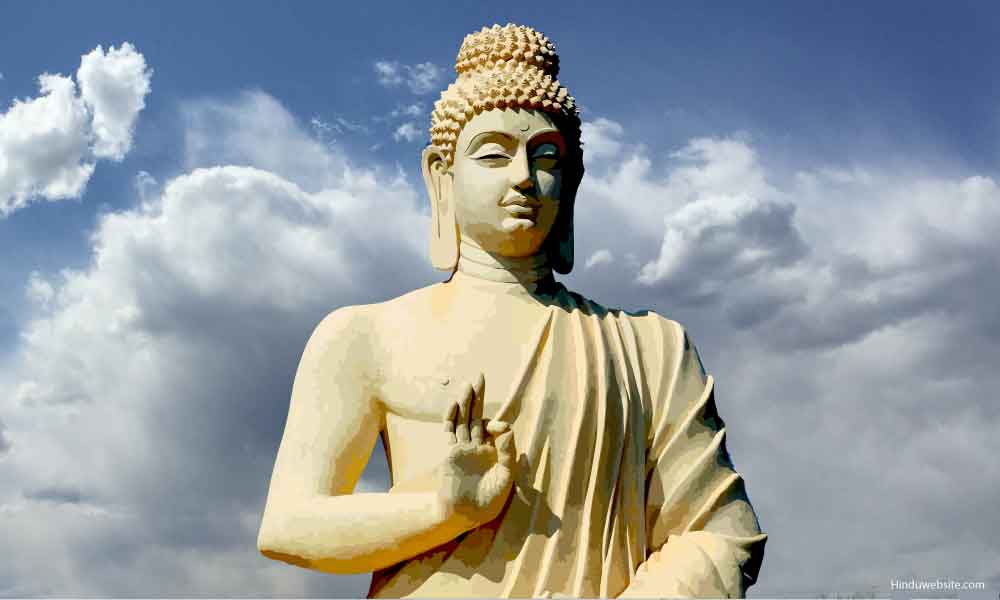
The Buddha image speaks to me, therefore, both of the wisdom which sees into the causes of human suffering and also of the compassion which lies at the very heart of true enlightenment. And it stirs me to try to do something to demolish some of the pain of our world.
7. Buddhism and Social Justice
Among such humans, brethren, there will arise a sword period of seven days during which they will look on each other as wild beasts; sharp swords will appear ready to their hands, and they thinking, "This is a wild beast," will with their swords deprive each other of life.
These words from the Pali Canon come towards the end of the Cakkavatti Sihanada Sutta of the Digha Nikaya. Here the Buddha describes the process whereby a society slides into a state of absolute anarchy and violence, reaching the point where all respect for the preciousness of human life is lost and humans kill each other without guilt or remorse. Stealing appears first, then murder; false speech and sexual promiscuity follow. Religion is undermined; respect for elders disintegrates; human life loses its worth. It is a horrifying picture of growing bestiality that is as relevant today as it was when first spoken.
When I first met Buddhism, an important question for me was what Buddhism had to say about the problems of violence and injustice, problems which affect every nation. The classic formula at the heart of Buddhism is that it is tanha, craving, which lies at the root of the world's misery. Often this is seen in a very individualistic way. The Buddhist path is held up as an escape route from suffering through withdrawal from society and through mental culture. I do not downplay this emphasis. The importance of mind-training was central to the Buddha's teaching. It holds the key to the liberating insight that can transform human life. Yet I have found that individual psychological factors are not the only ones emphasized in the Buddhist texts. The texts do give pictures for anyone concerned with justice and harmony within the body of society.
In the text I started with, the chain of causality which results in bestiality goes back to the State, the king, who forgets one of the duties ascribed to a just ruler in Buddhism. It is this: "And whosoever in thy kingdom is poor, to him let wealth be given." By overlooking this, the king denied the poor a living, and from this — a refusal to create economic justice — flows stealing, murder, lying, immorality, and bestiality. What I find interesting is that the accusing finger is pointed at the structures of power and not at evil qualities in the ordinary people. And the message is: violence and social breakdown are inevitable if people are denied the means to live with dignity. To use a Christian term, the poor in the myth are "sinned against" by their ruler. They are victims of structural injustice and their urge to survive corrupts the whole fabric of society.
The story within the Cakkavatti Sihanada Sutta, however, does not end with the sword period. When the depths of brutality have been reached, there are some who see the enormity of their fall from humane values. They go into retreat — into caves, jungle dens, and caverned tree trunks — and emerge to embrace one another and to restore harmony through the recovery of moral sense. A deterioration from the state downwards is transformed into a regeneration from the bottom upwards, through the will and discernment of the people themselves.
The message of this sutta challenges all those who see religion purely in individualistic terms. It demonstrates Buddhism's very real concern for social justice and also the stress it places on analyzing the root causes of disharmony and violence. It presents society as a net of interacting, interdependent beings who are helped or hindered from living wholesome lives by the forces which flow from the state or world structures. In Sri Lanka, I have met groups seeking to find elements in Buddhism relevant to social issues. This mythological story is one of them. It can be a resource to all of us. It urges us to look at the society in which we live critically and to ask, "Is there a deterioration of human values?" If so, we must ask further, "Does our society create the conditions in which each person can live with dignity?" If it does not, then Buddhism encourages not only a path of individual mental culture but also the kind of social involvement which recognizes the ability of ordinary people to change their situation and which seeks to struggle for a more just world where none is denied resources to live.
8. Compassion
Kataragama is a place of pilgrimage in the south of Sri Lanka, holy to both Buddhists and Hindus. In 1989, I went to their annual festival. On the final night, as elephants, drummers, and dancers were slowly and gracefully moving along the path between the shrine to Lord Kataragama and the Kiri Vehera, the Buddhist temple, with its milk-white dagoba, two powerful grenades were lobbed into the crowd, made up mainly of poor villagers but containing one political dignitary. About fifteen people were killed and many more were injured, especially in the rush to escape the sacred area. It was the time when the JVP, the People's Liberation Front, was attempting to seize political power through the gun and the death threat.
At Kataragama, religious devotion was shattered by blood in a pattern not unfamiliar in Sri Lanka. Both Hindus and Muslims have also been attacked when worshipping. Political concerns and religion have touched. In this context, the inter-religious encounter that I began in 1986 as a student of Buddhism in Sri Lanka, also became a journey into suffering and painful political reality, which included the violent death of friends and sharing the fear of those who were threatened. An important question for me at this time was how to cope with the suffering around me without being destroyed, how to empathize with others and deal with my own fear for the safety of dear ones.
In any situation of violence or war, there is a choice to be made — to become vulnerable to the pain involved or to raise defenses against it in a refusal to recognize its existence. Many raise defenses because such a path seems easier. For to become vulnerable is to let go of control — the control we place on our feelings when we repress them or fight them. And such a loss can be frightening. I found myself choosing vulnerability in Sri Lanka. I chose to look violence in the face. I chose to see its horror and to recognize the fear and pain it brings rather than to push these things from my consciousness.
The experience would not have been bearable if not for an encounter with compassion. For it was when I became aware, in my whole being rather than only at the level of the intellect, that what I was feeling was the pain of a nation, a world, rather than simply my own pain, that I was able to cope with it. It was the realization of interconnectedness — that we are woven one with another — an insight central to Buddhism. I saw that there is a common core of suffering in life which links us together so that to become vulnerable is inevitably to become aware not only of one's own pain but also of that of others. When I had reached this point of insight, compassion came like a gift and I learned that it could destroy bitterness and paralysis. Behind pain lies compassion — compassion for all beings caught up in the violence of existence.
It was at this time that I wrote the following words, disturbed by the number of people who seemed undisturbed by the fact that Sri Lanka had become a killing field:
Our eyes no longer cloud in grief
The sword
no longer twists in our own heart
Moans on the wind no longer
weaken our limbs
For we have grown accustomed, tamed
Our
vulnerability encased in self-erected stone.
Do we need to
relearn how to feel?
How to chip away what we ourselves have
built
To sense again the rising of agony,
the breaking
of control
As drops of blood become a river
And tears
merge with its bitter flow.
Is this asking too much?
That
we should so open our bodies to pain
To the shadowy part
of our deeper selves
Where the hurt and joy of a cosmos lie
And compassion, like a fertile seed,
awaits to grow?
I feel we must open ourselves up. We must recognize the suffering which lies at the heart of existence and then let compassion arise and strengthen us to struggle against all that dehumanizes.
Suggestions for Further Reading
- Buddhism - The Concept of Anatta or No Self
- Anatta or Anatma in Buddhism
- Anicca or Anitya in Buddhism
- The Buddha on God
- The Buddha on Avijja or Ignorance and on the Origin of Life
- The Eightfold Path Of Buddhism
- The Four Noble Truths of Buddhism
- Buddhism - Right Living On The Eightfold Path
- Handbook for the Relief of Suffering by Ajaan Lee
- Meat Eating or Vegetarianism in Buddhism
- The Agendas of Mindfulness
- Meditation on Anicca or Impermanence in Buddhism
- A Sketch of the Buddha's Life
- What is Ignorance And Cessation Of Ignorance
- The Meaning of the Buddha's Awakening
- Basic Breath Meditation Practice
- Buddha's Teachings on Kamma or Karma
- Affinities Of Buddhism And Christianity
- Death and Dying in Buddhism
- Buddhism In A Nutshell
- The Buddha on Ignorance or Avijja
- Dhamma for Everyone by Ajaan Lee Dhammadharo
- Advaita Vedanta and Buddhism
- Four Discourses of the Buddha on Everyman's Ethics
- The Five Aggregates A Study Guide
- The Healing Power of the Five Buddhist Percepts
- The Working of Maya or Illusion - A Buddhist Perspective
- Buddhism - Kamma (Karma) and its Fruit
- Buddhism - Kamma (Karma) A Study Guide
- Buddhism - Living the Dhamma A Practice Guide
- What Anatta or No-Self is All About
- Buddhism - The Middle Way
- The Buddhist Monastic Code, Dhamma-Vinaya
- Nibbana, or Nivranva in Buddhsim
- Why The Buddha Taught the Anatta or Not-Self Doctrine
- The Status of Women in Buddhist Societies
- Buddhism - The Practice of Loving-Kindness (Metta)
- Buddhism - Does Rebirth Make Sense
- Buddhism - Right Concentration
- Buddhism - Intentions and Nirvana
- The Round of Rebirth - Samsara
- The Role of Samavega in Buddhism
- The Chaos Theory and Nirvana in Buddhism
- A Christian's Journey Into Buddhism
- A Simple Guide to Buddhism
- Buddhist Cosmology - The Thirty one Realms of Existence
- Buddhism and the concept of renunciation
- Sankharas (Samskaras) in Buddhism
- Vedanta and Buddhism A Comparative Study
- Buddhism - Vipansana or Insight Meditation
- The Right Approach To End Suffering in Buddhismm
- Essays On Dharma
- Esoteric Mystic Hinduism
- Introduction to Hinduism
- Hindu Way of Life
- Essays On Karma
- Hindu Rites and Rituals
- The Origin of The Sanskrit Language
- Symbolism in Hinduism
- Essays on The Upanishads
- Concepts of Hinduism
- Essays on Atman
- Hindu Festivals
- Spiritual Practice
- Right Living
- Yoga of Sorrow
- Happiness
- Mental Health
- Concepts of Buddhism
- General Essays
Source: Bodhi Leaves No. 134 (Kandy: Buddhist Publication Society, 1994). Transcribed from a file provided by the BPS, with minor revisions in accordance with the ATI style sheet. Pali diacritics are represented using the Velthuis convention. Copyright © 1994 Elizabeth J. Harris. Reproduced, reformatted and added bookmarks to Access to Insight edition © 2005 For free distribution. This work may be republished, reformatted, reprinted, and redistributed in any medium. It is the author's wish, however, that any such republication and redistribution be made available to the public on a free and unrestricted basis and that translations and other derivative works be clearly marked as such.