
The Buddhist Monastic Code, Dhamma-Vinaya
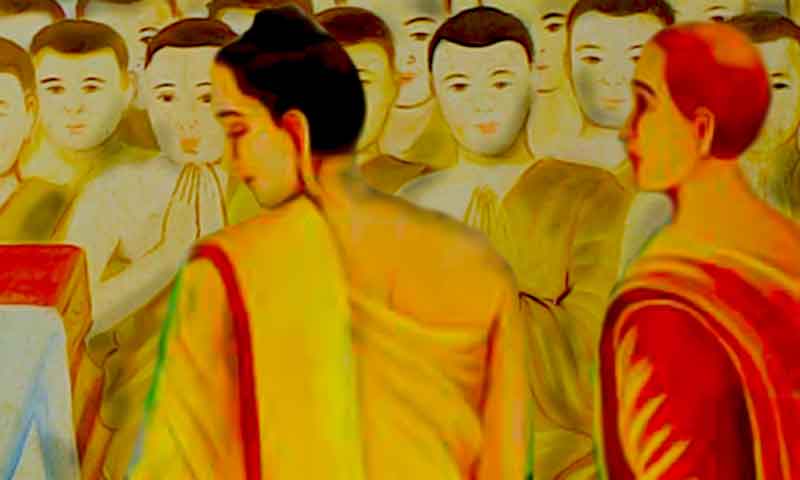
From The Buddhist Monastic Code I - The Patimokkha Rules Translated and Explained - by Thanissaro Bhikkhu
Dhamma-Vinaya was the Buddha's own name for the religion he founded. Dhamma — the truth — is what he discovered and pointed out as advice for all who want to gain release from suffering. Vinaya — discipline — is what he formulated as rules, ideals, and standards of behavior for those of his followers who went forth from home life to take up the quest for release in greater earnestness. Although this book deals primarily with discipline, we should note at the outset that Dhamma and Vinaya in practice function only together. Neither without the other can attain the desired goal. In theory they may be separate, but in the person who practices them they merge as qualities developed in the mind and character.
"Gotami, the qualities of which you may know, 'These qualities lead to dispassion, not to passion; to being unfettered and not to being fettered; to self-effacement and not to self-aggrandizement; to modesty and not to ambition; to contentment and not to discontent; to seclusion and not to entanglement; to energy and not to idleness; to being unburdensome and not to being burdensome': You may definitely hold, 'This is the Dhamma, this is the Vinaya, this is the Teacher's instruction.'" (Cv.X.5) Ultimately, the Buddha said, just as the sea has a single taste, that of salt, so too the Dhamma and Vinaya have a single taste: that of release. The connection between discipline and release is spelled out in a passage that recurs at several points in the Canon:
"Discipline is for the sake of restraint, restraint for the sake of freedom from remorse, freedom from remorse for the sake of joy, joy for the sake of rapture, rapture for the sake of tranquillity, tranquillity for the sake of pleasure, pleasure for the sake of concentration, concentration for the sake of knowledge and vision of things as they are, knowledge and vision of things as they are for the sake of disenchantment, disenchantment for the sake of dispassion, dispassion for the sake of release, release for the sake of knowledge and vision of release, knowledge and vision of release for the sake of total unbinding without clinging." (Pv.XII.2) In establishing his religion of release, though, the Buddha did not simply set out a body of recommendations and rules. He also founded a company (parisa) of followers. This company falls into four main groups: bhikkhus (monks), bhikkhunis (nuns), lay men, and lay women. Although the Buddha saw no need to organize the laity in any manner, he arranged for the bhikkhus and bhikkhunis — who had given up the entanglements of the household life to devote themselves more fully to the goal of release — to develop into communities; and saw that they needed, as all communities do, ideals and standards, rules and customs to ensure their stability. This need is what gave rise to the Vinaya.
In the early years of the Buddha's career, the texts tell us, there was no need to formulate disciplinary rules. All of the bhikkhus in his following — the Community of bhikkhunis had not yet been started — were men of high personal attainments who had succeeded in subduing many or all of the defilements of their minds. They knew his teachings well and behaved accordingly. The Canon tells of how Ven. Sariputta, one of the Buddha's foremost disciples, asked the Buddha at an early date to formulate a Patimokkha, or code of rules, to ensure that the holy life the Buddha had founded would last long, just as a thread holding together a floral arrangement ensures that the flowers are not scattered by the wind. The Buddha replied that the time for such a code had not yet come, for even the most backward of the men in the Community at that time had already had their first glimpse of the goal. Only when mental effluents (asava) made themselves felt in the Community would there be a need for a Patimokkha.
As time passed, the conditions that provided an opening for the effluents within the Community eventually began to appear. The Bhaddali Sutta (M.65) presents the Buddha at a later point in his career listing these conditions as five:
Ven. Bhaddali: "Why is it, venerable sir, that there used to be fewer training rules and more bhikkhus established in the knowledge of Awakening? And why is it that there are now more training rules and fewer bhikkhus established in the knowledge of Awakening?" [Bhaddali, who has been unwilling to abide by the training rules, seems to be suggesting that the rise in the number of training rules is itself the cause for fewer bhikkhus' attaining Awakening. The Buddha, however, offers a different explanation.] The Buddha: "So it is, Bhaddali. When beings have begun to degenerate, and the true Dhamma has begun to disappear, there are more training rules and fewer bhikkhus established in the knowledge of Awakening. The Teacher does not lay down a training rule for his disciples as long as there are no cases where the conditions that offer a foothold for the effluents have arisen in the Community. But when there are cases where the conditions that offer a foothold for the effluents have arisen in the Community, then the Teacher lays down a training rule for his disciples so as to counteract those very conditions.
"There are no cases where the conditions that offer a foothold for the effluents have arisen in the Community as long as the Community has not become large. But when the Community has become large, then there are cases where the conditions that offer a foothold for the effluents arise in the Community, and the Teacher then lays down a training rule for his disciples so as to counteract those very conditions... When the Community possesses great material gains... great status... a large body of learning... when the Community is long-standing, then there are cases where the conditions that offer a foothold for the effluents arise in the Community, and the Teacher then lays down a training rule for his disciples so as to counteract those very conditions."
Thus the rules themselves were not the cause for degeneracy in the Community, and the conditions that provided a foothold for the effluents were not themselves effluents. Rather, the growing complexity of the Community provided the opportunity for bhikkhus to act on the basis of their defilements in a growing variety of ways, and the rules — although they could not prevent any of the five conditions — had to become correspondingly complex to counteract the opportunities those conditions provided for unenlightened behavior.
Even when these conditions did arise, though, the Buddha did not set out a full code at once. Instead, he formulated rules one at a time, in response to events. The considerations that went into formulating each rule are best illustrated by the events surrounding the formulation of the first.
Ven. Sudinna, the story goes, had strong faith in the Buddha and had ordained after receiving his parents' grudging consent. He was their only child and, though married, was childless. His parents, fearing that the government would confiscate their property at their death if it had no heir, devised various schemes to lure Ven. Sudinna back to the lay life, but to no avail. Finally, his mother realized that he was firm in his intention to stay a bhikkhu and so asked him at least to have intercourse with his former wife so that their property would have an heir. Ven. Sudinna consented, took his wife into the forest, and had intercourse three times.
Immediately he felt remorseful and eventually confessed his deed to his fellow bhikkhus. Word reached the Buddha, who called a meeting of the Community, questioned Ven. Sudinna, and gave him a rebuke. The rebuke fell into two major parts. In the first part, the Buddha reminded Ven. Sudinna of his position as a samana — a contemplative — and that his behavior was unworthy of his position. Also, the Buddha pointed out to him of the aims of the teaching and noted that his behavior ran counter to them. The implication here was that Ven. Sudinna had not only acted inconsistently with the content of the teaching, but had also shown callous disregard for the Buddha's compassionate aims in making the Dhamma known.
"'Misguided man, it is unseemly, unbecoming, unsuitable, and unworthy of a contemplative; improper and not to be done... Have I not taught the Dhamma in many ways for the sake of dispassion and not for passion; for unfettering and not for fettering; for letting go and not for clinging? Yet here, while I have taught the Dhamma for dispassion, you set your heart on passion; while I have taught the Dhamma for unfettering, you set your heart on being fettered; while I have taught the Dhamma for letting go, you set your heart on clinging. "'Misguided man, haven't I taught the Dhamma in various ways for the fading of passion, the sobering of pride, the subduing of thirst, the destruction of attachment, the severing of the round, the depletion of craving, dispassion, stopping, unbinding? Haven't I advocated abandoning sensual pleasures, understanding sensual perceptions, subduing sensual thirst, destroying sensual preoccupations, calming sensual fevers?... Misguided man, this neither inspires faith in the faithless nor increases the faithful. Rather, it inspires lack of faith in the faithless and wavering in some of the faithful.'"
The second part of the rebuke dealt in terms of personal qualities: those that a bhikkhu practicing discipline is to abandon, and those he is to develop.
"Then the Blessed One, having in various ways rebuked Ven. Sudinna, having spoken in dispraise of being burdensome, demanding, arrogant, discontented, entangled, and indolent; in various ways having spoken in praise of being unburdensome, undemanding, modest, content, austere, scrupulous, gracious, self-effacing, and energetic; having given a Dhamma talk on what is seemly and becoming for bhikkhus, addressed the bhikkhus." This was where the Buddha formulated the training rule, after first stating his reasons for doing so.
"'In that case, bhikkhus, I will formulate a training rule for the bhikkhus with ten aims in mind: the excellence of the Community, the peace of the Community, the curbing of the shameless, the comfort of well-behaved bhikkhus, the restraint of effluents related to the present life, the prevention of effluents related to the next life, the arousing of faith in the faithless, the increase of the faithful, the establishment of the true Dhamma, and the fostering of discipline.'" These reasons fall into three main types. The first two are external: 1) to ensure peace and well-being within the Community itself, and 2) to foster and protect faith among the laity, on whom the bhikkhus depend for their support. (The origin stories of the various rules depict the laity as being very quick to generalize. One bhikkhu misbehaves, and they complain, "How can these bhikkhus do that?") The third type of reason, though, is internal: The rule is to help restrain and prevent mental effluents within the individual bhikkhus. Thus the rules aim not only at the external well-being of the Community, but also at the internal well-being of the individual. This latter point soon becomes apparent to anyone who seriously tries to keep to the rules, for they foster mindfulness and circumspection in one's actions, qualities that carry over into the training of the mind.
Over the course of time the Buddha formulated more than 200 major and minor rules, forming the Patimokkha that was recited fortnightly in each Community of bhikkhus. In addition, he formulated many other minor rules that were memorized by those of his followers who specialized in the subject of discipline, but nothing is known for sure of what format they used to organize this body of knowledge during his lifetime.
After his total nibbana, though, his followers made a concerted effort to establish a standard canon of Dhamma and Vinaya, and the Pali Canon as we know it began to take shape. The Vinaya was organized into two main parts: 1) the Sutta Vibhanga, the 'Exposition of the Text' (which from here on we will refer to simply as the Vibhanga), containing almost all the material dealing with the Patimokkha rules; and 2) the Khandhakas, or Groupings, which contain the remaining material organized loosely according to subject matter. The Khandhakas themselves are divided into two parts, the Mahavagga, or Greater Chapter, and the Cullavagga, or Lesser Chapter. Historians estimate that the Vibhanga and Khandhakas reached their present form no later than the 2nd century B.C.E., and that the Parivara, or Addenda — a summary and study guide — was added a few centuries later, closing the Vinaya Pitaka, the part of the Canon dealing with discipline.
Since the purpose of this book is to translate and explain the Patimokkha, we are most directly concerned with the Vibhanga. It is organized as follows: The rules in the Patimokkha are presented one by one, each rule preceded by an origin story telling the events that led up to its formulation. In some instances a rule went through one or more reformulations, in which case an additional story is provided for each amendment to show what prompted it.
After the final statement of the rule is a word-commentary, which explains in detail most of the important terms in the rule. For many of the rules this commentary includes one or more "wheels," or tables, giving the contingencies connected with the rule, working out all their possible permutations and passing judgment as to what penalty, if any, each permutation entails. For example, the discussion of the first rule contains a wheel that gives all the objects with which a person might have sexual intercourse, lists them against the variables of the sort of intercourse and whether or not the bhikkhu involved gives his consent, and announces the penalty for each possible combination of factors.
Following the word-commentary for each rule is a section of no-offense clauses, listing extenuating circumstances under which a bhikkhu would be exempted from the penalty imposed by the rule.
Finally, for the major rules, there is the Vinita Vatthu, or List of Precedents, which documents various cases related to the rule and gives verdicts as to what penalty, if any, they entail.
The Vibhanga forms the basis for most of the explanations of the training rules given in this book. However, there are occasional questions on which the Vibhanga is unclear or silent. To answer these questions, I have turned either to the Khandhakas or to the commentarial literature that has grown up around the Vinaya over the course of the centuries. The primary works I have consulted are these:
1) The Samanta-pasadika — "The Thoroughly Inspiring" — (from here on referred to as the Commentary), a commentary on the Vinaya Pitaka compiled in the 5th century C.E. by Bhadantacariya Buddhaghosa, who based his work on ancient commentaries brought to Sri Lanka from India at an unknown date and translated into Sinhalese. From internal evidence in Buddhaghosa's writings — he compiled commentaries on a major portion of the Canon — historians have estimated that the ancient commentaries were collected over a span of several centuries and closed in approximately the 2nd century C.E. Buddhaghosa's work thus contains material much older than his date would indicate.
By Buddhaghosa's time a belief had grown up that the ancient commentaries were the work of the Buddha's immediate disciples and thus indisputably conveyed the true intent of the Canon. However, as we shall see below, the ancient commentaries themselves did not make such exalted claims for themselves.
Still, the existence of this belief in the 5th century placed certain constraints on Buddhaghosa's work. At points where the ancient commentaries conflicted with the Canon, he had to write the discrepancies off as copier's mistakes or else side with the commentaries against the Canon. At a few points, such as his explanation of Pacittiya 9, he provides arguments against the ancient commentaries' interpretation but then backs off, saying that the ancient commentaries must be right because their authors knew the Buddha's intentions. Perhaps pressure from the elder bhikkhus at the Mahavihara in Anuradhapura — the place where the ancient commentaries had been preserved and where Buddhaghosa was allowed to do his work — was what made him back off in this way. At any rate, only on points where the different ancient commentaries were silent or gave divergent opinions did he feel free to express his opinions.
2) The Kankha-vitarani — "The Subjugator of Uncertainty" — (the K/Commentary), a commentary on the Patimokkha also compiled by Bhadantacariya Buddhaghosa. Although this work is largely a synopsis of material in the Commentary, it contains some independent material, in particular a system of classifying the offenses under each training rule into their component factors. It also contradicts the Commentary from time to time.
3) The Sarattha-dipani — "The Essence-Meaning Illustrator" — (the Sub-commentary), a sub-commentary on the Commentary, written in Sri Lanka in the 12th century C.E. by a Ven. Sariputta, the first Mahasami, or head of the Sri Lankan Sangha, after that Sangha was reformed and unified under the patronage of King Parakrama Bahu I. This work not only explains the Commentary, but also deals with points in the Canon itself, sometimes indicating passages where the Commentary has deviated from the Canon. It also quotes as authoritative the judgments of three ancient texts, the Ganthipadesa, which are no longer extant, and of Ven. Buddhadatta, a scholar of the 4th century C.E. who wrote two extant Vinaya guides.
4) The Vimati-vinodani — "The Remover of Perplexity" — (the V/Sub-commentary), another 12th-century sub-commentary, written in southern India by a Ven. Kassapa, who also wrote the Mohavicchedani, a synopsis of the Abhidhamma Pitaka and Buddhaghosa's commentaries on it.
5) The Attha-yojana — "The Interpretation of the Meaning" — (the A/Sub-commentary), a sub-commentary that, unlike the works of Vens. Sariputta and Kassapa, does little more than analyze the language of the Commentary. This was written in the 18th century C.E. by a Burmese scholar named Ven. Ñanakitti
From here on "the ancient commentaries" will denote the original commentaries that Buddhaghosa had to work with, and "the commentaries" all five works listed above.
In addition to the Canon and the commentaries, I have referred to the texts listed in the Bibliography. Two of these deserve special mention here.
1) The Vinaya Mukha, a guide to the Vinaya written in Thai in the early 20th century by Prince Vajirañana-varorasa, a son of King Rama IV who ordained as a bhikkhu and eventually held the position of Supreme Patriarch of the Thai Sangha for many years. This work he wrote as part of his attempt to unite the two major sects of the Thai Sangha. The attempt failed, but the book is still used as the official textbook on Vinaya for the examinations run by the Thai Ecclesiastical Board. Prince Vajirañana in his interpretations often disagrees openly not only with the commentaries, but also with the Vibhanga itself. Some of his disagreements with the commentaries are well-taken, some not.
I include the book here both for the valuable suggestions it makes for dealing with unclear points in the older texts and because it is taken as authoritative through much of Thailand. It has been translated into English, as The Entrance to the Vinaya, but I have chosen to translate anew all the passages I quote from it.
2) The Book of Discipline, a translation of the entire Vinaya Pitaka into English by Miss I. B. Horner. Although I have learned much from Miss Horner's work, there are points where my translations and conclusions differ from hers. Since many readers will want to check the information in this book against hers, I have marked these points with a "(%)." Anyone curious as to which interpretation is correct should check the passages in question against the Royal Thai edition of the Pali Canon, my major source throughout this book.
Disagreements among the texts.
One of the difficulties in trying to collate all these various texts is that there are points on which the Vibhanga is at variance with the wording of the Patimokkha rules, and the commentaries are at variance with the Canon. This forces us to decide which strata of the texts to take as authoritative. As far as discrepancies between the Vibhanga and the rules are concerned, the following passage in the Cullavagga (X.4) suggests that the Buddha himself gave preference to the way the bhikkhus worked out the rules in the Vibhanga:
"As she was standing at a respectful distance, Maha-pajapati Gotami spoke thus to the Blessed One: 'Lord, those rules of training for the bhikkhunis that are in common with those for the bhikkhus: What line of conduct should we follow in regard to them?' "'Those rules of training for the bhikkhunis, Gotami, that are in common with those for the bhikkhus: As the bhikkhus train themselves, so should you train yourselves'... (emphasis added).
"'And those rules of training for bhikkhunis that are not in common with those for bhikkhus: What line of conduct should we follow in regard to them?'
"'Those rules of training for the bhikkhunis, Gotami, that are not in common with those for the bhikkhus: Train yourselves in them as they are formulated.'"
This passage implies that already in the time of the Buddha the bhikkhus had begun working out a way to interpret the rules that in some cases was not exactly in line with the way the Buddha had originally formulated them. Some people have read this passage as suggesting that the Buddha, though resigned to this development, was displeased with it, but this would contradict the many passages in the Canon where the Buddha speaks in high praise of Ven. Upali, the foremost of his bhikkhu disciples in terms of his knowledge of Vinaya, who was responsible for teaching the rules to the other bhikkhus and who was largely responsible for the shape of the Vinaya as we now have it. It seems more likely that the Buddha in this passage is simply saying that, to avoid unnecessary controversy, the way the bhikkhus had worked out the implications of the rules was to be accepted as is.
Because this development eventually led to the Vibhanga, we can be confident that in adhering to the Vibhanga we are acting as the Buddha would have us do. And when we check the few places where the Vibhanga deviates from the wording of the rules, we find that almost invariably it has tried to reconcile contradictions among the rules themselves, and between the rules and the Khandhakas, so as to make the Vinaya a more coherent whole. This is particularly true with rules that touch on formal acts of the Community. Apparently many of these rules were formulated before the general patterns for formal acts were finalized in the Khandhakas. Thus, after the patterns were established, the compilers of the Vibhanga were sometimes forced to deviate from the wording of the rules to bring them into line with the patterns.
As for contradictions between the Commentary and the Vibhanga, this is a more controversial area, with two extremes of thought. One is to reject the Commentary entirely, as it is not the Buddha's word, for modern historical scholarship has shown decisively that it contains material dating many hundreds of years after the Buddha's passing away. This position assumes, though, that in the areas where the Canon is vague or unclear we have nothing to learn from the accumulated wisdom and experience of those who have lived the bhikkhu's life before us. The other extreme is to accept the Commentary as superseding the Vibhanga entirely, in line with the traditional belief that grew up around it: that it was composed at the First Council to express the true intent of those who composed the Vibhanga and yet somehow were unable to put what they really meant to say into the Canon itself.
Neither of these extremes is in line with the Great Standards for judging Dhamma and Vinaya that — as the Maha-parinibbana Sutta (D.16) reports — the Buddha formulated at Bhoganagara shortly before his passing away:
"There is the case where a bhikkhu says this: 'In the Blessed One's presence have I heard this, in the Blessed One's presence have I received this: This is the Dhamma, this is the Vinaya, this is the Teacher's instruction.' His statement is neither to be approved nor scorned. Without approval or scorn, take careful note of his words and make them stand against the Suttas and tally them against the Vinaya. If, on making them stand against the Suttas and tallying them against the Vinaya, you find that they don't stand with the Suttas or tally with the Vinaya, you may conclude: 'This is not the word of the Blessed One; this bhikkhu has misunderstood it' — and you should reject it. But if... they stand with the Suttas and tally with the Vinaya, you may conclude: 'This is the word of the Blessed One; this bhikkhu has understood it rightly.'" [The same criteria are to be used when the bhikkhu cites as his authority a Community with well-known leading elders; a monastery with many learned elders who know the tradition, who have memorized the Dhamma, the Vinaya, and the Matika (the precursor to the Abhidhamma as we know it); or a single elder who knows the tradition.]
In other words, the question is not one of the authority on whose word a claim is based, but one of consistency: Only if a statement stands up under comparison with the Canon should it be accepted as true Dhamma or Vinaya. The same principle holds for statements that are said to be not the word of the Buddha, but the opinion of respected teachers.
This point is borne out by two important passages in the texts. One is the narrative of the Second Council, during which the bhikkhus of Vesali defended ten practices on the grounds that they had learned them from their teachers. The elders who judged the case, though, insisted on evaluating the practices in terms of whether or not they adhered to the Canon. The primary point of controversy — the question of whose authority was greater, the Canon's or the teachers' — was point six:
"'The practice of what is habitual, sir — is it allowable?' "'What is the practice of what is habitual, my friend?'
"'To practice (thinking), this is the way my preceptor habitually practiced; this is the way my teacher habitually practiced — is this allowable?'
"'The practice of what is habitual is sometimes allowable, sometimes not.'" (CV.XII.2.8)
What this means, as the elders showed in the way they conducted the meeting, is that one's teacher's and preceptor's practices are to be followed only when they are in accordance with the Canon.
The second passage is the discussion of the Great Standards in the Commentary to the Maha-parinibbana Sutta, which concludes that the commentaries are to be accepted only where they are in agreement with the Canon. Apparently the teachers who compiled the ancient commentaries took a more modest view of their authority than did the elders of the Mahavihara at the time of Buddhaghosa and did not pretend to supersede the Canon as the final word on what is and is not true Dhamma and Vinaya.
Some may object that to pass judgment on the Commentary is to lack respect for the tradition, but actually it is because of respect for the compilers of the Vibhanga that I make the following assumptions in checking the Commentary against the Vibhanga:
1) The compilers of the Vibhanga were intelligent enough to be consistent within the discussion of each rule. Any explanation based on the premise that they were not consistent should give way to an explanation showing that they were.
2) The compilers were well enough acquainted with the contingencies surrounding each rule that they knew which factors were and were not crucial in determining what is and is not an offense. Any explanation that adds or subtracts factors from those mentioned in the Vibhanga should give way to one that follows the Vibhanga's analysis.
3) The compilers, in reporting the precedents in the Vinita Vatthu — the cases the Buddha judged against an existing rule — were careful enough to include all the important factors bearing on the judgment. Any explanation that requires rewriting the precedents, adding extra details extraneous to the Vibhanga to account for the judgment, should give way to an explanation that can make sense out of the precedents as they are reported and in terms of the analyses presented elsewhere in the Vibhanga.
It's not that I take any joy in arguing with the Commentary. In fact, wherever possible, I have been happy to give it the benefit of the doubt, and on many points I am very much in its debt. Still, now that Buddhism is coming to the West, I feel it is time to stop and take stock of the tradition, and to check the later traditions against the earliest sources. This is especially important in a way of thought and life that, from the very beginning, has appealed to reason and investigation rather than to blindly accepted authority. In doing this, I am simply following a pattern that has repeated itself through the history of the Theravadin tradition: that of returning to the original principles whenever the religion reaches a historic turning point.
There is, of course, a danger in being too independent in interpreting the tradition, in that strongly held opinions can lead to disharmony in the Community. Thus in evaluating the Commentary against the Canon, I do not want to imply that my conclusions are the only ones possible. Important points may have slipped my attention or escaped my grasp. For this reason, even in instances where I think that the Commentary does not do justice to the Vibhanga, I have tried to give a faithful account of the important points from the Commentary so that those who wish to take it as their authority may still use this book as a guide. If there are any points on which I am mistaken, I would be pleased if knowledgeable people would correct me.
At the same time, I hope that this book will show that there are many areas on which the Vibhanga is unclear and lends itself to a variety of equally valid interpretations. For proof of this, we need only look at the various traditions that have developed in the different Theravadin countries, and even within each country. For some reason, although people tend to be very tolerant of different interpretations of the Dhamma, they can be very intolerant of different interpretations of the Vinaya and can get into heated arguments over minor issues having very little to do with the training of the mind.
I have tried to make the point throughout this book that any interpretation based on a sound reading of the Canon should be respected: that each bhikkhu should follow the interpretations of the Community in which he is living, as long as they do not conflict with the Canon, so as to avoid conflict over minor matters in daily life; and that he should also show respect for the differing interpretations of other Communities where they too do not conflict with the Canon, so as to avoid the pitfalls of pride and narrow-mindedness.
This is especially true now that monasteries of different nationalities are taking root in close proximity to one another in the West. In the past, Thais, Burmese, and Sri Lankans could look down on one another's traditions without danger of causing friction, as they lived in separate countries and spoke different languages. Now, however, we have become neighbors and have begun to speak common languages, so it is best that we take to heart the writings of the Chinese pilgrims who visited India centuries ago. They reported that even after the early Buddhists had split into 18 schools, each with its own Tripitaka and Patimokkha, and the Mahayanists had added their texts to the tradition, bhikkhus belonging to different schools could be found living together in the same monastery, practicing and conducting communal business in peace and harmony. Theirs is a worthy example. We should not let our minor differences become stumbling blocks on our way.
My aim throughout this book has been practical. I have avoided dealing with academic issues concerning the authenticity and reliability of the tradition, and instead have tried simply to report and explain what the tradition has to say. Of course, I have had to be selective. Whatever the unconscious factors that have influenced my choice of material, the conscious considerations shaping this book are briefly as follows:
We are dealing primarily with rules, but rules are not the only way to express disciplinary norms, and the texts we are surveying express their norms in a variety of forms: as rules, principles, models, and virtues. The different forms are best suited for different purposes. Principles, models, and virtues are meant as personal, subjective standards and tend to be loosely defined. Their interpretation and application are left to the judgment of the individual. Rules are meant to serve as more objective standards. To work, they must be precisely defined in a way acceptable to the Community at large. The compilers of the Canon, recognizing this need, provided definitions for most of the terms in the rules, and the authors of the commentaries continued this task, carrying it out with even greater thoroughness. Thus much of this book, in reporting these texts, is concerned with the definition of terms.
This need for precision, though, accounts for the weakness of rules in general as universal guides to behavior. First, there is the question of where to draw the line between what is and is not an infraction of the rule. A clear break-off point is needed because rules — unlike principles — deal in two colors: black and white. In some cases, it is difficult to find a clear break-off point that corresponds exactly to one's sense of what is right and wrong, and so it is necessary to include the areas of gray either with the white or the black. In general, but not always, the Vibhanga's position is to include the gray with the white, and to rely on the principles of the Dhamma to encourage the individual bhikkhu to stay away from the gray.
Take, for instance, the rule against masturbation. The Vibhanga limits this rule to forbidding only those forms of masturbation that aim at ejaculation, for if it had drawn the line anywhere else, it would have become an offense for a bhikkhu simply to scratch himself. Thus self-stimulation that does not aim at ejaculation is not an offense, although in many cases it is clearly against the spirit of the Dhamma. The Vinaya Mukha notes, disapprovingly, a number of older Vinaya guides that like to dwell on these areas of gray and seem to delight in figuring out ways to avoid an offense by working around the letter of the rules. In this book I am taking a different tack: Under those rules that include large areas of gray with the white, I have noted a few relevant principles from the Dhamma to spell out a wise policy with regard to the gray areas — not to reformulate the rule, but simply as a reminder that, as noted above, the Vinaya without the Dhamma does not suffice as a guide to the goal.
Another drawback resulting from the need for precision in rules is that the more precisely a rule is defined to suit a particular time and place, the less well it may fit other times and places. The compilers of the Canon, in order to make up for this weakness, thus provided the origin stories and precedents to show the type of situation the rule was intended to prevent, providing principles and models that indicate the spirit of the rule and aid in applying it to differing contexts. In writing this book I have often made reference to these stories, to give this added dimension.
Admittedly, the stories do not make for inspiring reading. For example, instead of reading about bhikkhus accepting a meal at a donor's house and then uplifting the donor with a talk on Dhamma, we read about Ven. Udayin accepting a meal at the dwelling of a bhikkhuni who was his former wife, and the two of them sitting there exposing their genitals to each other. Still, the stories do remind us that the more inspiring stories we read in the discourses took place in a very real human world, and they also reveal the insight and understated wit of those who framed and interpreted the rules. The element of wit here is especially important, for without it there is no true understanding of human nature, and no intelligent system of discipline.
Finally, in compiling this book, I have tried to include whatever seems most worth knowing for the bhikkhu who aims at fostering the qualities of discipline in his life — so as to help train his mind and live in peace with his fellow bhikkhus — and for anyone who wants to support and encourage the bhikkhus in that aim.
Abbreviations
![[go to top]](../../images/scrollup.gif)
A .... Anguttara Nikaya
As .... Adhikarana-samatha
Ay .... Aniyata
BD .... Book of Discipline
Cv .... Cullavagga
D .... Digha Nikaya
Dhp .... Dhammapada
M .... Majjhima Nikaya
Mv .... Mahavagga
NP .... Nissaggiya Pacittiya
Pc .... Pacittiya
Pd .... Patidesaniya
Pr .... Parajika
Pv .... Parivara
S .... Samyutta Nikaya
Sg .... Sanghadisesa
Sk .... Sekhiya
Vism .... Visuddhi Magga
Numbers in the references to Mv, Cv, and Pv denote chapter, section and sub-section; in the references to D and M, discourse (sutta); in the references to S and A, section (samyutta or nipata) and discourse; in the references to Dhp, verse; in the references to Vism, chapter and paragraph.
Suggestions for Further Reading
- Buddhism - The Concept of Anatta or No Self
- Anatta or Anatma in Buddhism
- Anicca or Anitya in Buddhism
- The Buddha on God
- The Buddha on Avijja or Ignorance and on the Origin of Life
- The Eightfold Path Of Buddhism
- The Four Noble Truths of Buddhism
- Buddhism - Right Living On The Eightfold Path
- Handbook for the Relief of Suffering by Ajaan Lee
- Meat Eating or Vegetarianism in Buddhism
- The Agendas of Mindfulness
- Meditation on Anicca or Impermanence in Buddhism
- A Sketch of the Buddha's Life
- What is Ignorance And Cessation Of Ignorance
- The Meaning of the Buddha's Awakening
- Basic Breath Meditation Practice
- Buddha's Teachings on Kamma or Karma
- Affinities Of Buddhism And Christianity
- Death and Dying in Buddhism
- Buddhism In A Nutshell
- The Buddha on Ignorance or Avijja
- Dhamma for Everyone by Ajaan Lee Dhammadharo
- Advaita Vedanta and Buddhism
- Four Discourses of the Buddha on Everyman's Ethics
- The Five Aggregates A Study Guide
- The Healing Power of the Five Buddhist Percepts
- The Working of Maya or Illusion - A Buddhist Perspective
- Buddhism - Kamma (Karma) and its Fruit
- Buddhism - Kamma (Karma) A Study Guide
- Buddhism - Living the Dhamma A Practice Guide
- What Anatta or No-Self is All About
- Buddhism - The Middle Way
- The Buddhist Monastic Code, Dhamma-Vinaya
- Nibbana, or Nivranva in Buddhsim
- Why The Buddha Taught the Anatta or Not-Self Doctrine
- The Status of Women in Buddhist Societies
- Buddhism - The Practice of Loving-Kindness (Metta)
- Buddhism - Does Rebirth Make Sense
- Buddhism - Right Concentration
- Buddhism - Intentions and Nirvana
- The Round of Rebirth - Samsara
- The Role of Samavega in Buddhism
- The Chaos Theory and Nirvana in Buddhism
- A Christian's Journey Into Buddhism
- A Simple Guide to Buddhism
- Buddhist Cosmology - The Thirty one Realms of Existence
- Buddhism and the concept of renunciation
- Sankharas (Samskaras) in Buddhism
- Vedanta and Buddhism A Comparative Study
- Buddhism - Vipansana or Insight Meditation
- The Right Approach To End Suffering in Buddhismm
- Essays On Dharma
- Esoteric Mystic Hinduism
- Introduction to Hinduism
- Hindu Way of Life
- Essays On Karma
- Hindu Rites and Rituals
- The Origin of The Sanskrit Language
- Symbolism in Hinduism
- Essays on The Upanishads
- Concepts of Hinduism
- Essays on Atman
- Hindu Festivals
- Spiritual Practice
- Right Living
- Yoga of Sorrow
- Happiness
- Mental Health
- Concepts of Buddhism
- General Essays
Source: Copyright © 1994 Thanissaro Bhikkhu Reproduced and reformatted from Access to Insight edition © 1994 For free distribution. This work may be republished, reformatted, reprinted, and redistributed in any medium. It is the author's wish, however, that any such republication and redistribution be made available to the public on a free and unrestricted basis and that translations and other derivative works be clearly marked as such.